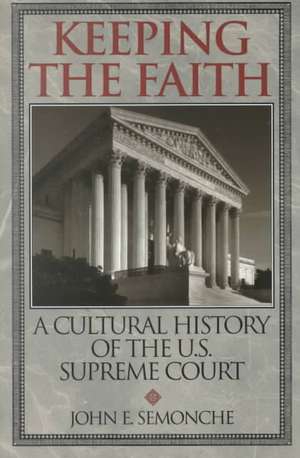
Keeping the Faith: A Cultural History of the U.S. Supreme Court
Autor John E. Semoncheen Limba Engleză Paperback – 19 iul 2000
Preț: 176.48 lei
Preț vechi: 226.82 lei
-22%
Puncte Express: 265
Preț estimativ în valută:
31.23€ • 36.50$ • 27.12£
31.23€ • 36.50$ • 27.12£
Carte tipărită la comandă
Livrare economică 20 februarie-06 martie
Preluare comenzi: 021 569.72.76
Specificații
ISBN-13: 9780847689866
ISBN-10: 0847689867
Pagini: 499
Dimensiuni: 149 x 227 x 27 mm
Greutate: 0.65 kg
Ediția:0499
Editura: Bloomsbury Publishing
Colecția Rowman & Littlefield Publishers
Locul publicării:New York, United States
ISBN-10: 0847689867
Pagini: 499
Dimensiuni: 149 x 227 x 27 mm
Greutate: 0.65 kg
Ediția:0499
Editura: Bloomsbury Publishing
Colecția Rowman & Littlefield Publishers
Locul publicării:New York, United States
V-ar putea interesa
-
 -29%Preț: 647.55 lei918.36 lei
 -
 Legal Rights of Prisoners: Cases and CommentsJames F. Anderson-31%Preț: 351.47 lei513.03 lei
 -
 Fundamental Issues in Consumption TaxationDavid F BradfordPreț: 72.67 lei
Cuprins
Chapter 1 Introduction: The Ties That Bind
Chapter 2 "In the Beginning Was the Word," 1620-1791
Chapter 3 Establishing the Parameters of Priestly Duties, 1790-1821
Chapter 4 Expounding the Holy Writ in Troubled Times, 1810-1860
Chapter 5 Interpreting New and Old Holy Books: Part I: Beginning to Widen the Civil Religious Community, 1860-1917
Chapter 6 Interpreting New and Old Holy Books: Part II: Protecting Property and Other Individual Rights in the Changing Economy, 1864-1917
Chapter 7 Responding to New Crises and Exploring the Implications of the Civil Theology, 1917-1941
Chapter 8 Searching for the Meaning of Loyalty within the American Civil Religion, 1940-1959
Part 9 Struggling to Equalize Justice and Expand the Civil Theology's Reach
Chapter 10 Part I: The Matter of Race, 1954-1997
Chapter 11 Part II: Other Matters Including Gender and Sectarian Religion: 1962-1997
Chapter 12 Making the Scriptures on Individual Rights Nationally Operative, 1960-1997
Chapter 13 The Blessings of Liberty
Chapter 14 Notes
Chapter 15 Justices of the Supreme Court
Chapter 16 Case Index
Chapter 17 Subject Index
Chapter 2 "In the Beginning Was the Word," 1620-1791
Chapter 3 Establishing the Parameters of Priestly Duties, 1790-1821
Chapter 4 Expounding the Holy Writ in Troubled Times, 1810-1860
Chapter 5 Interpreting New and Old Holy Books: Part I: Beginning to Widen the Civil Religious Community, 1860-1917
Chapter 6 Interpreting New and Old Holy Books: Part II: Protecting Property and Other Individual Rights in the Changing Economy, 1864-1917
Chapter 7 Responding to New Crises and Exploring the Implications of the Civil Theology, 1917-1941
Chapter 8 Searching for the Meaning of Loyalty within the American Civil Religion, 1940-1959
Part 9 Struggling to Equalize Justice and Expand the Civil Theology's Reach
Chapter 10 Part I: The Matter of Race, 1954-1997
Chapter 11 Part II: Other Matters Including Gender and Sectarian Religion: 1962-1997
Chapter 12 Making the Scriptures on Individual Rights Nationally Operative, 1960-1997
Chapter 13 The Blessings of Liberty
Chapter 14 Notes
Chapter 15 Justices of the Supreme Court
Chapter 16 Case Index
Chapter 17 Subject Index
Recenzii
In his illuminating study of the significance of the Supreme Court in American public culture, Professor Semonche contends that, from the very beginning, the Justices have played an unappreciated role in shaping American identity and binding us together as a nation. Readers will be fascinated by this challenge to the fashionable naysayers, for Semonche offers a much cheerier view of the performance of the high priests of our civil religion.
The author not only provides a detailed history of the Court's consistent protection of individual rights, but also how the cultural dependence on that consistency makes this a law-abiding nation.
Professor Semonche has written an excellent analytical history of the role and function of what he calls 'the high priests of the American civil religion.' He has succeeded ably in weaving both the theory and the practice of the high tribunal into his historical presentation, and he never lets the reader forget that, as he puts it, 'the Court plays the most significant role as an actor within the culture.' Semonche's tome is a welcome addition to the literature in the field; he reasons comprehensively; and he writes engagingly.
Semonche's book is worthy of commendation for having illuminated the role that the Supreme Court has come to play over time, and the consequences for American politics, life, and culture. Keeping the Faith's central thesis is one that all serious students of the Supreme Court will need to consider.
Semonche's broad legal-historical survey stands as a model of intelligence and grace . . . warrants the consideration of all students of American law.
Gracefully written for a wide audience.
An innovative study of the history of the Supreme Court that draws imaginatively on concepts of culture in general and civic religion in particular. Every student of the Court will benefit from Semonche's insightful analysis that has as much to say about the values that bind Americans as it does about constitutional law and the justices.
The justices of the Supreme Court are the nation's 'high priests,' and their primary function is to interpret our 'holy writ,' that is the U.S. Constitution. They are the keepers of the flame of liberty, the defenders of the covenant, our help in ages past, and our hope in years to come. . . . The author has good case to make about this civic faith or civil religion.
A fascinating look at the history and role of the United States Supreme Court. . . . The book would make an excellent supplemental text for classes on Supreme Court history or on civil liberties.
A thoughtful, balanced, and perceptive account of the Supreme Court in American government and politics. . . . A sweeping historical survey, richly informed.
A remarkable study of the Supreme Court's crutial-and yet often overlooked and certainly underappreciated-role in the formation and development of American political culture.
Engaging and provocative, Keeping the Faith is a book that deserves a wide audience among those interested in constitutional history. Semonche is able to summarize Court history compellingly and efficiently. Semonche is able to condense a good deal in a few paragraphs, his grasp of the full range of the Court's history is exemplary, and he has developed a distinctive thesis that will catch the attention of both scholars and general readers of serious nonfiction.
The author not only provides a detailed history of the Court's consistent protection of individual rights, but also how the cultural dependence on that consistency makes this a law-abiding nation.
Professor Semonche has written an excellent analytical history of the role and function of what he calls 'the high priests of the American civil religion.' He has succeeded ably in weaving both the theory and the practice of the high tribunal into his historical presentation, and he never lets the reader forget that, as he puts it, 'the Court plays the most significant role as an actor within the culture.' Semonche's tome is a welcome addition to the literature in the field; he reasons comprehensively; and he writes engagingly.
Semonche's book is worthy of commendation for having illuminated the role that the Supreme Court has come to play over time, and the consequences for American politics, life, and culture. Keeping the Faith's central thesis is one that all serious students of the Supreme Court will need to consider.
Semonche's broad legal-historical survey stands as a model of intelligence and grace . . . warrants the consideration of all students of American law.
Gracefully written for a wide audience.
An innovative study of the history of the Supreme Court that draws imaginatively on concepts of culture in general and civic religion in particular. Every student of the Court will benefit from Semonche's insightful analysis that has as much to say about the values that bind Americans as it does about constitutional law and the justices.
The justices of the Supreme Court are the nation's 'high priests,' and their primary function is to interpret our 'holy writ,' that is the U.S. Constitution. They are the keepers of the flame of liberty, the defenders of the covenant, our help in ages past, and our hope in years to come. . . . The author has good case to make about this civic faith or civil religion.
A fascinating look at the history and role of the United States Supreme Court. . . . The book would make an excellent supplemental text for classes on Supreme Court history or on civil liberties.
A thoughtful, balanced, and perceptive account of the Supreme Court in American government and politics. . . . A sweeping historical survey, richly informed.
A remarkable study of the Supreme Court's crutial-and yet often overlooked and certainly underappreciated-role in the formation and development of American political culture.
Engaging and provocative, Keeping the Faith is a book that deserves a wide audience among those interested in constitutional history. Semonche is able to summarize Court history compellingly and efficiently. Semonche is able to condense a good deal in a few paragraphs, his grasp of the full range of the Court's history is exemplary, and he has developed a distinctive thesis that will catch the attention of both scholars and general readers of serious nonfiction.