Cantitate/Preț
Produs
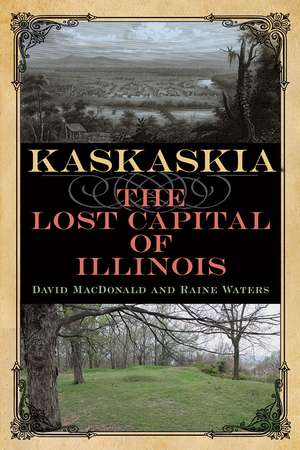
Kaskaskia: The Lost Capital of Illinois de David MacDonald

Kaskaskia: The Lost Capital of Illinois

16461 lei
Carte indisponibilă temporar

Te anunțăm când e disponibilă:

Adaugă în listă247 Puncte Express

Despre carte

This first comprehensive account of the Illinois village of Kaskaskia covers more than two hundred years in the vast and compelling history of the state. David MacDonald and Raine Waters explore Illinois’s first capital in great detail, from its foundation in 1703 to its destruction by the Mississippi River in the latter part of the nineteenth century, as well as everything in between: successes, setbacks, and the lives of the people who inhabited the space.
 
At the outset the Kaskaskia tribe, along with Jesuit missionaries and French traders, settled near the confluence of the Kaskaskia and Mississippi rivers, about sixty miles south of modern-day St. Louis. The town quickly became the largest French town and most prosperous settlement in the Illinois Country. After French control ended, Kaskaskia suffered under corrupt British and then inept American rule. In the 1790s the town revived and became the territorial capital, and in 1818 it became the first state capital. Along the way Kaskaskia was beset by disasters: crop failures, earthquakes, tornadoes, floods, epidemics, and the loss of the capital-city title to Vandalia. Likewise, human activity and industry eroded the river’s banks, causing the river to change course and eventually wash away the settlement. All that remains of the state’s first capital today is a village several miles from the original site.
 
MacDonald and Waters focus on the town’s growth, struggles, prosperity, decline, and obliteration, providing an overview of its domestic architecture to reveal how its residents lived. Debunking the notion of a folklore tradition about a curse on the town, the authors instead trace those stories to late nineteenth-century journalistic inventions. The result is a vibrant, heavily illustrated, and highly readable history of Kaskaskia that sheds light on the entire early history of Illinois.
 

Din seria Shawnee Books

  • Snake Road: A Field Guide to the Snakes of LaRue-Pine Hills
    18109 lei
  • From the Center of America: Steamboats and Shipyards Along the Lower Ohio River
    17630 lei
  • A Nickel's Worth of Skim Milk: A Boy's View of the Great Depression
    9814 lei
  • Giant City State Park and the Civilian Conservation Corps: A History in Words and Pictures
    14779 lei
  • Fishing Southern Illinois
    17105 lei -21% 21774 lei
  • Foothold on a Hillside: Memories of a Southern Illinoisan
    12069 lei
  • A Penny's Worth of Minced Ham: Another Look at the Great Depression
    8359 lei
  • All Anybody Ever Wanted of Me Was to Work: The Memoirs of Edith Bradley Rendleman
    10835 lei
  • Land of Big Rivers: French and Indian Illinois, 1699-1778
    17338 lei
  • The State of Southern Illinois: An Illustrated History
    34364 lei
  • 20 Day Trips in and around the Shawnee National Forest
    16606 lei -29% 23430 lei
  • America's Deadliest Twister: The Tri-State Tornado of 1925
    11228 lei
  • History as They Lived It: A Social History of Prairie du Rocher, Illinois
    19090 lei -25% 25319 lei
  • Colonial Ste. Genevieve: An Adventure on the Mississippi Frontier
    23282 lei
  • The Civilian Conservation Corps in Southern Illinois, 1933-1942
    37881 lei -19% 46580 lei
  • Fluorspar Mining: Photos from Illinois and Kentucky, 1905-1995
    19615 lei
  • Forgetting and the Forgotten: A Thousand Years of Contested Histories in the Heartland
    17309 lei
  • Dawn's Light Woman & Nicolas Franchomme: Marriage and Law in the Illinois Country
    28019 lei
  • Southern Illinois Fishing: A Comprehensive Guide for Anglers
    17679 lei

Detalii

ISBN-13
9780809337316
ISBN-10
0809337312
Editura
Southern Illinois University Press
Colecția
Southern Illinois University Press
Seria
Shawnee Books
Ediția
1st Edition
Pagini
226
Ilustrații
99
Dimensiuni
152 x 229 x 15 mm
Greutate
0.31 kg

Notă biografică

David MacDonald is an emeritus professor of history at Illinois State University and the author of Lives of Fort de Chartres: Commandants, Soldiers, and Civilians in French Illinois, 1720–1770.
 
Raine Waters is an instructor of history at Heartland Community College and Illinois Valley Community College.
 

Extras

Introduction
 
There are many types of history. Much modern history is thesis-driven, the mustering of facts and examples to demonstrate a particular interpretation of the past. This sort of history necessarily interposes the author’s understanding between the sources and the reader. Another type is descriptive, presenting material to the reader with minimal interpretation to enable the reader to see and interpret the past for him- or herself. That is the sort of history we have endeavored to write here, a simple exposition of Kaskaskia, the largest town in Illinois from the time of its founding in 1703 until well into the nineteenth century.
 
Colonial Kaskaskia was a center of French culture and language in Illinois and the largest of the French villages in Illinois, a prosperous agricultural settlement exporting grain and other resources down the Mississippi to Louisiana. The return trip brought the goods of Europe to the middle of the wilderness, where the citizens of Kaskaskia enjoyed a lifestyle far more sophisticated than that of the pioneers slowly advancing the frontier from the Eastern Seaboard. Life in French Kaskaskia, of course, was not without problems. War came near at times and claimed the lives of local citizens, and crops did not thrive every year. Still, for two generations the inhabitants of Kaskaskia were prosperous and content, but that happy state ended suddenly.
 
The French government lost Canada and then abandoned Illinois and Louisiana at the end of the French and Indian War. The town suffered through more than a decade of inept and corrupt British rule that drove many citizens across the Mississippi to the Spanish-ruled west bank. During the American Revolution, George Rogers Clark captured the town from the British, securing Illinois for the United States. The emerging nation, however, could not adequately govern the new territory, and during the 1780s, the citizens of Kaskaskia lived through an era of virtual anarchy, during which they lived in fear or abandoned their homes and fled. A priest lamented Kaskaskia’s situation, and from that lament arose the first notion that Kaskaskia suffered under a curse.
 
Kaskaskia did revive when the United States was finally able to assert control in the 1790s. Kaskaskia became the capital of the Illinois Territory and then the first state capital of Illinois, and the town was home to leading political and economic figures in the early, shaping years of Illinois. Good fortune, however, did not long endure. Natural disasters of unprecedented magnitude—crop failure, earthquake, tornado, flood, and pestilence—seemed to haunt Kaskaskia and robbed the town of vitality. People came to regard Kaskaskia, once the center and focus of Illinois, as just a quaint and somehow foreign relic. Finally, the great river, so long Kaskaskia’s highway and source of its prosperity, turned on the town, washing away the buildings and even the very ground on which it was built. The changing course of the Mississippi was merely the coup de grâce, the finishing blow, the last of the disasters that led even reasonable people to wonder whether Kaskaskia had been cursed. As the last of old Kaskaskia fell victim to the river, newspaper reporters, eager to fill pages with sensational stories, seized on old notions and combined them with their own creative imaginations to present new fictions as old traditions. Some still regard these late fictions seriously. Others less credulous reject this fake lore but still feel that an aura of the unnatural surrounds the events that befell Kaskaskia and led to its final destruction.
 
Today, new Kaskaskia, now a tiny village with fewer than a score of inhabitants a few miles from the location of the old town, preserves some of the relics of old Kaskaskia. The furnishings of the church date to the early days of the French town, and visitors can see the bell sent by the king of France to Kaskaskia in 1741 and rung to announce George Rogers Clark’s annexation of Illinois to the United States. New Kaskaskia is well worth a visit, but it is nothing like the old town.
 
Other relics of old Kaskaskia also survive: written documents, objects, maps, engravings, sketches, and photographs made before the city crumbled into the Mississippi River. (We exclude all imagined reconstructions; the only modern illustrations are photographs of objects that still exist.) They all contain some essence of the lost town so important to the origin of modern Illinois and perhaps also some of the atmosphere that led people to whisper that Kaskaskia had fallen under a curse.
 

Cuprins

Contents
List of Figures
Acknowledgments

Introduction

Part 1. History of Kaskaskia 
1.    Dawn of Kaskaskia, 1673–1719   
2.    French and Indian Kaskaskias, 1719–1765 
3.    Kaskaskia and Indian Kaskaskia under British and Early American Rule, 1765–1790 
4.    Mixed Fortunes, 1790–1820 
5.    Kaskaskia in Decline, 1820–1881 
6.    Destruction, 1881–circa 1913  

Part 2. Domestic Architecture at Kaskaskia
7.    Introduction
8.    Franco-American Homes of Kaskaskia  
9.    Midwestern Federal and Eclectic Houses and Their Owners 

Part 3. Pseudo-Folklore
10. “The Curse of Kaskaskia”—Creative Fiction, Not History

Appendix A: Notes on Photographers and Sketch Artists 
Appendix B: Lexicon  
Notes 
Bibliography 
Index 
 

Recenzii din presă

“This book skillfully limns an engaging account of Kaskaskia’s colonial beginnings, its multitudinous tribulations, and its ultimate surrender to the waters of the Mississippi. Highly reliable and readable, and furnished with numerous illustrations, the work will appeal to the specialist and general reader alike.”—Morris S. Arnold, author of Colonial Arkansas, 1686–1804: A Social and Cultural History

“If you asked the average Midwesterner to point out Kaskaskia on a map, he or she would most likely struggle to find it. Yet this innocuous little village has big history hiding behind it, tying it not only to Illinois’s past but to a larger, international world when the makeup of North America looked quite different from today. This book is a must-read for anyone who enjoys colonial history or strange Americana: the authors take the reader on a journey into the intriguing story of this Midwestern community with an amazing French past that had everything going for it, even becoming a state capital, before fate decided otherwise.”—Joseph Gagné, creator of Electronic New France and author of Inconquis: Deux retraites françaises vers la Louisiane après 1760

“This book draws together a visual and descriptive history of Kaskaskia, its homes, and the lives of its people—from mansions to cabins, from prominent statesmen to former slaves. Lost Kaskaskia lives again in photographs and text in this thoroughly researched study.”—Margaret Kimball Brown, author of History as They Lived It: A Social History of Prairie du Rocher, Illinois