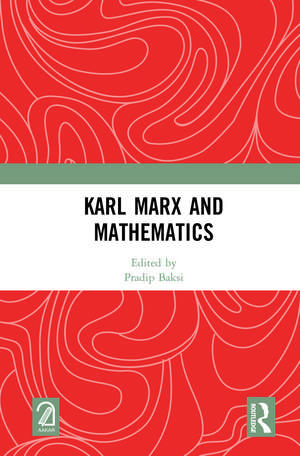
Karl Marx and Mathematics
Editat de Pradip Baksien Limba Engleză Hardback – 2 noi 2020
Suntem de părere că volumul Karl Marx and Mathematics, editat de Pradip Baksi, reprezintă o resursă esențială pentru studenții postuniversitari și cercetătorii interesați de istoria ideilor și de filosofia științei. Această a doua ediție revizuită extinde semnificativ cercetările asupra unui aspect mai puțin explorat al operei lui Marx: manuscrisele sale matematice. Reținem că volumul nu se limitează la o simplă recuperare arhivistică, ci plasează preocupările lui Marx în contextul modern al etnomatematicii și al software-urilor statistice care remodelează disciplina astăzi.
Structura cărții facilitează o progresie logică de la documentul istoric la analiza critică. Prima parte reunește scrisori fundamentale între Marx și Engels, oferind o perspectivă rară asupra modului în care aceștia analizau algebra și calculul diferențial în a doua jumătate a secolului al XIX-lea. Partea a doua oferă o dimensiune internațională, analizând recepția acestor manuscrise în centre academice din Rusia, India și Franța, în timp ce partea a treia discută conceptul de „matematici plurale”. Considerăm că includerea bibliografiilor despre Hegel și semiotică transformă acest titlu într-un instrument de lucru complex.
Ca alternativă la Marx and Engels's "German ideology" Manuscripts de Terrell Carver pentru cursurile de istoria filozofiei sau metodologie, acest volum are avantajul de a se concentra pe rigoarea logică și matematică, mai degrabă decât pe construcția politică a textelor. În timp ce Carver analizează modul în care manuscrisele au fost „fabricate” editorial pentru a servi unei teorii a istoriei, Pradip Baksi investighează modul în care studiul matematicii a influențat structura gândirii lui Marx, oferind o perspectivă tehnică asupra evoluției sale intelectuale.
Preț: 722.23 lei
Carte disponibilă
Livrare economică 14-28 mai
Livrare express 29 aprilie-05 mai pentru 45.99 lei
Specificații
ISBN-10: 0367640627
Pagini: 258
Ilustrații: 7 Halftones, black and white; 7 Illustrations, black and white
Dimensiuni: 156 x 234 x 22 mm
Greutate: 0.64 kg
Ediția:1
Editura: Aakar Books
Colecția Routledge
Public țintă
PostgraduateDe ce să citești această carte
Recomandăm această carte cercetătorilor care doresc să înțeleagă fundamentele logice ale gândirii marxiste dincolo de economie. Cititorul câștigă acces la corespondență rară și la o analiză modernă a etnomatematicii, fiind un motiv concret pentru a reevalua manuscrisele lui Marx prin prisma noilor descoperiri din istoria științei asiatice și europene. Este o piesă de colecție pentru orice bibliotecă academică axată pe istoria matematicii.
Despre autor
Pradip Baksi este un editor și cercetător independent recunoscut pentru eforturile sale de recuperare și analiză a manuscriselor matematice ale lui Karl Marx. Activitatea sa se concentrează pe intersecția dintre istoria matematicii, filozofie și lingvistică, având o contribuție semnificativă în promovarea studiilor despre matematicile plurale și etnomatematică. Prin colaborarea cu edituri precum Aakar Books și Routledge, Baksi a facilitat accesul mediului academic la texte care au fost mult timp neglijate sau interpretate fragmentar, aducând în prim-plan conexiunile dintre tradițiile matematice orientale și cele occidentale în contextul dezvoltării materialismului dialectic.
Descriere scurtă
The emergence and development of the Ethnomathematics movement continue to change our understanding of the history of evolution of plural mathematics on planet earth since the Neolithic age. Rediscovery and study of some of the neglected source texts have further energized investigations on the subsequent history of mathematical cultures, including those on the histories of algebra and analysis in some of the ancient and medieval languages of Asia, like Sanskrit, Arabic and Malayalam. Consequently, it is now possible to indicate some of the larger gaps in the dominant understanding of history of mathematics not only in Marx’s time, but also at the time of editing Marx’s mathematical manuscripts in the twentieth century, and even today. Finally, the emergence and development of mathematical and statistical software packages are vigorously reshaping our ways of conceptualizing and doing mathematics towards an unknown future. It is time now for taking yet another look at all mathematical text from the past and that includes the mathematical manuscripts of Marx.
These texts have been divided into three parts. Part one contains some topical texts related to the history of emergence, development, editing, publication and reception of the mathematical manuscripts of Karl Marx. Part two contains a selection of five articles reflecting some of the investigations inspired by these manuscripts in Russia, India and France. Part three contains five articles on plural mathematics before and after Karl Marx (1818-1883). The texts in this collection are followed by two appendices containing two bibliographies: one on Hegel and mathematics and, the other on mathematics and semiotics.
Please note: This title is co-published with Aakar Books, Bew Delhi. Taylor & Francis does not sell or distribute the print edition in South Asia (India, Sri Lanka, Nepal, Bangladesh, Pakistan, Maldives or Bhutan).
Cuprins
Part One: History
EXCERPTS FROM LETTERS 3. Marx to Engels: 11 January 1858, 6 July 1863 4. Engels to F.A. Lange: 29 March 1865 5. Marx to Engels: 31 May 1873 6. Engels to Marx:18 August 1881, 21 November 1882 7. Marx to Engels: 22 November 1882
EXCERPTS FROM REMINISCENCES
8. Engels’: Speech at Marx’s funeral, 17 March 1883 9. Preface to the second edition of Anti-Dühring, 23 September 1885, Paul Lafargue: 1890 10. A note on the history of collecting, deciphering, editing and publication of Marx’s 11. Mathematical Manuscripts, 1994 – Pradip Baksi 12. Notes to references in the preceding pages
BIBLIOGRAPHY
13. Different editions of Karl Marx’s Mathematical Manuscripts 14. Books and articles on Karl Marx’s Mathematical Manuscripts 15. Additions to the Bibliography 16. Emil Julius Gumbel (1891-1966): The first editor of the Mathematical Manuscripts of Karl Marx – Annette Vogt
Part Two: Investigations
16. The Concept of Differential according to Marx and Hadamard 17. Marx’s “Mathematical Manuscripts” and development of history of mathematics
in the USSR 18. On the logical apparatus working in Karl Marx’s Capital and Mathematical Manuscripts 19. On the problem of situating Marx’s mathematical manuscripts in the history of ideas 20. The differential calculus, mathematicians and economists in the nineteenth century:
Part Three: Plural Mathematics
21. Mathematics and its history in retrospective 22. Nonstandard analysis and the history of classical analysis 22. The new structural approach in mathematics and some of its methodological problems 23. Reflections on seven themes of philosophy of mathematics 24. Emergence and development of the concept of constructivisability in mathematics 25. Appendices: Two Bibliographies 26. Appendix I. A bibliography on Hegel and mathematics 27. Appendix II. A bibliography on mathematics and semiotics