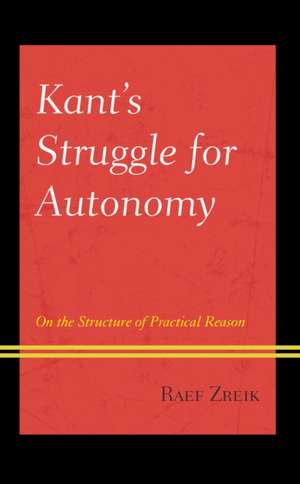
Kant's Struggle for Autonomy: On the Structure of Practical Reason: Contemporary Studies in Idealism
Autor Raef Zreiken Limba Engleză Hardback – 15 feb 2023
In Kant's Struggle for Autonomy: On the Structure of Practical Reason, Raef Zreik presents an original synoptic view of Kant's practical philosophy, uncovering the relatively hidden architectonics of Kant's system and critically engaging with its broad implications. He begins by investigating the implicit strategy that guides Kant in making the distinctions that establish the autonomous spheres: happiness, morality, justice, public order-legitimacy. The organizing principle of autonomy sets these spheres apart, assuming there is self-sufficiency for each sphere.
Zreik then develops a critique of this strategy, showing its limits, its costs, and its inherent instability. He questions self-sufficiency and argues that autonomy is a matter of ongoing struggle between the forces of separation and unification. Zreik proceeds to suggest that we "read Kant backward," reading early Kant in light of late Kant.
This reading reveals Kant's strategy of both taking things apart and putting them together, focusing on the joints, transitions, and metastructures of the system. The image emanating from this account of Kant's legal and moral philosophy is of an intimate yet tragic conflict within Kant's thought-one that leaves us to our own judgment as to where to draw the boundaries between spheres, opening the door for politicizing Kant's practical philosophy.




Preț: 570.01 lei
Preț vechi: 857.02 lei
-33%
100.88€ • 117.90$ • 87.58£
Carte tipărită la comandă
Livrare economică 19 februarie-05 martie
Specificații
ISBN-10: 1793638837
Pagini: 336
Ilustrații: 1 b/w illustrations; 1 tables;
Dimensiuni: 157 x 237 x 25 mm
Greutate: 0.63 kg
Editura: Bloomsbury Publishing
Colecția Lexington Books
Seria Contemporary Studies in Idealism
Locul publicării:New York, United States
Cuprins
Abbreviations
Part 1: Kant's Strategy of Retreat
Chapter 1: Autonomy in Kant's Critique of Pure Reason
Chapter 2: The Autonomy of Morality
Chapter 3: The Autonomy of Justice (Law)
Chapter 4: The Autonomy of Public Order (Legitimacy): Kant on Revolution
Part 2: Critique of Kant's Strategy of Retreat
Chapter 5: The Autonomy of Public Order (Legitimacy) Revisited
Chapter 6: The Autonomy of Justice (Law) Revisited
Chapter 7: The Autonomy of Morality Revisited
Part 3: Beyond Kant. Engagements with Current Debates
Chapter 8: Wood and Willaschek: Between Law and Morality Again
Chapter 9: Korsgaard on Lexical Priority, Rigorism, and the Double-level Theory
Chapter 10: Herman and the Sensitivity to the Particular
Conclusion
Recenzii
Zreik's account of the implicit structure of Kant on morality, justice, law, and virtue is brilliant and original, not least because he brings Kant into conversation with contemporary post-Realist legal theory and the debates regarding the autonomy of law. It is clear and concise and comprehensive and full of new insights. It is an ideal introduction to the most demanding and also puzzling dimensions of Kant as a philosopher of freedom.
Raef Zreik has written a remarkably original book on Kant's practical philosophy. Writing in an easily accessible prose, he demonstrates the centrality of the concept of autonomy to every element of Kant's project, linking his views on theory and practice to his views on law and revolution. Autonomy is, for Zreik, the master concept that cannot quite do the work asked of it. Those limits ask us to rethink the necessity of politics and the role of judgement.