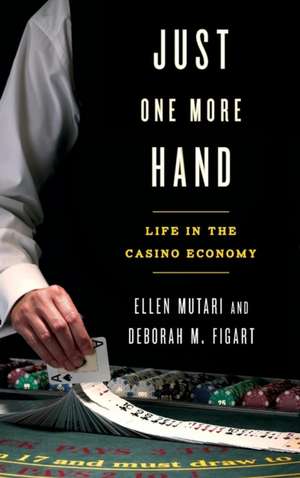
Just One More Hand: Life in the Casino Economy
Autor Ellen Mutari, Deborah M. Figarten Limba Engleză Hardback – 2 feb 2015
Această lucrare reprezintă o resursă academică de referință pentru nivelul de licență și masterat în domeniile sociologiei economice, politicilor publice și studiilor despre munca industrială. În Just One More Hand, observăm o analiză critică a modului în care industria jocurilor de noroc, odată văzută ca un motor de stabilitate economică pentru Atlantic City, s-a transformat într-un sector marcat de precaritate. Ellen Mutari și Deborah M. Figart reușesc să depășească cifrele reci ale statisticilor economice prin integrarea unor viniete autentice, precum poveștile lui SueBee sau Peter, care oferă o perspectivă umană asupra impactului direct al stagnării salariale și al programelor de lucru fragmentate.
Structura volumului este riguros organizată, pornind de la istoria orașului construit „pe nisip” și ajungând la provocările actuale ale globalizării industriei de gaming. Un element distinctiv este modul în care autoarele poziționează experiența lucrătorilor în contextul eforturilor de rebranding urban, demonstrând că investițiile publice nu garantează automat locuri de muncă de calitate. Cititorii familiarizați cu Deindustrialization and Casinos de Alissa Mazar vor aprecia aici focalizarea pe experiența directă a angajatului, Just One More Hand oferind o examinare mai intimă a modului în care „economia cazinoului” erodează demnitatea muncii în servicii.
Această abordare este o continuare firească a cercetărilor anterioare ale autoarelor, care au explorat în Women and the Economy: A Reader dinamica de gen și inegalitățile de pe piața muncii. Volumul de față extinde aceste teme, analizând cum polarizarea veniturilor și presiunea asupra sectorului de servicii transformă radical comunitățile locale. Este o lectură densă, susținută de patru ilustrații alb-negru și o bibliografie extinsă, ce documentează eșecul strategiilor de dezvoltare bazate exclusiv pe atragerea turismului de masă prin jocuri de noroc.
Preț: 222.73 lei
Carte în stoc
Livrare din stoc 24 aprilie
Specificații
ISBN-10: 1442236671
Pagini: 280
Ilustrații: 4 BW Illustrations
Dimensiuni: 157 x 237 x 26 mm
Greutate: 0.56 kg
Editura: Bloomsbury Publishing
Colecția Rowman & Littlefield
Locul publicării:New York, United States
V-ar putea interesa
-
 Heat Transfer and Fluid Flow in Biological ProcessesSid M. Becker-26%Preț: 540.11 lei729.71 lei
 -
 Sports GeographyJ. Bale-15%Preț: 462.24 lei543.81 lei
 -
 Preț: 255.34 lei
 -
 Preț: 208.06 lei
 -
 The Culture of CraftPeter DormerPreț: 126.91 lei
 -
 -29%Preț: 385.71 lei540.10 lei
 -
 Environmental Restoration and Design for Recreation and EcotourismRobert L. France-18%Preț: 1202.93 lei1466.99 lei
 -
 PELT 5E Bk/DVD PackJeremy HarmerPreț: 356.54 lei
 -
 The Art of Couture SewingZoya Nudelman-38%Preț: 573.88 lei920.83 lei
 -
 -18%Preț: 915.13 lei1116.02 lei
 -
 Preț: 242.24 lei
 -
 Football Conditioning A Modern Scientific ApproachAdam Owen Ph. DPreț: 245.37 lei
De ce să citești această carte
Recomandăm această carte studenților și profesioniștilor interesați de transformările pieței muncii și de sociologie urbană. Veți câștiga o înțelegere profundă a modului în care industriile de servicii pot deveni precare sub presiunea globalizării. Este un studiu de caz esențial despre Atlantic City care demonstrează, prin povești reale și date economice, de ce pariul pe cazinouri ca strategie de dezvoltare comunitară aduce adesea pierderi tocmai celor care muncesc în sistem.
Cuprins
1: Stories from a Casino Economy
Vignette: SueBee's story
2: A City Built on Sand
Vignette: Caroline and Ruth's story
3: Going Upscale in an Era of Income Polarization
Vignette: Ken and Marlene's story
4: Dealing with Change
Vignette: Inez and Lily's story
5: The Squeeze on Service
Vignette: Aparna's story
6: Collective Voice in Turbulent Times
Vignette: Peter's story
7: Public Investment or Socialized Risk?
Vignette: Lena's story
8: The Future of the Casino Economy
Appendix: Atlantic City Casinos Timeline
Bibliography
Recenzii
Inspired by a simple question-'Could you build a life working in Atlantic City's booming casinos?'-Mutari and Figart investigate the complex answer's very human face. Underpinning their analyses with real-life experiences of casino housekeepers and cocktail waitresses, pit bosses and poker dealers, they find the gaming industry-and the economic footing of its employees-in flux, an apt lens for a new economic order.
Ever wonder what life in the casino is like? This fine book tells all, and it does so in the words and stories of the dignified, resourceful and dogged workers of Atlantic City, squeezed ever-more-tightly between a slow economy, corporate cost-cutting and the digital revolution.
Casinos represent the most lurid face of the service sector, and both a microcosm and a metaphor of a broader economy in which growth has become increasingly unsustainable and the risk of deindustrialization is always just a product cycle away. This vivid, up-close-and-personal look at casino work, the workers who do it, and the communities that host it, is a valuable window on the changing American economy.
Atlantic City was in decline in the 1970s with businesses closing and unemployment rising when the city bet on casinos to rescue its economy and provide decent jobs for its residents. Even as the early glitter of gambling as an economic development strategy, state and local officials doubled down on their initial bet. Just One More Hand is a masterful tale of the perils of economic development strategy gone awry, told with the analytical skills of two talented economists and seen through the eyes of a diverse group of people who depended on Atlantic City's casinos for their livelihoods.