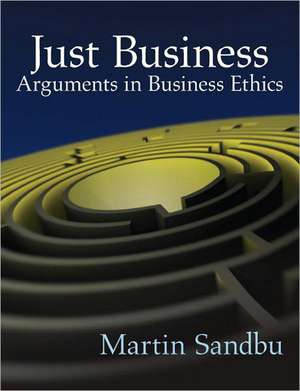
Just Business: Arguments in Business Ethics
Autor Martin E. Sandbuen Limba Engleză Paperback – 31 dec 2010
Preț: 669.74 lei
Preț vechi: 869.80 lei
-23%
Puncte Express: 1005
Carte tipărită la comandă
Livrare economică 08-22 iunie
Specificații
ISBN-13: 9780205697755
ISBN-10: 0205697755
Pagini: 206
Dimensiuni: 175 x 229 x 10 mm
Greutate: 0.28 kg
Ediția:1
Editura: Prentice Hall
Locul publicării:Upper Saddle River, United States
ISBN-10: 0205697755
Pagini: 206
Dimensiuni: 175 x 229 x 10 mm
Greutate: 0.28 kg
Ediția:1
Editura: Prentice Hall
Locul publicării:Upper Saddle River, United States
V-ar putea interesa
-
 The Oxford Handbook of Business and the Natural EnvironmentPratima Bansal-8%Preț: 306.23 lei331.68 lei
 -
 Metaphor and Dialectic in Managing DiversityC. Schwabenland-15%Preț: 619.35 lei728.64 lei
 -
 Seven Management MoralitiesT. Klikauer-15%Preț: 624.38 lei734.56 lei
 -
 Ethical Lessons of the Financial CrisisEileen FlynnPreț: 361.29 lei
 -
 -8%Preț: 511.34 lei555.81 lei
 -
 Marketing and the Common Good: Essays from Notre Dame on Societal ImpactPatrick E. Murphy-18%Preț: 1075.42 lei1311.49 lei
 -
 Screw Business as UsualRichard Branson-21%Preț: 81.30 lei102.49 lei
 -
 Business Ethics: New Challenges in a Globalised WorldJanet Morrison-18%Preț: 398.22 lei487.52 lei
 -
 Preț: 130.13 lei
 -
 A Strategic and Tactical Approach to Global Business EthicsLawrence A. BeerPreț: 164.14 lei
 -
 Globalisation, Governance & Ethics: New Managerial & Economic InsightsJacques-Marie Aurifeille-30%Preț: 717.35 lei1024.55 lei
Descriere
This new first edition introduces business students, scholars, and practitioners to moral reasoning as it applies naturally in business. It "works through" rather than simply "presents" the moral philosophy's relevance to business, thus teaching students how to do moral reasoning as opposed to just learning about moral reasoning.
By choosing examples and questions that show students how one cannot make informed business decisions if you cannot think philosophically; the author identifies, develops, and critically appraises the main approaches in contemporary moral philosophy as they apply to the specific problems that business people confront.
By choosing examples and questions that show students how one cannot make informed business decisions if you cannot think philosophically; the author identifies, develops, and critically appraises the main approaches in contemporary moral philosophy as they apply to the specific problems that business people confront.
Cuprins
Introduction
The Purpose Of This Book
Chapter One
The Business Of Ethics: Reasoning About Right And Wrong
Chapter Two
Two Extreme Views: Managing For Shareholders Or
Stakeholders?
Chapter Three
Doing One’s Job Well: The Ethics Of Social Roles
Chapter Four
Roles And Conventions: Confronting Cultural Conflicts
Chapter Five
Ethics As Efficiency: Making Everyone Better Off
Chapter Six
Is Greed Good? Advancing Society Through Selfish Action
Chapter Seven
Consequentialist Complications: Sacrificing One For The
Many
Chapter Eight
Self-Evident Truths? Imagining A World Without Rights
Chapter Nine
The Case For Rights: Justifying Right-Claims
Chapter Ten
Ethics As Equal Freedom: Respecting Each Person’s Dignity
Chapter Eleven
Fair Shares: Dividing The Value Added
Chapter Twelve
Just Business: Fulfilling Social Contracts
Appendix
Suggestions For Supplementary Material
The Purpose Of This Book
Chapter One
The Business Of Ethics: Reasoning About Right And Wrong
Chapter Two
Two Extreme Views: Managing For Shareholders Or
Stakeholders?
Chapter Three
Doing One’s Job Well: The Ethics Of Social Roles
Chapter Four
Roles And Conventions: Confronting Cultural Conflicts
Chapter Five
Ethics As Efficiency: Making Everyone Better Off
Chapter Six
Is Greed Good? Advancing Society Through Selfish Action
Chapter Seven
Consequentialist Complications: Sacrificing One For The
Many
Chapter Eight
Self-Evident Truths? Imagining A World Without Rights
Chapter Nine
The Case For Rights: Justifying Right-Claims
Chapter Ten
Ethics As Equal Freedom: Respecting Each Person’s Dignity
Chapter Eleven
Fair Shares: Dividing The Value Added
Chapter Twelve
Just Business: Fulfilling Social Contracts
Appendix
Suggestions For Supplementary Material
Notă biografică
Martin E. Sandbu is the economics editorial writer for The Financial Times. He is also a Senior Fellow at the Zicklin Center for Business Ethics Research at the Wharton School, where he previously taught the main business ethics course in the undergraduate curriculum for several years. He has appeared on the BBC World Service, National Public Radio morning edition, and CNBC among other broadcast interviews.
In his academic career, Dr. Sandbu has worked on questions at the intersection between economics, politics and philosophy and published across all three fields. He holds degrees in Philosophy, Politics, and Economics from Balliol College, Oxford University, and in Political Economy and Government from Harvard University. His doctoral thesis, â Explorations in Process-Dependent Preference Theory,â was published in top academic field journals in economics and philosophy. His academic writings have analyzed topics including business ethics, distributive justice, preference theory, collective responsibility, deliberative democracy, and the political economy of development.
Dr. Sandbuâ s interests range beyond the theoretical. His academic research has informed policy advice, including on natural resource governance in developing countries. He participates in the global policy debate through his contributions to the Financial Timesâ editorial column and through opinion pieces in his own name in the FT and other newspapers. He has been invited to give numerous lectures, presentations, and panel appearances for the worldâ s top universities, national governments, intergovernmental organizations, top academic professional associations, and civil society groups.
In his academic career, Dr. Sandbu has worked on questions at the intersection between economics, politics and philosophy and published across all three fields. He holds degrees in Philosophy, Politics, and Economics from Balliol College, Oxford University, and in Political Economy and Government from Harvard University. His doctoral thesis, â Explorations in Process-Dependent Preference Theory,â was published in top academic field journals in economics and philosophy. His academic writings have analyzed topics including business ethics, distributive justice, preference theory, collective responsibility, deliberative democracy, and the political economy of development.
Dr. Sandbuâ s interests range beyond the theoretical. His academic research has informed policy advice, including on natural resource governance in developing countries. He participates in the global policy debate through his contributions to the Financial Timesâ editorial column and through opinion pieces in his own name in the FT and other newspapers. He has been invited to give numerous lectures, presentations, and panel appearances for the worldâ s top universities, national governments, intergovernmental organizations, top academic professional associations, and civil society groups.
Caracteristici
Hallmark Features:
Chooses a different approach from the norm by weaving cases and examples into the text in a summary fashion, resulting in a concise book on normative reasoning that can organize thoughts and intuitions brought forth by a variety of possible cases rather than add to the existing shelf of anthologies and case compendia.
Visits the main mileposts of western moral cannon, but goes further to show that these theories are part of the cannon because they are solutions to problems we face, rather than the other way round. It demonstrates that they are positions a reflective person may naturally arrive at when reasoning in good faith about moral problems.
Focuses on the basic arguments in moral philosophy that are most relevant to business practice: The possibility of reasoned argument about ethics at all (Chapters One and Two); Whether moral questions can be satisfactorily answered with reference to the virtues, social roles, and cultural conventions (Chapters Three and Four); The claim that consequences—in particular for people’s well-being—are all that matter morally (Chapters Five to Seven); The disputed need for rights and how to justify and specify them (Chapters Eight to Twelve, which include discussions of distributive justice and social contract theory).
Engages the reader in the process of moral reasoning and not merely its product.
Focuses on the justification and development of ideas rather than their exposition and application
Develops an argument broadly in favor of a social-contract approach to business ethics.
Each chapter ends with a short section entitled “Summary of the argument in this chapter”, which gives a roadmap to the book as well as enables instructors to judge whether to use the book as a whole or excerpt individual parts
Every chapter contributes a theoretical development of the ideas that are predictably generated by case discussions on the topic, so that case readings or other texts can be most effectively interweaved.
An appendix gives further references and suggestions for supplementary material to match the text.
Can be paired with MyEthicsKit for Just Business, helping instructors bring the world into their classroom and take their classroom into the world. This is a groundbreaking online tool that features online video casebooks, interactive simulations where students roll play, newsfeeds that allow students to apply the core concepts of the course to breaking events in the business world, a primary source library with all of the additional readings that you might assign and an assessment/study plan program that allows students to gauge their level of understanding of the core concepts of the course.
Chooses a different approach from the norm by weaving cases and examples into the text in a summary fashion, resulting in a concise book on normative reasoning that can organize thoughts and intuitions brought forth by a variety of possible cases rather than add to the existing shelf of anthologies and case compendia.
Visits the main mileposts of western moral cannon, but goes further to show that these theories are part of the cannon because they are solutions to problems we face, rather than the other way round. It demonstrates that they are positions a reflective person may naturally arrive at when reasoning in good faith about moral problems.
Focuses on the basic arguments in moral philosophy that are most relevant to business practice: The possibility of reasoned argument about ethics at all (Chapters One and Two); Whether moral questions can be satisfactorily answered with reference to the virtues, social roles, and cultural conventions (Chapters Three and Four); The claim that consequences—in particular for people’s well-being—are all that matter morally (Chapters Five to Seven); The disputed need for rights and how to justify and specify them (Chapters Eight to Twelve, which include discussions of distributive justice and social contract theory).
Engages the reader in the process of moral reasoning and not merely its product.
Focuses on the justification and development of ideas rather than their exposition and application
Develops an argument broadly in favor of a social-contract approach to business ethics.
Each chapter ends with a short section entitled “Summary of the argument in this chapter”, which gives a roadmap to the book as well as enables instructors to judge whether to use the book as a whole or excerpt individual parts
Every chapter contributes a theoretical development of the ideas that are predictably generated by case discussions on the topic, so that case readings or other texts can be most effectively interweaved.
An appendix gives further references and suggestions for supplementary material to match the text.
Can be paired with MyEthicsKit for Just Business, helping instructors bring the world into their classroom and take their classroom into the world. This is a groundbreaking online tool that features online video casebooks, interactive simulations where students roll play, newsfeeds that allow students to apply the core concepts of the course to breaking events in the business world, a primary source library with all of the additional readings that you might assign and an assessment/study plan program that allows students to gauge their level of understanding of the core concepts of the course.