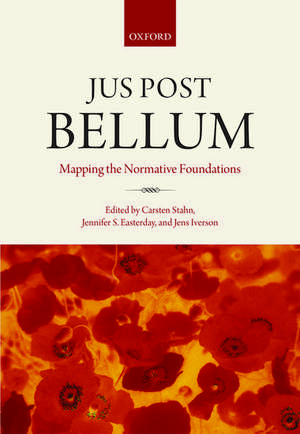
Jus Post Bellum: Mapping the Normative Foundations
Editat de Carsten Stahn, Jennifer S. Easterday, Jens Iversonen Limba Engleză Hardback – 13 feb 2014
Preț: 927.12 lei
Preț vechi: 1337.43 lei
-31%
Puncte Express: 1391
Carte tipărită la comandă
Livrare economică 26 noiembrie-02 decembrie
Livrare prin curier în România Termenul estimat este afișat lângă disponibilitate.
Transport gratuit pentru acest produs Plată online sau ramburs, în funcție de opțiunile comenzii.
Retur gratuit în 14 zile Comandă securizată și suport în română.
Specificații
ISBN-13: 9780199685899
ISBN-10: 0199685894
Pagini: 600
Dimensiuni: 182 x 254 x 39 mm
Greutate: 1.21 kg
Editura: Oxford University Press
Colecția OUP Oxford
Locul publicării:Oxford, United Kingdom
ISBN-10: 0199685894
Pagini: 600
Dimensiuni: 182 x 254 x 39 mm
Greutate: 1.21 kg
Editura: Oxford University Press
Colecția OUP Oxford
Locul publicării:Oxford, United Kingdom
V-ar putea interesa
-
 Human Rights and Personal Self-Defense in International LawJan Arno Hessbruegge-31%Preț: 712.18 lei1035.71 lei
 -
 Indigenous Peoples in International LawS. James Anaya-11%Preț: 356.18 lei399.46 lei
 -
 Fundamental Rights in EuropeFederico Fabbrini-31%Preț: 916.50 lei1330.99 lei
 -
 Pluralism in International Criminal LawElies van Sliedregt-31%Preț: 984.68 lei1427.96 lei
 -
 The Settlement of International Cultural Heritage DisputesAlessandro Chechi-31%Preț: 981.70 lei1426.14 lei
 -
 The Law and Practice of the International Criminal CourtCarsten Stahn-32%Preț: 1722.73 lei2542.02 lei
 -
 -30%Preț: 688.30 lei990.24 lei
 -
 -31%Preț: 773.89 lei1123.61 lei
 -
 The Accountability of Armed Groups under Human Rights LawKatharine Fortin-31%Preț: 826.68 lei1200.84 lei
 -
 -33%Preț: 740.74 lei1104.62 lei
 -
 Media Law and Human RightsJustice Nicol-33%Preț: 627.35 lei930.26 lei
 -
 The Oxford Companion to International Criminal JusticeAntonio Cassese-23%Preț: 704.30 lei911.55 lei
 -
 The Oxford Handbook of International Law in Armed ConflictAndrew Clapham-35%Preț: 1331.16 lei2060.98 lei
 -
 The Culturalization of Human Rights LawFederico Lenzerini-35%Preț: 853.46 lei1309.18 lei
 -
 International Migration LawVincent Chetail-20%Preț: 434.44 lei546.28 lei
 -
 The Treatment of Prisoners under International LawNigel Rodley-27%Preț: 490.86 lei675.85 lei
 -
 Contested JusticeChristian de Vos-14%Preț: 957.34 lei1113.19 lei
 -
 A Critique of Proportionality and BalancingFrancisco Urbina-14%Preț: 772.27 lei897.99 lei
 -
 Preț: 345.41 lei
 -
 -18%Preț: 1122.15 lei1368.47 lei
 -
 Peace Diplomacy, Global Justice and International AgencyCarsten StahnPreț: 456.22 lei
 -
 The Fundamental Rights of Companies: EU, US and International Law ComparedProfessor Peter J Oliver-34%Preț: 522.44 lei789.15 lei
 -
 Jus Post BellumCarsten StahnPreț: 391.16 lei
Notă biografică
Carsten Stahn is Professor of International Criminal Law and Global Justice at Leiden University and Program Director of the Grotius Centre. He is the author of The Law and Practice of International Territorial Administration: Versailles to Iraq and Beyond. He has published articles on international criminal law and transitional justice in leading international journals (American Journal of International Law, European Journal of International Law, Journal of International Criminal Justice, Harvard International Law Journal), and edited several collections of essays in the field.Jennifer Easterday is a Researcher for the 'Jus Post Bellum' project. She is also an international justice consultant and a Trial Monitor for the Open Society Justice Initiative. She previously worked for International Criminal Law Services, an NGO based in The Hague, on a variety of international criminal law capacity-building projects in domestic jurisdictions in the former Yugoslavia and Africa. She has also worked as a Senior Researcher and Trial Monitor for the UC Berkeley War Crimes Studies Center, researching and monitoring the Special Court for Sierra Leone trial of Charles Taylor. She has experience at the ICTY and with other international criminal law and human rights NGOs in the United States and Latin America. She received her Juris Doctor from the University of California, Berkeley School of Law and is a member of the California State Bar.Jens Iverson is a Researcher for the 'Jus Post Bellum' project and an attorney specializing in public international law. A member of the California Bar, the Thurston Society, and the Order of the Coif, he received his Juris Doctor cum laude from the University of California, Hastings, and his Bachelor of Arts from Yale University. He has worked with the Cambodian Genocide Program, the Documentation Centre of Cambodia, and the Coalition for the International Criminal Court. As the co-founder of a human rights clinic, he helped represent the former Prime Minister of Haiti in a successful petition to the Inter-American Commission on Human Rights that ultimately resulted in a landmark ruling requiring Haitian prison reform. He has practiced at the International Criminal Tribunal for the former Yugoslavia on both the Popovic et al and Prlic et al cases.