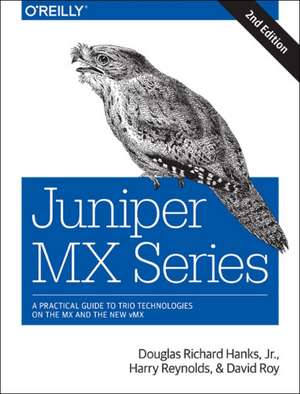
Juniper MX Series
Autor Jr Douglas Richard Hanks, Harry Reynolds, David Royen Limba Engleză Paperback – 18 oct 2016
Structura progresivă a acestui volum ghidează cititorul de la înțelegerea fundamentală a conceptelor hardware până la implementări complexe de servicii în rețele de mare densitate. Analizăm în detaliu arhitectura seriei Juniper MX Series, punând accent pe modul în care chipset-ul Trio gestionează serviciile inline, precum NAT, tunelurile GRE bazate pe filtre și redundanța tunelurilor logice. Considerăm că forța acestei a doua ediții rezidă în abordarea aplicată, oferind configurații pas cu pas pentru serviciile Ethernet Layer 2 și Layer 3, esențiale atât pentru mediul enterprise, cât și pentru furnizorii de servicii. Subliniem importanța noilor secțiuni dedicate virtualizării prin vMX, care permit inginerilor să exploreze beneficiile unui ruter virtual în scenarii de testare și producție. Apreciem rigoarea tehnică cu care sunt tratate mecanismele de securitate, de la protecția DDOS specifică Junos până la cadrele de filtrare firewall și funcția SCFD. Complementar lui Junos Enterprise Routing, care se concentrează pe certificări și soluții generale de rutare, volumul de față acoperă specificitatea hardware-ului MX și optimizarea fluxurilor prin ierarhizarea planificării (hierarchical scheduling) și gestionarea cozilor de intrare (ingress queuing). În contextul operei autorilor, această lucrare completează trilogia practică ce include Juniper QFX10000 Series și Juniper Qfx5100 Series. Dacă lucrările anterioare se concentrau pe arhitecturile de switching și virtualizarea centrelor de date, Juniper MX Series adresează nucleul rețelelor de transport, menținând același stil tehnic dens și orientat spre soluții de teren, documentate de ingineri cu experiență vastă în centrele de operațiuni de rețea (NOC).
Preț: 365.01 lei
Preț vechi: 456.27 lei
-20%
Carte disponibilă
Livrare economică 07-21 noiembrie
Livrare express 27-31 octombrie pentru 95.46 lei
Specificații
ISBN-10: 1491932724
Pagini: 1136
Dimensiuni: 181 x 233 x 60 mm
Greutate: 1.94 kg
Ediția:2nd edition
Editura: O'Reilly
V-ar putea interesa
-
 Computer Networks: A Systems ApproachLarry L. Peterson-41%Preț: 558.53 lei941.05 lei
 -
 -20%Preț: 450.69 lei563.37 lei
 -
 Deploying Juniper Data Centers with EVPN VXLANAninda Chatterjee-20%Preț: 481.42 lei601.78 lei
 -
 Segment Routing for Service Provider and Enterprise NetworksFlorian Deragisch-20%Preț: 492.95 lei616.18 lei
 -
 TCP/IP IllustratedKevin Fall-20%Preț: 403.13 lei503.92 lei
 -
 Mastering VMware NSX for vSphereElver Sena Sosa-20%Preț: 294.39 lei368.00 lei
 -
 -20%Preț: 321.35 lei401.68 lei
 -
 -24%Preț: 432.06 lei571.07 lei
 -
 -20%Preț: 432.49 lei540.61 lei
 -
 -20%Preț: 335.34 lei419.18 lei
 -
 -20%Preț: 571.67 lei714.58 lei
 -
 -20%Preț: 454.61 lei568.26 lei
 -
 -20%Preț: 447.36 lei559.21 lei
 -
 -20%Preț: 242.75 lei303.43 lei
 -
 MongoDB in Action, Third EditionArek Borucki-20%Preț: 355.71 lei444.63 lei
 -
 The Book of PF, 4th Edition: A No-Nonsense Guide to the OpenBSD FirewallPeter N.M. Hansteen-36%Preț: 279.74 lei437.64 lei
 -
 Packet Tracer for Young Intermediate AdminsDamian Strojek-20%Preț: 260.94 lei326.17 lei
 -
 Computer Networks in Packet Tracer for Intermediate UsersDamian Strojek-20%Preț: 265.31 lei331.65 lei
De ce să citești această carte
Recomandăm această carte inginerilor de rețea care operează în medii de mare viteză și au nevoie de o referință tehnică pentru platforma Juniper MX. Cititorul câștigă o înțelegere profundă a chipset-ului Trio și a implementărilor VXLAN sau MC-LAG. Este un instrument esențial pentru tranziția de la rutarea teoretică la administrarea practică a unora dintre cele mai scalabile rutere din industrie, oferind scenarii de configurare gata de aplicat în producție.
Despre autor
Jr Douglas Richard Hanks este un expert recunoscut în arhitecturi de rețea, ocupând poziția de Senior NOC Engineer. Expertiza sa practică în operarea echipamentelor Juniper Networks este reflectată în numeroasele ghiduri tehnice publicate la editura O'Reilly. Alături de coautorii Harry Reynolds și David Roy, acesta a contribuit la definirea standardelor de documentare pentru seriile MX și QFX. Experiența sa directă în rezolvarea incidentelor complexe de rețea transformă scrierile sale în resurse indispensabile pentru profesioniștii care caută soluții robuste de scalabilitate și securitate în infrastructurile critice.
Descriere scurtă
This second edition was written by a Senior NOC Engineer, whose vast experience with the MX Series is well documented. Each chapter covers a specific Juniper MX vertical and includes review questions to help you test what you've learned. This edition includes new chapters on load balancing and vMX—Juniper MX's virtual instance.
- Discover Junos architecture, MX chassis, and Trio Linecards
- Work with Juniper MX's bridging, VLAN VXLAN, and virtual switches
- Create a firewall filter framework and discover the latest flexible filtering options
- Secure your router and add an extra layer of security with Junos DDOS protection and SCFD feature
- Discover the advantages of hierarchical scheduling, ingress queuing, and flexible remarking
- Combine Juniper MX routers, using a virtual chassis or MC-LAG
- Understand and use classical and advanced Trio Chipset's load balancing features
- Dive into Trio inline services such as inline NAT, redundant logical tunnel, or filter-based GRE tunnel
- Discover vMX internal architecture and explore the benefits and typical use case of a virtual router