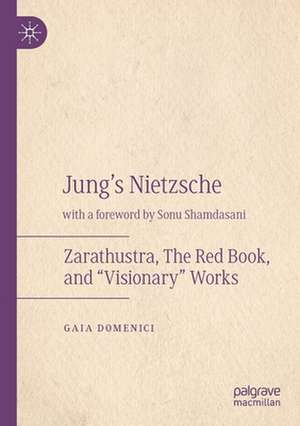
Jung's Nietzsche
Autor Gaia Domenicien Limba Engleză Paperback – 9 aug 2020
Preț: 561.30 lei
Preț vechi: 660.36 lei
-15%
Puncte Express: 842
Carte tipărită la comandă
Livrare economică 18 noiembrie-02 decembrie
Livrare prin curier în România Termenul estimat este afișat lângă disponibilitate.
Transport gratuit pentru acest produs Plată online sau ramburs, în funcție de opțiunile comenzii.
Retur gratuit în 14 zile Comandă securizată și suport în română.
Specificații
ISBN-13: 9783030176723
ISBN-10: 303017672X
Pagini: 268
Ilustrații: XVII, 250 p.
Dimensiuni: 148 x 210 x 15 mm
Greutate: 0.35 kg
Ediția:1st ed. 2019
Editura: Springer
Locul publicării:Cham, Switzerland
ISBN-10: 303017672X
Pagini: 268
Ilustrații: XVII, 250 p.
Dimensiuni: 148 x 210 x 15 mm
Greutate: 0.35 kg
Ediția:1st ed. 2019
Editura: Springer
Locul publicării:Cham, Switzerland
Cuprins
Chapter 1: Introduction.- Chapter 2: ʻVisionaryʼ Works And Liber Novus.- Chapter 3: Nietzsche In Liber Novus.- Chapter 4: Liber Novus In Nietzsche: Jungʼs Seminar On Zarathustra.- Chapter 5: Conclusion.
Notă biografică
Gaia Domenici is Honorary Research Fellow at the Institute for Advanced Studies, University College London, UK.
Textul de pe ultima copertă
This book explores C.G. Jung's complex relationship with Friedrich Nietzsche through the lens of the so-called 'visionary' literary tradition. The book connects Jung's experience of the posthumously published Liber Novus (The Red Book) with his own (mis)understanding of Nietzsche's Zarathustra, and formulates the hypothesis of Jung considering Zarathustra as Nietzsche's Liber Novus –– both works being regarded by Jung as 'visionary' experiences. After exploring some 'visionary' authors often compared by Jung to Nietzsche (Goethe, Hölderlin, Spitteler, F. T. Vischer), the book focuses upon Nietzsche and Jung exclusively. It analyses stylistic similarities, as well as explicit references to Nietzsche and Zarathustra in Liber Novus, drawing on Jung's annotations in his own copy of Zarathustra. The book then uses Liber Novus as a prism to contextualize and understand Jung's five-year seminar on Zarathustra: allthe nuances of Jung's interpretation of Zarathustra can be fully explained, only when compared with Liber Novus and its symbology. One of the main topics of the book concerns the figure of 'Christ' and Nietzsche's and Jung's understandings of the 'death of God.'
Caracteristici
Explores how Jung's opinion on Nietzsche changes and develops throughout Jung's life Discusses the figure of 'Christ' and Nietzsche's and Jung's understandings of the 'death of God' Offers a close reading of the Red Book in the light of Jung’s later seminar on Thus Spoke Zarathustra