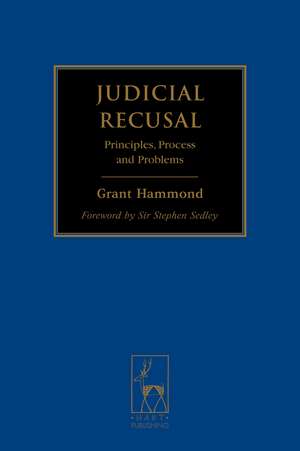
Judicial Recusal: Principles, Process and Problems
Autor R Grant Hammonden Limba Engleză Hardback – 27 iul 2009
The book commences with an introduction which is followed by an analysis of the essential features of the law, the legal principles (common-law origins, the law today in the USA, UK and Commonwealth) and the difficulties which currently arise in the cases and by operation of statute. The third part looks at process, including waiver, necessity, appellate review, and final appeals. Three specific problem areas (judicial misconduct in court, prior viewpoints, and unconcious bias) are then discussed. The book ends with the author's reflections on future developments and possible reforms of recusal law.
Preț: 645.08 lei
Preț vechi: 913.59 lei
-29%
Puncte Express: 968
Carte tipărită la comandă
Livrare economică 09-23 decembrie
Livrare prin curier în România Termenul estimat este afișat lângă disponibilitate.
Transport gratuit pentru acest produs Plată online sau ramburs, în funcție de opțiunile comenzii.
Retur gratuit în 14 zile Comandă securizată și suport în română.
Specificații
ISBN-13: 9781841132600
ISBN-10: 1841132608
Pagini: 208
Dimensiuni: 152 x 236 x 20 mm
Greutate: 0.45 kg
Editura: Bloomsbury Publishing
Colecția Hart Publishing
Locul publicării:London, United Kingdom
ISBN-10: 1841132608
Pagini: 208
Dimensiuni: 152 x 236 x 20 mm
Greutate: 0.45 kg
Editura: Bloomsbury Publishing
Colecția Hart Publishing
Locul publicării:London, United Kingdom
Cuprins
Part A: Introduction
1. THE ESSENTIAL QUESTIONS
Part B: Principles
2. THE EVOLUTION OF THE PRESENT LAW IN THE COMMON LAW WORLD
3. THE CLASSIFICATION OF THE PRESENT DAY RECUSAL PRINCIPLES IN THE BRITISH COMMONWEALTH
4. AUTOMATIC DISQUALIFICATION IN THE BRITISH COMMONWEALTH
5. APPARENT BIAS IN THE BRITISH COMMONWEALTH
6. FEDERAL RECUSAL LAW IN THE UNITED STATES OF AMERICA
Part C: Process
7. THE IMPORTANCE OF PROCESS
8. PRUDENCE: IF IN DOUBT, OUT?
9. PRACTICE RULES AND PROTOCOLS
10. DISCLOSURE
11. WAIVER
12. NECESSITY
13. APPELLATE REVIEW OF LOWER COURT DECISIONS
14. RECUSAL PROCEDURE IN APPELLATE COURTS
Part D: Some Specific Problem Areas
15. JUDICIAL MISCONDUCT IN COURT: JUDGES WHO GO TOO FAR
16. PRIOR VIEWPOINTS
17. UNCONSCIOUS BIAS
Part E: The Future of Recusal Law
18. POSSIBLE REFORMS
19. JUDGES OR LEGISLATORS?
1. THE ESSENTIAL QUESTIONS
Part B: Principles
2. THE EVOLUTION OF THE PRESENT LAW IN THE COMMON LAW WORLD
3. THE CLASSIFICATION OF THE PRESENT DAY RECUSAL PRINCIPLES IN THE BRITISH COMMONWEALTH
4. AUTOMATIC DISQUALIFICATION IN THE BRITISH COMMONWEALTH
5. APPARENT BIAS IN THE BRITISH COMMONWEALTH
6. FEDERAL RECUSAL LAW IN THE UNITED STATES OF AMERICA
Part C: Process
7. THE IMPORTANCE OF PROCESS
8. PRUDENCE: IF IN DOUBT, OUT?
9. PRACTICE RULES AND PROTOCOLS
10. DISCLOSURE
11. WAIVER
12. NECESSITY
13. APPELLATE REVIEW OF LOWER COURT DECISIONS
14. RECUSAL PROCEDURE IN APPELLATE COURTS
Part D: Some Specific Problem Areas
15. JUDICIAL MISCONDUCT IN COURT: JUDGES WHO GO TOO FAR
16. PRIOR VIEWPOINTS
17. UNCONSCIOUS BIAS
Part E: The Future of Recusal Law
18. POSSIBLE REFORMS
19. JUDGES OR LEGISLATORS?
Recenzii
This handsome and excellent monograph provides a learned account of the law relating to 'judicial recusal'
The author... draws on his rich academic and practical experience to produce a thoughtful and scholarly exegesis on an area of law which has rarely been explored in such a comprehensive manner.
...this is an admirable book which should be a valuable addition to the 'must' library collection of judicial officers and all those who have an interest in the healthy functioning of the justice system in a liberal democracy.
The book grapples with many difficult questions, including disclosure of interest, wavier, necessity and issues faced by appellate and final courts. It is thorough, wide-ranging and indeed fascinating. The writing is tight and there is a sense of contemporaneity, though the problem is timeless.Erudite and entertaining, it should also be read by those involved in our plethora of administrative tribunals and other quasi-judicial bodies; decision makers and commentators, politicians and journalists.Day-to-day adjudicators, lawyers and advocates will benefit from this commendable book.
This is a handy little book. Cases in which a judge is asked to recuse often occur without much prior warning and it is good both for advocates and judges to be able to grab hold of a concise treatment of the subject to take to court to help one through the day.
Grant Hammond has the advantage of being both a distinguished academic and a distinguished judge, as well as having been a successful practitioner. His learning is broad and deep, his analysis shrewd, his exposition lucid and his prose enjoyable. It's hard to ask more of a law book.
Hammond reviews future developments and possible reforms of recusal law in this splendid Hart publication which maintains the highest standards of intellectual legal titles.
An eminently readable book . to be welcomed for a much needed and highly lucid examination of a controversial and complex subject.
This work is a real and meaningful contribution to an area of law which in the Commonwealth lacks cohesion
He has provided a rigorous analysis of the issues and laid out in some detail the pitfalls and possible paths forward in this area. As a former academic, lawyer, and now a senior appellate judge, he brings a considerable experience to bear on the issues.
An enormous breadth of knowledge which is lacking in much modern legal writing
This work will be an invaluable resource for judges considering, as well as litigants and lawyers bringing or opposing, recusal applications.
The ... analysis is as readable as it is erudite and comprehensive, encompassing the substantive, theoretical and practical questions that one would expect to find in a learned treatise on the subject - and more. The book is a notable contribution to the literature on recusals, and should be of considerable interest to public lawyers and judiciary watchers.
A brief review of this nature could not sufficiently comment on such excellent scholarship.
Hammond has written an excellent book that should engage scholars, judges and policy-makers alike. Recusal law is much the richer for it.
The book is a worthwhile purchase. It is very readable and generally concise.
Useful, succinct and intelligent new monograph.
The layout of the book is simple and sensible
Hammond provides a well researched and readable examination of judicial recusal which easily fills what was a surprising gap in the extensive literature of public law in the common law world.
The breadth of comparative material gathered by Hammond enables the book to provide a useful resource for judges and practitioners faced with the issue.
The author... draws on his rich academic and practical experience to produce a thoughtful and scholarly exegesis on an area of law which has rarely been explored in such a comprehensive manner.
...this is an admirable book which should be a valuable addition to the 'must' library collection of judicial officers and all those who have an interest in the healthy functioning of the justice system in a liberal democracy.
The book grapples with many difficult questions, including disclosure of interest, wavier, necessity and issues faced by appellate and final courts. It is thorough, wide-ranging and indeed fascinating. The writing is tight and there is a sense of contemporaneity, though the problem is timeless.Erudite and entertaining, it should also be read by those involved in our plethora of administrative tribunals and other quasi-judicial bodies; decision makers and commentators, politicians and journalists.Day-to-day adjudicators, lawyers and advocates will benefit from this commendable book.
This is a handy little book. Cases in which a judge is asked to recuse often occur without much prior warning and it is good both for advocates and judges to be able to grab hold of a concise treatment of the subject to take to court to help one through the day.
Grant Hammond has the advantage of being both a distinguished academic and a distinguished judge, as well as having been a successful practitioner. His learning is broad and deep, his analysis shrewd, his exposition lucid and his prose enjoyable. It's hard to ask more of a law book.
Hammond reviews future developments and possible reforms of recusal law in this splendid Hart publication which maintains the highest standards of intellectual legal titles.
An eminently readable book . to be welcomed for a much needed and highly lucid examination of a controversial and complex subject.
This work is a real and meaningful contribution to an area of law which in the Commonwealth lacks cohesion
He has provided a rigorous analysis of the issues and laid out in some detail the pitfalls and possible paths forward in this area. As a former academic, lawyer, and now a senior appellate judge, he brings a considerable experience to bear on the issues.
An enormous breadth of knowledge which is lacking in much modern legal writing
This work will be an invaluable resource for judges considering, as well as litigants and lawyers bringing or opposing, recusal applications.
The ... analysis is as readable as it is erudite and comprehensive, encompassing the substantive, theoretical and practical questions that one would expect to find in a learned treatise on the subject - and more. The book is a notable contribution to the literature on recusals, and should be of considerable interest to public lawyers and judiciary watchers.
A brief review of this nature could not sufficiently comment on such excellent scholarship.
Hammond has written an excellent book that should engage scholars, judges and policy-makers alike. Recusal law is much the richer for it.
The book is a worthwhile purchase. It is very readable and generally concise.
Useful, succinct and intelligent new monograph.
The layout of the book is simple and sensible
Hammond provides a well researched and readable examination of judicial recusal which easily fills what was a surprising gap in the extensive literature of public law in the common law world.
The breadth of comparative material gathered by Hammond enables the book to provide a useful resource for judges and practitioners faced with the issue.