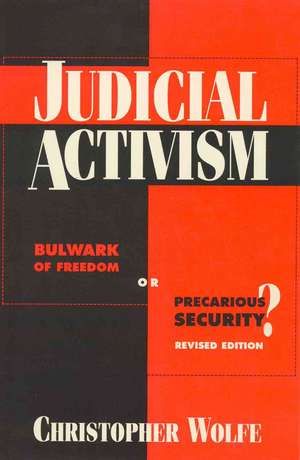
Judicial Activism: Bulwark of Freedom or Precarious Security?
Autor Christopher Wolfeen Limba Engleză Paperback – 30 apr 1997
Praise for the first edition of Judicial Activism:
"This is a splendid contribution to the literature, integrating for the first time between two covers an extensive debate, honestly and dispassionately presented, on the role of courts in American policy.
-Stanley C. Brubaker, Colgate University
Preț: 315.93 lei
Preț vechi: 389.85 lei
-19%
Puncte Express: 474
Carte tipărită la comandă
Livrare economică 01-15 decembrie
Livrare prin curier în România Termenul estimat este afișat lângă disponibilitate.
Transport gratuit de la 400.00 lei Plată online sau ramburs, în funcție de opțiunile comenzii.
Retur gratuit în 14 zile Comandă securizată și suport în română.
Specificații
ISBN-13: 9780847685318
ISBN-10: 0847685314
Pagini: 184
Dimensiuni: 154 x 230 x 8 mm
Greutate: 0.41 kg
Ediția:Revised
Editura: Bloomsbury Publishing
Colecția Rowman & Littlefield
Locul publicării:New York, United States
ISBN-10: 0847685314
Pagini: 184
Dimensiuni: 154 x 230 x 8 mm
Greutate: 0.41 kg
Ediția:Revised
Editura: Bloomsbury Publishing
Colecția Rowman & Littlefield
Locul publicării:New York, United States
Cuprins
Chapter 1 Introduction
Chapter 2 Framing the Issue
Chapter 3 The Constitution and the Need for Adaptation
Chapter 4 Judicial Review and Democracy
Chapter 5 Judicial Review and Good Government
Chapter 6 Democracy and the Indirect Effects of Judicial Review
Chapter 2 Framing the Issue
Chapter 3 The Constitution and the Need for Adaptation
Chapter 4 Judicial Review and Democracy
Chapter 5 Judicial Review and Good Government
Chapter 6 Democracy and the Indirect Effects of Judicial Review
Recenzii
A thoughtful and illuminating analysis of one of the most influential policy making institutions in contemporary government. Scrupulously fair in his description of the arguments for and against judicial activism, Wolfe presents the political and constitutional debate over the democratic character of judicial review in rich historical detail.
Professor Wolfe has done something remarkable: put analytical rigor into the concept of judicial activism. The result is an extraordinarily penetrating analysis and critique of the Judiciary's usurpation of democratic authority.
Wolfe offers a lucid summary of the main arguments on judicial activism-both pro and con. He presents an intellectually honest dialectic between the traditional and modern views, stability versus change, legal interpretation versus legislating. Wolfe's book is destined to loom large in constitutional scholarship.
Professor Wolfe has done something remarkable: put analytical rigor into the concept of judicial activism. The result is an extraordinarily penetrating analysis and critique of the Judiciary's usurpation of democratic authority.
Wolfe offers a lucid summary of the main arguments on judicial activism-both pro and con. He presents an intellectually honest dialectic between the traditional and modern views, stability versus change, legal interpretation versus legislating. Wolfe's book is destined to loom large in constitutional scholarship.