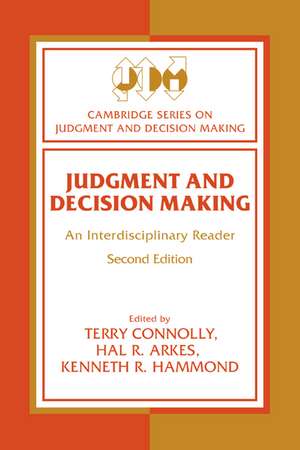
Judgment and Decision Making
Editat de Kenneth R. Hammond, Terry Connolly, Lola Lopesen Limba Engleză Paperback – 24 ian 2007
Această a doua ediție a lucrării Judgment and Decision Making, editată de Terry Connolly, Hal R. Arkes și Kenneth R. Hammond, reprezintă o revizuire substanțială și o extindere a colecției clasice din 1986. Considerăm că noutatea majoră constă în adaptarea conținutului la realitățile contemporane ale cercetării aplicate, integrând studii de caz din domenii care au evoluat rapid, precum strategia de afaceri, medicina și politicile publice. Față de literatura existentă, volumul reușește să traducă rigoarea științifică într-un format accesibil, care nu necesită o pregătire tehnică avansată. Recomandăm această antologie deoarece extinde cadrul teoretic propus de Blackwell Handbook of Judgment and Decision Making prin includerea unor date noi din sfera practicii juridice și a mărturiilor oculte, oferind o perspectivă mai pragmatică asupra modului în care indivizii procesează informația. Structura narativă este susținută de comentarii editoriale critice care leagă articolele între ele, oferind o coerență rar întâlnită în volumele de tip reader. Cele 74 de ilustrații și 45 de tabele funcționează ca indicatori de experiență, facilitând înțelegerea modelelor matematice și psihologice descrise. În contextul operei editorilor, această lucrare consolidează temele explorate în The Psychology of Decision Making, dar se distanțează de abordarea pur organizațională a aceleia, preferând o viziune panoramică, interdisciplinară. Dacă în Decision Modeling and Behavior in Complex and Uncertain Environments accentul era pus pe modelarea matematică în condiții de incertitudine, volumul de față prioritizează factorul uman și erorile cognitive sistematice. Este o resursă fundamentală care demonstrează că procesele decizionale nu sunt izolate în laborator, ci influențează direct eficiența diagnosticelor medicale și a negocierilor colective.
Preț: 703.22 lei
Preț vechi: 868.16 lei
-19%
Carte tipărită la comandă
Livrare economică 26 noiembrie-10 decembrie
Specificații
ISBN-10: 0521626021
Pagini: 808
Ilustrații: 74 b/w illus. 45 tables
Dimensiuni: 156 x 234 x 43 mm
Greutate: 1.2 kg
Ediția:Revizuită
Editura: Cambridge University Press
Locul publicării:New York, United States
V-ar putea interesa
-
 The Agile MindWilma Koutstaal-20%Preț: 503.88 lei632.90 lei
 -
 The Conceptual Link from Physical to MentalRobert Kirk-28%Preț: 479.35 lei669.11 lei
 -
 Agency and Joint AttentionJanet Metcalfe-14%Preț: 904.26 lei1051.47 lei
 -
 SparkJohn J RateyPreț: 110.60 lei
 -
 -15%Preț: 444.99 lei523.51 lei
 -
 Grounding CognitionDiane PecherPreț: 466.81 lei
 -
 Figurative LanguageBarbara DancygierPreț: 389.43 lei
 -
 The Psychology of Visual ArtGeorge MatherPreț: 432.22 lei
 -
 Understanding Autobiographical MemoryDorthe BerntsenPreț: 399.86 lei
 -
 Cognition and MotivationShulamith Kreitler-11%Preț: 628.66 lei706.36 lei
 -
 Preț: 252.14 lei
 -
 Critical FeelingRolf ReberPreț: 285.51 lei
 -
 Extraordinary BeliefsPeter LamontPreț: 284.05 lei
 -
 iDisorderLarry D. RosenPreț: 113.36 lei
 -
 The Art of Thinking ClearlyRolf Dobelli-27%Preț: 68.51 lei93.23 lei
De ce să citești această carte
Această carte este esențială pentru profesioniștii din drept, medicină sau afaceri care doresc să înțeleagă mecanismele din spatele propriilor decizii. Cititorul câștigă o înțelegere profundă a modului în care intuiția poate fi educată prin metode științifice. Este un instrument practic care transformă teorii complexe în strategii aplicabile pentru a evita erorile de judecată costisitoare în viața profesională.
Despre autor
Terry Connolly, Hal R. Arkes și Kenneth R. Hammond sunt figuri centrale în psihologia cognitivă și teoria deciziei. Terry Connolly este recunoscut pentru cercetările sale privind deciziile în condiții de incertitudine, în timp ce Hal R. Arkes a adus contribuții majore în studiul erorilor de judecată (judgmental biases). Kenneth R. Hammond este unul dintre pionierii teoriei judecății sociale. Împreună, acești editori au definit standardele academice în cadrul Cambridge Series on Judgment and Decision Making, reușind să creeze o punte între cercetarea fundamentală și aplicațiile practice în politici publice și management.