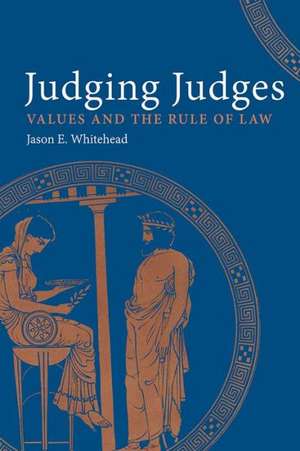
Judging Judges: Values and the Rule of Law
Autor Jason E. Whiteheaden Limba Engleză Hardback – 30 noi 2014
Această monografie de cercetare semnată de Jason E. Whitehead oferă o perspectivă necesară asupra mecanismelor interne care definesc actul de justiție în democrațiile liberale. Observăm că Judging Judges nu se limitează la o analiză teoretică, ci plonjează în realitatea practicii judiciare prin interviuri aprofundate care expun sistemele de valori ale magistraților. Autorul demonstrează că statul de drept nu este un mecanism automat bazat pe aplicarea literală a legii, ci o construcție socială fragilă, dependentă de atitudinea subiectivă a celor care o interpretează.
Comparabil cu All Judges Are Political—Except When They Are Not de Keith Bybee în rigurozitatea analizei tensiunii dintre drept și politică, volumul de față este actualizat pentru un context în care judecătorii sunt frecvent vilificați de public. Whitehead propune o schimbare de paradigmă: statul de drept este, în esență, o chestiune de încredere socială, nu doar o succesiune de constrângeri textuale. Structura cărții urmărește o progresie logică, de la introducerea bătăliei pentru statul de drept, la capitole dedicate specific diferitelor tipuri de valori (formaliste, de bună-credință, cinice sau arbitrare) care pot influența deciziile de pe bancă.
Apreciem modul în care Judging Judges reușește să integreze etica religioasă și valorile personale într-un discurs despre obligația juridică, oferind o viziune nuanțată asupra modului în care judecătorii își exercită autoritatea. Stilul este academic, însă accesibil celor interesați de intersecția dintre științele politice, drept și sociologie, oferind o bază solidă pentru a reevalua criteriile după care „îi judecăm pe judecători”.
Preț: 418.14 lei
Carte disponibilă
Livrare economică 17 noiembrie-01 decembrie
Specificații
ISBN-10: 1602585253
Pagini: 253
Dimensiuni: 152 x 228 x 30 mm
Greutate: 0.56 kg
Editura: Baylor University Press
Colecția Baylor University Press (US)
V-ar putea interesa
-
 -31%Preț: 706.44 lei1028.39 lei
 -
 -31%Preț: 536.39 lei778.67 lei
 -
 -13%Preț: 260.69 lei298.59 lei
 -
 -30%Preț: 963.20 lei1379.06 lei
 -
 Reason in Action: Collected Essays Volume IJohn Finnis-9%Preț: 337.52 lei372.08 lei
 -
 OCR Religious Ethics for AS and A2Jill OliphantPreț: 407.13 lei
 -
 The Cambridge Companion to Christian EthicsRobin GillPreț: 304.61 lei
 -
 Sacred and Secular, Second EditionPippa NorrisPreț: 290.76 lei
 -
 The Political Morality of Liberal DemocracyMichael J. PerryPreț: 309.06 lei
 -
 Finding Meaning in BusinessB. OkonkwoPreț: 400.08 lei
 -
 Preț: 411.10 lei
 -
 Religion & HealthcareAnthony M Curtis-27%Preț: 844.61 lei1150.71 lei
De ce să citești această carte
Este o lectură esențială pentru studenții la drept, profesioniștii din sistemul juridic și cetățenii preocupați de integritatea democrației. Cititorul va înțelege că deciziile judecătorești nu sunt simple rezultate ale unei ecuații legale, ci produse ale unor sisteme de valori complexe. Cartea oferă instrumentele necesare pentru a trece dincolo de etichetele politice simpliste și a vedea justiția ca pe un angajament social comun.
Despre autor
Jason E. Whitehead este profesor asociat de științe politice și director al Programului de Studii Juridice la California State University, Long Beach. Experiența sa academică se concentrează pe intersecția dintre drept, politică și comportament judiciar. Prin activitatea sa de cercetare, Whitehead explorează modul în care valorile umane și structurile sociale influențează interpretarea legii, aducând o contribuție semnificativă studiilor juridice contemporane prin combinarea metodelor empirice cu teoria politică.
Descriere scurtă
Recenzii
"Whitehead uses extensive interviews with appellate judges to delineate the ways that judges think about their task of interpreting the law. In doing so, he provides us with new insights and valuable evidence about the role of legal considerations in judicial decision-making." -- Lawrence Baum, Professor Emeritus of Political Science, Ohio State University
"Jason Whitehead offers a nuanced analysis of the constraints that are imposed by the judicial role and the relatively limited range of choices that are open to judges when they interpret the law. This book is a tour de force and a model of scholarship. It can be read profitably by judges, legal theorists, and political scientists, indeed by anyone who is intrigued by the complexity hidden in the seemingly simple question, 'What does it mean to apply rules?'" -- Malcolm M Feeley, Claire Sanders Clements Dean's Professor, Boalt Hall School of Law, University of California at Berkeley