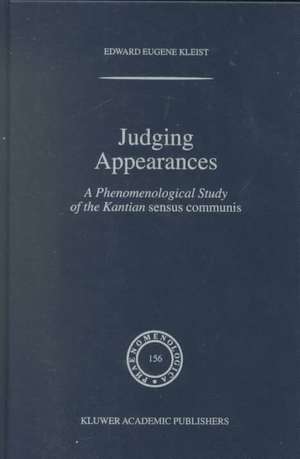
Judging Appearances
Autor E E Kleisten Limba Engleză Hardback – 31 iul 2000
Preț: 401.31 lei
Puncte Express: 602
Carte tipărită la comandă
Livrare economică 28 noiembrie-12 decembrie
Livrare prin curier în România Termenul estimat este afișat lângă disponibilitate.
Transport gratuit pentru acest produs Plată online sau ramburs, în funcție de opțiunile comenzii.
Retur gratuit în 14 zile Comandă securizată și suport în română.
Specificații
ISBN-13: 9780792363101
ISBN-10: 0792363108
Pagini: 164
Ilustrații: X, 164 p.
Dimensiuni: 160 x 241 x 15 mm
Greutate: 0.44 kg
Ediția:2000 edition
Editura: Springer
Locul publicării:Dordrecht, Netherlands
ISBN-10: 0792363108
Pagini: 164
Ilustrații: X, 164 p.
Dimensiuni: 160 x 241 x 15 mm
Greutate: 0.44 kg
Ediția:2000 edition
Editura: Springer
Locul publicării:Dordrecht, Netherlands
V-ar putea interesa
-
 Hegel's Development: Night Thoughts (Jena 1801-1806)H. S. Harris-32%Preț: 797.83 lei1177.51 lei
 -
 Mind, Method, and Morality: Essays in Honour of Anthony KennyJohn Cottingham-31%Preț: 871.14 lei1264.02 lei
 -
 Genius: A Very Short IntroductionAndrew Robinson-20%Preț: 57.12 lei71.12 lei
 -
 Reality: A Very Short IntroductionJan Westerhoff-20%Preț: 56.62 lei70.82 lei
 -
 David Hume: A Treatise of Human Nature: Two-volume setDavid Fate Norton-21%Preț: 512.38 lei645.71 lei
 -
 -28%Preț: 362.88 lei504.95 lei
 -
 Effective Intentions: The Power of Conscious WillAlfred R. Mele-13%Preț: 299.37 lei345.20 lei
 -
 The Routledge Companion to PostmodernismStuart SimPreț: 334.79 lei
 -
 An Intellectual History of CannibalismC¿t¿lin AvramescuPreț: 274.45 lei
 -
 The I in WeAxel HonnethPreț: 168.90 lei
 -
 Deleuze and LawLaurent De Sutter-17%Preț: 233.85 lei280.90 lei
 -
 Preț: 164.39 lei
 -
 Gottfried Wilhelm LeibnizMarcelo Dascal-18%Preț: 1385.40 lei1689.52 lei
 -
 Just the ArgumentsMichael BrucePreț: 144.92 lei
 -
 Introducing Slavoj ZizekChristopher Kul-WantPreț: 56.58 lei
 -
 Who Am I and If So How Many?: A Journey Through Your MindRichard David Precht-26%Preț: 69.61 lei93.87 lei
 -
 You Kant Make it Up!Gary HaydenPreț: 78.47 lei
Public țintă
ResearchCuprins
I / Introduction: A Phenomenological Approach.- The Problem of Harmony and Ground.- Objections to a Phenomenological Study of Kantian Aesthetics.- Precedents for the Phenomenological Interpretation.- Rationale for a Phenomenological Approach.- II / Phenomenological Reconstruction.- First Moment: Kant’s Analysis of Disinterestedness.- Second Moment: Universality without Concept.- Third Moment: Purposiveness without Purpose.- Fourth Moment: Exemplary Necessity.- III / The Indeterminacy of Grounds (Kant and Leibniz).- Kant’s Appropriation of Leibniz before the Critique of Judgment.- The Problem of Appearance and Ground in Leibnizian Aesthetics.- Indeterminacy and Appearance in the Critique of Judgment.- Appendix: Excerpts from the Latin Version of the Monadologie.- IV / Being Mindful of Appearance: Receptivity, Neutralization, Discursivity.- Sensibility.- The Faculties of Representation.- Imagination.- Imagination and Neutralization.- The Discursivity of Human Understanding as “Thinking” [Denken]: Kant’s Rejection of Intellectual Intuition/Intuitive Understanding.- The Discursivity of Reason in Thinking, Contemplation and Desire.- V / Conclusion.- Kant and Humanism.- Maxims of Common Human Understanding.