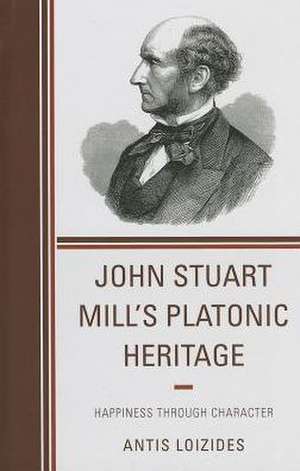
John Stuart Mill’s Platonic Heritage: Happiness through Character
Autor Antis Loizidesen Limba Engleză Hardback – 22 mar 2013
Preț: 538.08 lei
Preț vechi: 837.61 lei
-36%
Puncte Express: 807
Preț estimativ în valută:
95.13€ • 110.69$ • 82.31£
95.13€ • 110.69$ • 82.31£
Carte tipărită la comandă
Livrare economică 23 aprilie-07 mai
Specificații
ISBN-13: 9780739173930
ISBN-10: 0739173936
Pagini: 248
Dimensiuni: 161 x 236 x 26 mm
Greutate: 0.54 kg
Editura: Bloomsbury Publishing
Colecția Lexington Books
Locul publicării:New York, United States
ISBN-10: 0739173936
Pagini: 248
Dimensiuni: 161 x 236 x 26 mm
Greutate: 0.54 kg
Editura: Bloomsbury Publishing
Colecția Lexington Books
Locul publicării:New York, United States
Cuprins
Abbreviations
Preface
Acknowledgments
Introduction
Part I: Classical Reception in Nineteenth-Century Britain
Chapter One: Reform through Classics
Contesting the Place of Classics
Athenian Institutions and Reform
Concluding Remarks
Notes
Chapter Two: Plato in Pre-Victorian Britain
Rediscovering Plato
A Neoplatonist Born Out of Due Season
Socrates in Early-Nineteenth Century
Socrates, Plato and the Utilitarians
Concluding Remarks
Notes
Chapter Three: James Mill on Plato
Radicalising Plato
James Mill's 'Platonism'
Concluding Remarks
Notes
Part II: John Stuart Mill's Appropriation of Plato
Chapter Four: Educative Past
Reforming Educational Practice
Reforming Social Institutions
Reforming Political Practice
Concluding Remarks
Notes
Chapter Five: Reading Plato
Mill's First Reading: Defining Plato's Creed
Mill's Second Reading: Grote's Plato
Concluding Remarks
Notes
Chapter Six: On Plato's Method
Mill's Intellectual Development and Plato
Mill's Dialectical Method
Concluding Remarks
Notes
Part III: John Stuart Mill's Platonic Heritage
Chapter Seven: The Art of Life
Reason and Action
Mill and the Art of Life
An Education for the Art of Life
Concluding Remarks
Notes
Chapter Eight: Character, Ethology and Virtue
Defining Character
Means and Ends of Character Formation
Concluding Remarks
Notes
Chapter Nine: Eudaimonia and Utility
Utility or Eudaimonia?
Additive and Directive Views of Happiness
Direction, Pleasure and Lives
Concluding Remarks
Notes
Conclusion
Bibliography
Index
Preface
Acknowledgments
Introduction
Part I: Classical Reception in Nineteenth-Century Britain
Chapter One: Reform through Classics
Contesting the Place of Classics
Athenian Institutions and Reform
Concluding Remarks
Notes
Chapter Two: Plato in Pre-Victorian Britain
Rediscovering Plato
A Neoplatonist Born Out of Due Season
Socrates in Early-Nineteenth Century
Socrates, Plato and the Utilitarians
Concluding Remarks
Notes
Chapter Three: James Mill on Plato
Radicalising Plato
James Mill's 'Platonism'
Concluding Remarks
Notes
Part II: John Stuart Mill's Appropriation of Plato
Chapter Four: Educative Past
Reforming Educational Practice
Reforming Social Institutions
Reforming Political Practice
Concluding Remarks
Notes
Chapter Five: Reading Plato
Mill's First Reading: Defining Plato's Creed
Mill's Second Reading: Grote's Plato
Concluding Remarks
Notes
Chapter Six: On Plato's Method
Mill's Intellectual Development and Plato
Mill's Dialectical Method
Concluding Remarks
Notes
Part III: John Stuart Mill's Platonic Heritage
Chapter Seven: The Art of Life
Reason and Action
Mill and the Art of Life
An Education for the Art of Life
Concluding Remarks
Notes
Chapter Eight: Character, Ethology and Virtue
Defining Character
Means and Ends of Character Formation
Concluding Remarks
Notes
Chapter Nine: Eudaimonia and Utility
Utility or Eudaimonia?
Additive and Directive Views of Happiness
Direction, Pleasure and Lives
Concluding Remarks
Notes
Conclusion
Bibliography
Index
Recenzii
. . . . Kuhar and Patternotte's anthology provides an encouraging methodological example as to how sociological research into pressing political issues can be conducted. In their sober, account-taking style, the essays provide maximum enlightenment. At the same time, they create the baffling result that this book would serve just as well as a manual for building anti-gender campaigns, or for building one's political career on no expertise except authoritarian anti-gender rhetorics. Anti-Gender Campaigns in Europe is neither a blazing ideology critique nor a manual for resistance. But asking for that might be getting ahead of things. The first step is to take the phenomenon of anti-genderism seriously and learn about its dynamics, as this book enables us to do.
Everyone knows that John Stuart Mill began to learn Greek at the age of three. Very few have a clear idea of what Mill permanently incorporated into his mature thinking about ethics, politics, and individual happiness from his youthful and subsequent encounters with Greek philosophy, and with Plato above all. Antis Loizides' book casts a wholly novel light on familiar issues, such as the way in which the younger Mill half-accepted and half-rejected his father's ideas, and in doing so, forces us to reconsider his father's utilitarianism as well as his own. The list of topics that Antis Loizides illuminates by carefully retracing Mill's engagement with Plato is very long indeed; among them, Mill's concern to develop an 'art of life' that would do justice to the noble and the beautiful in conduct, to kalon, and his careful balancing of representative democracy's need for citizens with the critical skills of a Socrates on the one hand and its need for dispassionate Platonic expertise on the other. Finally, Mill's concern with character and self-development, which is all too easy to see as a gift from Thomas Carlyle, turns out to have deep roots in Plato, as does the thought, central to On Liberty, that the happiness of a fully-developed human being exists in their capacity for rational self-direction. This is a deeply engrossing book.
Antis Loizides has produced an enlightening study of ancient Greek intellectual influences on James Mill and his son John Stuart. He makes a convincing case that Plato's ideas in particular, especially his Socratic method of dialectic, as much as Bentham's ideas, helped to shape not only James's classical utilitarian philosophy but also John's enlarged utilitarian 'art of life', though both Mills agreed with George Grote in rejecting Plato's metaphysical idealism, mysticism and distaste for democracy. The study is full of important insights and sheds light on many aspects of John's unusual utilitarianism. For instance, Loizides calls attention to James's suggestive remarks about higher pleasures, including the remark that mental pleasures include bodily sensations of pleasure or at least their traces in memory or imagination as ingredients. To take another example, he also demonstrates through numerous quotations that John rejects the internalist doctrine, shared by idealists such as Plato and Kant, that knowledge of virtue is sufficient to motivate us to act virtuously, a doctrine incorrectly attributed to Mill by modern utilitarians such as R.M. Hare. Loizides concludes his study with an interesting discussion in which he compares Mill's hedonistic conception of happiness with the Greek idea of eudaimonia. He speculates that, for Mill, a noble and virtuous life is also the most pleasant life. But he also suggests at times that rational deliberation is what ultimately directs an individual to develop a noble and virtuous character, and that feelings of pleasure merely accompany rather than motivate noble and virtuous activities. In my view, that suggestion is incompatible with Mill's hedonism and his rather Humean claim that feeling, not reason, is the ultimate spring of human action.
Everyone knows that John Stuart Mill began to learn Greek at the age of three. Very few have a clear idea of what Mill permanently incorporated into his mature thinking about ethics, politics, and individual happiness from his youthful and subsequent encounters with Greek philosophy, and with Plato above all. Antis Loizides' book casts a wholly novel light on familiar issues, such as the way in which the younger Mill half-accepted and half-rejected his father's ideas, and in doing so, forces us to reconsider his father's utilitarianism as well as his own. The list of topics that Antis Loizides illuminates by carefully retracing Mill's engagement with Plato is very long indeed; among them, Mill's concern to develop an 'art of life' that would do justice to the noble and the beautiful in conduct, to kalon, and his careful balancing of representative democracy's need for citizens with the critical skills of a Socrates on the one hand and its need for dispassionate Platonic expertise on the other. Finally, Mill's concern with character and self-development, which is all too easy to see as a gift from Thomas Carlyle, turns out to have deep roots in Plato, as does the thought, central to On Liberty, that the happiness of a fully-developed human being exists in their capacity for rational self-direction. This is a deeply engrossing book.
Antis Loizides has produced an enlightening study of ancient Greek intellectual influences on James Mill and his son John Stuart. He makes a convincing case that Plato's ideas in particular, especially his Socratic method of dialectic, as much as Bentham's ideas, helped to shape not only James's classical utilitarian philosophy but also John's enlarged utilitarian 'art of life', though both Mills agreed with George Grote in rejecting Plato's metaphysical idealism, mysticism and distaste for democracy. The study is full of important insights and sheds light on many aspects of John's unusual utilitarianism. For instance, Loizides calls attention to James's suggestive remarks about higher pleasures, including the remark that mental pleasures include bodily sensations of pleasure or at least their traces in memory or imagination as ingredients. To take another example, he also demonstrates through numerous quotations that John rejects the internalist doctrine, shared by idealists such as Plato and Kant, that knowledge of virtue is sufficient to motivate us to act virtuously, a doctrine incorrectly attributed to Mill by modern utilitarians such as R.M. Hare. Loizides concludes his study with an interesting discussion in which he compares Mill's hedonistic conception of happiness with the Greek idea of eudaimonia. He speculates that, for Mill, a noble and virtuous life is also the most pleasant life. But he also suggests at times that rational deliberation is what ultimately directs an individual to develop a noble and virtuous character, and that feelings of pleasure merely accompany rather than motivate noble and virtuous activities. In my view, that suggestion is incompatible with Mill's hedonism and his rather Humean claim that feeling, not reason, is the ultimate spring of human action.