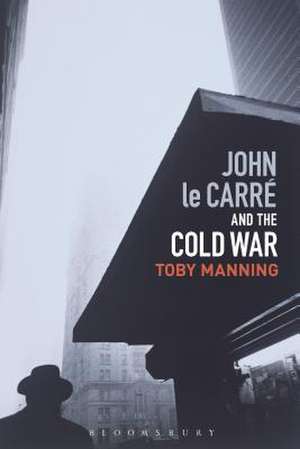
John le Carré and the Cold War
Autor Dr Toby Manningen Limba Engleză Paperback – 19 sep 2019
Examining The Spy Who Came in from the Cold (1963), Tinker Tailor Soldier Spy (1974), Smiley's People (1979) and other novels, this book offers an illuminating picture of Cold-War Britain, while situating le Carré's work alongside that of George Orwell, Graham Greene and Ian Fleming. Providing a valuable contribution to contemporary understandings of both British spy fiction and post-war fiction, Toby Manning challenges the critical consensus to reveal a considerably less radical writer than is conventionally presented.
Preț: 249.73 lei
Preț vechi: 331.73 lei
-25%
Puncte Express: 375
Carte tipărită la comandă
Livrare economică 13-27 noiembrie
Livrare prin curier în România Termenul estimat este afișat lângă disponibilitate.
Transport gratuit de la 400.00 lei Plată online sau ramburs, în funcție de opțiunile comenzii.
Retur gratuit în 14 zile Comandă securizată și suport în română.
Specificații
ISBN-13: 9781350122161
ISBN-10: 1350122165
Pagini: 256
Dimensiuni: 154 x 232 x 20 mm
Greutate: 0.36 kg
Editura: Bloomsbury Publishing
Colecția Bloomsbury Academic
Locul publicării:London, United Kingdom
ISBN-10: 1350122165
Pagini: 256
Dimensiuni: 154 x 232 x 20 mm
Greutate: 0.36 kg
Editura: Bloomsbury Publishing
Colecția Bloomsbury Academic
Locul publicării:London, United Kingdom
Cuprins
Dedication
Acknowledgements
Introduction: 'A Nation's Political Health'
The enemy
The state
The nation
Cold-War consensus to critical consensus
Chapter 1. 'Murderers and Spies': The Communist Threat and Call for the Dead
'Mass philosophy': The Cold-War enemy
'A symbol of nothing at all': The British state
'Deep love of England': Imagining the nation
'Who was then the gentleman?': Nation, state and enemy
Chapter 2. 'Breeze Blocks and Barbed Wire': The Berlin Wall and The Spy Who Came in from the Cold
'Party Terms': The communist enemy
'Not quite a gentleman': Leamas and the classless British nation
'We are defensive': English empiricism, ideology and the British state
Chapter 3. 'Looking at His Own Reflection': The Establishment and The Looking Glass War
'A sort of Cuba situation': Reflections of the enemy
'Government hirings': The Department, the Circus and the British state
'The mystery of England': The nation and class
Chapter 4. 'Holding the World Together': The Cambridge Spies and Tinker Tailor Soldier Spy
'The imminent collapse of the nation': England and the establishment
'Russians taken over the government': The infiltrated British state
'Fanaticism' and 'mindless treason': Enemy characterization
'Haydon's crooked deathmask': State, nation and enemy
Chapter 5. 'All One Vanishing World': The Honourable Schoolboy, Colonialism and Communism
'Her colonial grip': Britain, the Empire and the special relationship
'A spreading plague': Communism and Southeast Asia
Chapter 6. 'Only People': Humanism, Populism, the Second Cold War and Smiley's People
'Deniable blessing': Smiley and the British state
'British to the core': Smiley's tour of the nation
'The danger is absolute": Karla and communism
'Half-angels' and 'half-devils': Smiley, Karla and the Cold War
Conclusion: 'Man, Not the Mass'
The enemy
The state
The nation
Appendix I: Plot Synopses
Bibliography
Index
Acknowledgements
Introduction: 'A Nation's Political Health'
The enemy
The state
The nation
Cold-War consensus to critical consensus
Chapter 1. 'Murderers and Spies': The Communist Threat and Call for the Dead
'Mass philosophy': The Cold-War enemy
'A symbol of nothing at all': The British state
'Deep love of England': Imagining the nation
'Who was then the gentleman?': Nation, state and enemy
Chapter 2. 'Breeze Blocks and Barbed Wire': The Berlin Wall and The Spy Who Came in from the Cold
'Party Terms': The communist enemy
'Not quite a gentleman': Leamas and the classless British nation
'We are defensive': English empiricism, ideology and the British state
Chapter 3. 'Looking at His Own Reflection': The Establishment and The Looking Glass War
'A sort of Cuba situation': Reflections of the enemy
'Government hirings': The Department, the Circus and the British state
'The mystery of England': The nation and class
Chapter 4. 'Holding the World Together': The Cambridge Spies and Tinker Tailor Soldier Spy
'The imminent collapse of the nation': England and the establishment
'Russians taken over the government': The infiltrated British state
'Fanaticism' and 'mindless treason': Enemy characterization
'Haydon's crooked deathmask': State, nation and enemy
Chapter 5. 'All One Vanishing World': The Honourable Schoolboy, Colonialism and Communism
'Her colonial grip': Britain, the Empire and the special relationship
'A spreading plague': Communism and Southeast Asia
Chapter 6. 'Only People': Humanism, Populism, the Second Cold War and Smiley's People
'Deniable blessing': Smiley and the British state
'British to the core': Smiley's tour of the nation
'The danger is absolute": Karla and communism
'Half-angels' and 'half-devils': Smiley, Karla and the Cold War
Conclusion: 'Man, Not the Mass'
The enemy
The state
The nation
Appendix I: Plot Synopses
Bibliography
Index
Recenzii
An analysis inspired by venerated figures of 20th-century Marxist literary criticism. This reappraisal of the popular novelist's oeuvre incorporates a fan's enthusiasm with the literary scholar's eye for ideological complexity. Summing Up: Recommended.
John le Carre and the Cold War is highly informative and loaded with historical context.
Manning's study proves to be an important contribution to le Carré scholarship and to criticism of espionage ?ction as a whole. Its signi?cance lies also in laying the foundations for future research.
An important contribution to work on spy fiction and its contexts.
Confidently in command of his materials, Toby Manning has produced a carefully compiled dossier on the historical and political valence of Le Carre's central fiction. His finely nuanced interpretations radiate with an authority indicative of a keen grasp of the literary imagination and a judicious depth of learning.
John le Carre and the Cold War is highly informative and loaded with historical context.
Manning's study proves to be an important contribution to le Carré scholarship and to criticism of espionage ?ction as a whole. Its signi?cance lies also in laying the foundations for future research.
An important contribution to work on spy fiction and its contexts.
Confidently in command of his materials, Toby Manning has produced a carefully compiled dossier on the historical and political valence of Le Carre's central fiction. His finely nuanced interpretations radiate with an authority indicative of a keen grasp of the literary imagination and a judicious depth of learning.