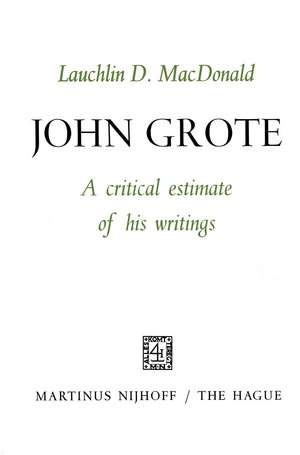
John Grote
Autor Lauchlin D MacDonalden Limba Engleză Paperback – 1966
Preț: 405.27 lei
Puncte Express: 608
Carte tipărită la comandă
Livrare economică 08-22 decembrie
Livrare prin curier în România Termenul estimat este afișat lângă disponibilitate.
Transport gratuit pentru acest produs Plată online sau ramburs, în funcție de opțiunile comenzii.
Retur gratuit în 14 zile Comandă securizată și suport în română.
Specificații
ISBN-13: 9789401185042
ISBN-10: 9401185042
Pagini: 284
Ilustrații: XXI, 284 p. 1 illus.
Dimensiuni: 155 x 235 x 17 mm
Greutate: 0.48 kg
Ediția:1966 edition
Editura: Springer
Locul publicării:Dordrecht, Netherlands
ISBN-10: 9401185042
Pagini: 284
Ilustrații: XXI, 284 p. 1 illus.
Dimensiuni: 155 x 235 x 17 mm
Greutate: 0.48 kg
Ediția:1966 edition
Editura: Springer
Locul publicării:Dordrecht, Netherlands
V-ar putea interesa
-
 Derrida: A Very Short IntroductionSimon GlendinningPreț: 69.23 lei
 -
 Donald Davidson: A Short IntroductionKathrin Glüer-10%Preț: 348.00 lei386.81 lei
 -
 Idealist EpilogueG. R. G. Mure-21%Preț: 372.68 lei473.39 lei
 -
 The Philosophy of J. L. AustinMartin Gustafsson-31%Preț: 695.08 lei1001.72 lei
 -
 Contrary Thinking: Selected Essays of Daya KrishnaDaya Krishna-30%Preț: 769.76 lei1097.79 lei
 -
 Hatred and ForgivenessJulia KristevaPreț: 224.99 lei
 -
 Gilles Deleuze and Félix Guattari - Intersecting LivesFrancois DossePreț: 335.32 lei
 -
 This Incredible Need to BelieveJulia KristevaPreț: 82.66 lei
 -
 Mute Speech – Literature, Critical Theory and PoliticsJacques RancièrePreț: 240.75 lei
 -
 The Responsibility of the PhilosopherGianni VattimoPreț: 190.68 lei
 -
 Preț: 76.96 lei
 -
 Herbert Marcuse: An Aesthetics of LiberationMalcolm MilesPreț: 294.55 lei
 -
 Ontology of the AccidentCatherine MalabouPreț: 88.36 lei
 -
 Deleuze and SexFrida Beckman-17%Preț: 228.90 lei277.43 lei
 -
 Not Half No EndGeoffrey Bennington-17%Preț: 178.32 lei214.98 lei
 -
 Theology After DeleuzeDr Kristien Justaert-15%Preț: 236.65 lei276.99 lei
 -
 BubblesPeter Sloterdijk-18%Preț: 212.45 lei258.65 lei
 -
 Lehre vom ZerfallEmile M. CioranPreț: 122.26 lei
 -
 Manifest des evolutionären HumanismusMichael Schmidt-SalomonPreț: 86.35 lei
Public țintă
ResearchCuprins
I. Introduction.- 1. John Grote’s Life.- 2. Writings.- 3. Statement, and Division, of the Problem.- 4. Survey of Sources and of Previous Work on the Problem.- 5. Transition to Next Chapter.- II. Grote’s View of Phenomenalism.- I. Distinction of Terms: ‘Noumenon,’ ‘Phenomenon,’ and ‘Thing in Itself’.- 2. What Phenomenalism Means.- 3. Phenomenal Reality.- 4. Two Tests of Phenomenalism.- 5. The Phenomenalist Spirit or Mind.- 6. Summary and Foreword to Next Chapter.- III. Grote’s Interpretation of the Relation of Phenomenalism to Philosophy.- 1. Each is Necessary to the Other.- 2. Consciousness as Active and Passive.- 3. Analysis of Sensation.- 4. Time and Space.- 5. The Relationship of Phenomenalism to Philosophy Further Illustrated.- 6. Relationship Through Contrast.- 7. Mind Provides Unity.- 8. Grote Avoids A Basic Blunder in Behaviorism.- 9. Kant’s Abstraction of Phenomenal Reality from Reason.- 10. Abstracting of Consciousness from Phenomena is Unwarranted.- 11. Historical Recapitulation.- 12. Main Contribution of the Chapter, with Comment.- 13. Transition to Next Chapter.- IV. Philosophy As Consciousness and the Ego.- 1. Introduction.- 2. Ferrier’s Treatment of Philosophy and Phenomenalism.- 3. Criticism of Grote and Ferrier on the Basis of Lotze’s Position.- 4. Meaning of ‘Know,’ and ‘Know About,’ in Reference to Phenomenal Reality.- 5. Relativity of Knowledge.- 6. Summary of Main Issues.- V. ‘Philosophy’ and the Scale of Sensation.- 1. Introduction.- 2. Importance of the Scale of Sensation.- 3. Two Kinds of Knowledge — ‘Higher’ and ‘Lower’.- 4. Hamilton, Mill and Reid Compared.- 5. Descartes and Hamilton.- 6. Proper Use of Certain Terms in Relation to the Scale of Sensation.- 7. Critical Reflection on the ForegoingChapter.- VI. Phenomenalist Logic and Knowledge.- 1. Introductory.- 2. Grote’s Own Position Revealed Through Criticism of Hamilton and Mill.- 3. Phenomenalism Inadequate For A Perfect Scheme of Knowledge.- 4. Critical Observations and Analyses.- VII. The Introspective Method in Knowledge.- 1. Introduction.- 2. Locke’s Psychology.- 3. Hume’s Rationalism.- 4. Berkeley’s Subjectivism.- 5. Spencer’s and Morell’s Evolutionism.- 6. Retrospect and Prospect.- VIII. Immediateness and Reflection.- 1. Introduction.- 2. Purpose of the Chapter in Introducing These Terms.- 3. Meaning of Immediateness and Reflection.- 4. Significance of Immediateness and Reflection in Grote’s Philosophy.- 5. Critical Comment.- 6. Relation to the Following Chapter.- IX. Personalism in Grote’s Writings.- 1. Introduction.- 2. Epistemological Monism.- 3. Monistic, Pluralistic, and Theistic Personalism.- 4. Critique of Materialism.- 5. Critical Comment.- 6. Summary and Transition to Next Chapter.- X. Grote’s Idealism.- 1. Introduction.- 2. Grote’s Platonism.- 3. Critique of Utilitarianism.- 4. A Critique of Moral Ideals.- 5. Critical Remarks.- 6. Concluding Note to this Chapter.- Conclusion.- 1. Grote’s Position in the History of Philosophy.- 2. Further Critical Comment.- Appendix: An Exposition of the Miscellaneous Writings of John Grote.- I. “On A Furture State”.- 1. Glorification of body and mind.- 2. Simplicity of style and thought in this article.- 3. Effect of present life on the future.- 4. Manner of individual appearance in a future life is unimportant.- 5. Stress on the importance of both present and future life.- 6. Comment.- II. “On Glossology”.- 1. Concerning terminology.- i. Break in Grote’s projected work on glossology.- ii.’ Phone’ and ‘noem’.-iii.’ Phonism’ and ‘noematism’.- iv. Ideas of physical ‘things’.- v. Stomatism.- vi. ‘Hypophonism’.- 2. The philosophy of language.- i. Four divisions.- ii. ‘Noematism’.- iii. ‘Noematoschematism’.- iv.’ Phonarium’.- v. ‘Dianoematism’.- vi. In extreme cases the modification in noematism is very great.- 3. Criticism of Tooke.- 4. Criticism of Trench.- 5. Comment.- III. “Thought vs. Learning”.- 1. A contrast.- 2. Use of one’s own mind is of chief importance.- 3. Thought and learning stagnation.- 4. Comment.- IV. “Pascal and Montaigne”.- 1. A brief comparison.- 2. Pascal’s devotion to religion.- 3. Montaigne’s neopaganism.- 4. Pascal on happiness.- 5. Comment.- V. “On the Dating of Ancient History”.- 1. Dating of events by two methods — epochal and eponymous.- 2. Dynastical reckoning.- 3. Olympiadic dating.- 4. Dating by lunar months.- 5. Dating originating in Christendom.- 6. Other methods of dating.- 7. Present and future methods of dating.- VI. “Origin and Meaning of Roman Names”.- 1. Significance of ‘nomen,’ ‘praenomen,’ and ‘cognomen’.- 2. Criticism of Plutarch.- 3. Change in a Roman name.- 4. Criticism of Varro’s view.- 5. Present-day names based on Roman rather than on Greek.- VII. Conclusion to Miscellaneous Writings.- Chronological Bibliography of the Writings of John Grote.- General Bibliography.