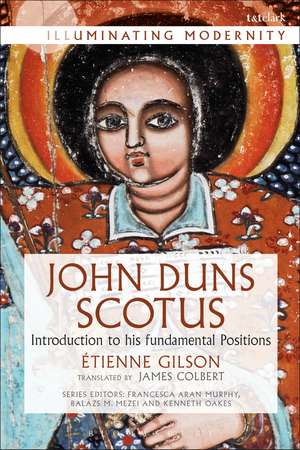
John Duns Scotus: Introduction to His Fundamental Positions: Illuminating Modernity
Traducere de Dr James Colbert Autor Etienne Gilsonen Limba Engleză Paperback – 25 iun 2020
Scotus contributed to the development of a metaphysical system that was compatible with Christian doctrine, an epistemology that altered the 13th century understanding of human knowledge, and a theology that stressed both divine and human will. Gilson, in turn, offers a thoroughly comprehensive introduction to the fundamental positions that Scotus stood for. Explaining Scotus's views on metaphysics, the existence of infinite being and divine nature, the matter of the physical spiritual and angelic, intellectual knowledge and will and Scotus' relationship with other scholars, Gilson and Colbert show how deeply Scotus left a mark on discussions of such disparate topics as the semantics of religious language, the problem of universals, divine illumination, and the nature of human freedom.
This work has been translated from the original work in French Jean Duns Scot. Introduction à ses positions fondamentales (© 1952 by Librairie Philosophique J. Vrin).
| Toate formatele și edițiile | Preț | Express |
|---|---|---|
| Paperback (1) | 244.47 lei 6-8 săpt. | |
| Bloomsbury Publishing – 25 iun 2020 | 244.47 lei 6-8 săpt. | |
| Hardback (1) | 1035.43 lei 6-8 săpt. | |
| Bloomsbury Publishing – 27 dec 2018 | 1035.43 lei 6-8 săpt. |
Preț: 244.47 lei
Preț vechi: 319.97 lei
-24%
Puncte Express: 367
Preț estimativ în valută:
43.29€ • 50.56$ • 37.61£
43.29€ • 50.56$ • 37.61£
Carte tipărită la comandă
Livrare economică 21 februarie-07 martie
Preluare comenzi: 021 569.72.76
Specificații
ISBN-13: 9780567695253
ISBN-10: 0567695255
Pagini: 632
Dimensiuni: 152 x 232 x 36 mm
Greutate: 1.04 kg
Editura: Bloomsbury Publishing
Colecția T&T Clark
Seria Illuminating Modernity
Locul publicării:London, United Kingdom
ISBN-10: 0567695255
Pagini: 632
Dimensiuni: 152 x 232 x 36 mm
Greutate: 1.04 kg
Editura: Bloomsbury Publishing
Colecția T&T Clark
Seria Illuminating Modernity
Locul publicării:London, United Kingdom
Cuprins
Foreword
Translator's Preface
Preface
Chapter 1: The Object of Metaphysics
Chapter 2: The Existence of Infinite Being
Chapter 3: The Divine Nature
Chapter 4: Origin of the Contingent
Chapter 5: Angels
Chapter 6: Matter
Chapter 7: The Human Soul
Chapter 8: Intellectual Knowledge
Chapter 9: The Will
Chapter 10: Duns Scotus and the Philosophers
Appendices
A, Bibliographical Information
B, Biographical Information
C. Alphabetum Scoti
Afterword: The Dissolution of Divine Government: Gilson and the 'Scotus Story'
Bibliography
Index of Names
Index of Terms
Translator's Preface
Preface
Chapter 1: The Object of Metaphysics
Chapter 2: The Existence of Infinite Being
Chapter 3: The Divine Nature
Chapter 4: Origin of the Contingent
Chapter 5: Angels
Chapter 6: Matter
Chapter 7: The Human Soul
Chapter 8: Intellectual Knowledge
Chapter 9: The Will
Chapter 10: Duns Scotus and the Philosophers
Appendices
A, Bibliographical Information
B, Biographical Information
C. Alphabetum Scoti
Afterword: The Dissolution of Divine Government: Gilson and the 'Scotus Story'
Bibliography
Index of Names
Index of Terms
Recenzii
This classic book offers a way of understanding Scotus, as well as contemporary interpretations of Scotus. In his Preface, Gilson cautions that 'it is always imprudent to extract in Scotus's name consequences that he has not deduced.' The timeliness of this warning--which henceforth I intend to heed--makes clear the importance of this translation.
At long last we have a highly readable translation of Étienne Gilson's Jean Duns Scot. This book is utterly indispensable for three reasons. First, it offers a lucid introduction to the most important medieval thinker after Aquinas; secondly, it illuminates the thought of the most prominent mediaevalist of the 20th century; and thirdly, John Milbank's interpretative Afterword is a genuine masterclass in its own right.
Why translate into English today a six hundred eighty-page history of a medieval author's treatment of diverse metaphysical issues, published in French back in 1952? Probably for many of the same reasons that this work was translated into Italian only in 2007. Gilson's original Preface and the translator's Appendices provide the perspective to see the worth of translating the mammoth text: together they all offer an invitation to pursue today a deeper understanding of Scotus's collection of metaphysical themes.
.Colbert delivers to English readers a translation of a difficult and expansive book. This translation is not only lucidly rendered, as well as faithful to Gilson; it is also a deeply learned volume. Colbert distinguishes this translation throughout by profound immersion in the complex theology and philosophy of Duns Scots-and of medieval scholastic thought in general. For the herculean effort, assiduity, and deep erudition that this volume required, [.] readers of Gilson and of Scotus, as well as historian of medieval Christian history and thought, owe Colbert their enthusiasm and gratitude.
At long last we have a highly readable translation of Étienne Gilson's Jean Duns Scot. This book is utterly indispensable for three reasons. First, it offers a lucid introduction to the most important medieval thinker after Aquinas; secondly, it illuminates the thought of the most prominent mediaevalist of the 20th century; and thirdly, John Milbank's interpretative Afterword is a genuine masterclass in its own right.
Why translate into English today a six hundred eighty-page history of a medieval author's treatment of diverse metaphysical issues, published in French back in 1952? Probably for many of the same reasons that this work was translated into Italian only in 2007. Gilson's original Preface and the translator's Appendices provide the perspective to see the worth of translating the mammoth text: together they all offer an invitation to pursue today a deeper understanding of Scotus's collection of metaphysical themes.
.Colbert delivers to English readers a translation of a difficult and expansive book. This translation is not only lucidly rendered, as well as faithful to Gilson; it is also a deeply learned volume. Colbert distinguishes this translation throughout by profound immersion in the complex theology and philosophy of Duns Scots-and of medieval scholastic thought in general. For the herculean effort, assiduity, and deep erudition that this volume required, [.] readers of Gilson and of Scotus, as well as historian of medieval Christian history and thought, owe Colbert their enthusiasm and gratitude.