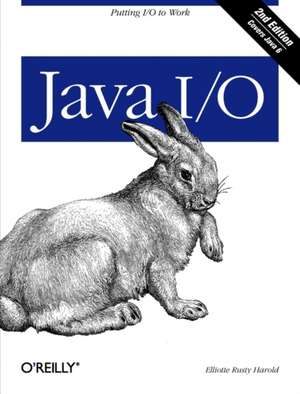
Java I/O
Autor Elliotte Rusty Harolden Limba Engleză Paperback – 20 iun 2006
Prin parcurgerea acestui manual tehnic, cititorul va implementa sisteme robuste de gestionare a fluxurilor de date, capabile să proceseze informații complexe prin tehnici de compresie, criptare și formatare internațională. Descoperim aici o analiză exhaustivă a bibliotecii standard Java, unde Elliotte Rusty Harold descompune universul stream-urilor în patru piloni fundamentali: fluxurile de intrare și ieșire pentru date binare, respectiv cititoarele și scriitoarele pentru date textuale. Considerăm esențial focusul pe eficiență, autorul explicând cum utilizarea corectă a stream-urilor cu buffer poate optimiza performanța aplicațiilor. Mai mult, lucrarea oferă soluții practice pentru provocările moderne ale programării, precum manipularea datelor criptate prin CipherInputStream sau automatizarea compresiei cu ZipOutputStream. Pe linia practică a volumului Java I/O, NIO and NIO.2 de Jeff Friesen, această carte se concentrează pe fundamentele fluxurilor clasice și pe stăpânirea seturilor de caractere Unicode, facilitând scrierea de software multilingv într-o eră a globalizării. Reținem că această ediție a doua reprezintă o piesă centrală în bibliografia autorului, făcând puntea între Java Network Programming și XML in a Nutshell. Dacă în lucrările despre rețelistică Harold se concentra pe transportul datelor, aici detaliază mecanica internă a acestora, oferind precizia tehnică necesară pentru a controla formatarea numerică și textuală la cel mai înalt nivel. Structura este una de referință, transformând un subiect arid într-un ghid aplicat, indispensabil pentru dezvoltatorii care au depășit stadiul de începător, așa cum este prezentat în Core Java.
Preț: 378.93 lei
Preț vechi: 473.66 lei
-20%
Carte tipărită la comandă
Livrare economică 23 noiembrie-07 decembrie
Specificații
ISBN-10: 0596527500
Pagini: 726
Dimensiuni: 179 x 236 x 37 mm
Greutate: 1.06 kg
Ediția:2nd edition
Editura: O'Reilly
Locul publicării:United States
V-ar putea interesa
-
 Thinking in JavaBruce Eckel-20%Preț: 406.17 lei507.71 lei
 -
 Effective JavaJoshua Bloch-20%Preț: 322.10 lei402.63 lei
 -
 Core Java for the ImpatientCay Horstmann-20%Preț: 364.02 lei455.03 lei
 -
 -20%Preț: 496.58 lei620.72 lei
 -
 Java Server and Servlets: Building portable web applicationsPeter Rossbach-20%Preț: 326.32 lei407.90 lei
 -
 Internet & World Wide Web: How to ProgramHarvey Deitel-20%Preț: 605.11 lei756.38 lei
 -
 Java Concurrency in PracticeBrian Goetz-20%Preț: 294.27 lei367.84 lei
 -
 Programming Language PragmaticsMichael Scott-40%Preț: 488.02 lei808.04 lei
 -
 Java SecurityScott Oaks-20%Preț: 336.84 lei421.05 lei
 -
 Data Structures and Algorithms in JavaRobert Lafore-20%Preț: 352.37 lei440.46 lei
 -
 -20%Preț: 316.22 lei395.27 lei
 -
 -20%Preț: 234.45 lei293.07 lei
 -
 Java: The Complete Reference, Thirteenth EditionHerbert Schildt-34%Preț: 297.59 lei450.22 lei
 -
 -20%Preț: 441.34 lei551.67 lei
 -
 Java Essentials for DummiesDoug Lowe-20%Preț: 78.97 lei98.70 lei
 -
 Java Network ProgrammingElliotte Rusty Harold-20%Preț: 283.18 lei353.98 lei
 -
 Kafka Streams in Action, Second EditionBill Bejeck-20%Preț: 344.92 lei431.16 lei
 -
 Troubleshooting Java, Second EditionLaurentiu Spilca-20%Preț: 407.57 lei509.47 lei
De ce să citești această carte
Recomandăm această carte programatorilor Java care doresc să stăpânească fluxurile de date dincolo de elementele de bază. Veți câștiga expertiză în manipularea eficientă a fișierelor, criptarea stream-urilor și suportul pentru internaționalizare. Este un instrument esențial pentru oricine dezvoltă aplicații ce necesită procesare intensivă de date sau comunicare securizată, oferind soluții concrete pentru optimizarea performanței I/O.
Despre autor
Elliotte Rusty Harold este un autor și conferențiar recunoscut în industria software, originar din New Orleans și stabilit în Brooklyn. Este o figură proeminentă în comunitatea open-source, fiind creatorul bibliotecii XOM pentru procesarea XML în Java. Expertiza sa vastă se reflectă în numeroasele titluri publicate la editura O'Reilly, unde abordează teme complexe precum programarea de rețea, API-urile de mail și standardele XML, fiind un vorbitor frecvent la conferințe de prestigiu precum Software Development și Dr. Dobb's Architecture & Design World.
Descriere scurtă
A discussion of I/O wouldn't be complete without treatment of character sets and formatting. Java supports the Unicode standard, which provides definitions for the character sets of most written languages. Consequently, Java is the first programming language that lets you do I/O in virtually any language. Java also provides a sophisticated model for formatting textual and numeric data. Java I/O, 2nd Edition shows you how to control number formatting, use characters aside from the standard (but outdated) ASCII character set, and get a head start on writing truly multilingual software.
Java I/O, 2nd Edition includes:
- Coverage of all I/O classes and related classes
- In-depth coverage of Java's number formatting facilities and its support for international character sets