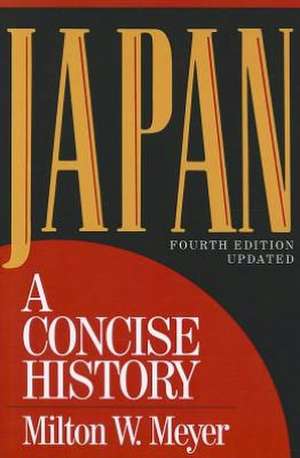
Japan: A Concise History
Autor Milton W. Meyeren Limba Engleză Paperback – 9 aug 2012
For all readers wanting to better understand this dynamic country, this popular and accessible introduction offers an authoritative yet concise overview of two thousand years of Japanese history. Now fully updated to the present, this edition also includes an array of photographs and illustrations. The first half of the book explores the pre-Meiji era up to 1868. The second half traces domestic changes and relevant foreign issues in the modernizing era launched by the Meiji Restoration. Highlighting key historical events, Milton W. Meyer also includes cultural, artistic, and religious milestones. Summaries and datelines at the end of each chapter, as well as a glossary, offer additional essential reference points. With its clear explanations of Japanese traditions, religion, history, economics, politics, and relations with the West, this book provides an invaluable guide for understanding contemporary Japan.
Preț: 349.92 lei
Preț vechi: 464.76 lei
-25%
Puncte Express: 525
Carte tipărită la comandă
Livrare economică 07-21 decembrie
Livrare prin curier în România Termenul estimat este afișat lângă disponibilitate.
Transport gratuit de la 400.00 lei Plată online sau ramburs, în funcție de opțiunile comenzii.
Retur gratuit în 14 zile Comandă securizată și suport în română.
Specificații
ISBN-13: 9780742541184
ISBN-10: 0742541185
Pagini: 380
Ilustrații: illustrations
Dimensiuni: 150 x 232 x 24 mm
Greutate: 0.62 kg
Ediția:Fourth Updated
Editura: Bloomsbury Publishing
Colecția Rowman & Littlefield
Locul publicării:New York, United States
ISBN-10: 0742541185
Pagini: 380
Ilustrații: illustrations
Dimensiuni: 150 x 232 x 24 mm
Greutate: 0.62 kg
Ediția:Fourth Updated
Editura: Bloomsbury Publishing
Colecția Rowman & Littlefield
Locul publicării:New York, United States
Cuprins
Chapter 1: Introducing Japan
Part I: Traditional Japan: Prehistory to 1185
Chapter 2: Ancient Japan (to ca. 400 CE)
Chapter 3: Yamato Japan (ca. 400-700)
Chapter 4: Nara Japan (710-794)
Chapter 5: Heian Japan (794-1185)
Part II: Feudal Japan (1185-1868)
Chapter 6: Kamakuru Japan (1185-1333)
Chapter 7: Ashikaga Japan (1333-1603)
Chapter 8: Tokugawa Japan (1603-1868): Stability
Chapter 9: Tokugawa Japan: Change
Chapter 10: Tokugawa Japan: Western Intrusion
Part III: Modern Japan (1868-1945)
Chapter 11: Meiji Japan (1868-1912): Politics
Chapter 12: Meiji Japan: Economics and Society
Chapter 13: Meiji Japan: Foreign Relations
Chapter 14: Imperial Japan: World Power (1912-1922)
Chapter 15: Imperial Japan: Peace and Conflict (1922-1937)
Chapter 16: Imperial Japan: World War II (1937-1945)
Part IV: Postwar Japan (1945 to Present)
Chapter 17: Occupied Japan (1945-1952)
Chapter 18: Contemporary Japan (Since 1952): Domestic Affairs-Politics
Chapter 19: Contemporary Japan: Domestic Affairs-Economics and Society
Chapter 20: Contemporary Japan: Foreign Affairs
Part I: Traditional Japan: Prehistory to 1185
Chapter 2: Ancient Japan (to ca. 400 CE)
Chapter 3: Yamato Japan (ca. 400-700)
Chapter 4: Nara Japan (710-794)
Chapter 5: Heian Japan (794-1185)
Part II: Feudal Japan (1185-1868)
Chapter 6: Kamakuru Japan (1185-1333)
Chapter 7: Ashikaga Japan (1333-1603)
Chapter 8: Tokugawa Japan (1603-1868): Stability
Chapter 9: Tokugawa Japan: Change
Chapter 10: Tokugawa Japan: Western Intrusion
Part III: Modern Japan (1868-1945)
Chapter 11: Meiji Japan (1868-1912): Politics
Chapter 12: Meiji Japan: Economics and Society
Chapter 13: Meiji Japan: Foreign Relations
Chapter 14: Imperial Japan: World Power (1912-1922)
Chapter 15: Imperial Japan: Peace and Conflict (1922-1937)
Chapter 16: Imperial Japan: World War II (1937-1945)
Part IV: Postwar Japan (1945 to Present)
Chapter 17: Occupied Japan (1945-1952)
Chapter 18: Contemporary Japan (Since 1952): Domestic Affairs-Politics
Chapter 19: Contemporary Japan: Domestic Affairs-Economics and Society
Chapter 20: Contemporary Japan: Foreign Affairs
Recenzii
Meyer succeeds in compacting a truly impressive mass of information. The format he uses features brevity but never paucity of data. He manages to incorporate useful Japanese phrases for specialists without wasting the general reader's time with detailed explanations. His chapter on contemporary politics shows all his strengths.