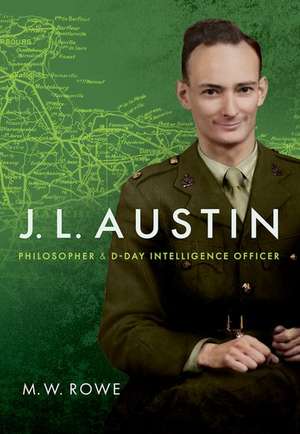
J. L. Austin: Philosopher and D-Day Intelligence Officer
Autor M. W. Roween Limba Engleză Hardback – 11 mai 2023
Preț: 282.85 lei
Preț vechi: 306.16 lei
-8%
Puncte Express: 424
Carte disponibilă
Livrare economică 19-24 noiembrie
Livrare express 30 octombrie-05 noiembrie pentru 104.27 lei
Livrare prin curier în România Termenul estimat este afișat lângă disponibilitate.
Transport gratuit de la 400.00 lei Plată online sau ramburs, în funcție de opțiunile comenzii.
Retur gratuit în 14 zile Comandă securizată și suport în română.
Specificații
ISBN-13: 9780198707585
ISBN-10: 0198707584
Pagini: 682
Ilustrații: 24 black-and-white illustrations
Dimensiuni: 180 x 252 x 35 mm
Greutate: 1.5 kg
Editura: OUP OXFORD
Colecția OUP Oxford
Locul publicării:Oxford, United Kingdom
ISBN-10: 0198707584
Pagini: 682
Ilustrații: 24 black-and-white illustrations
Dimensiuni: 180 x 252 x 35 mm
Greutate: 1.5 kg
Editura: OUP OXFORD
Colecția OUP Oxford
Locul publicării:Oxford, United Kingdom
V-ar putea interesa
-
 In Search of Pink FlamingosSusan E. GreisenPreț: 104.32 lei
 -
 STILL STANDINGM. G. CrisciPreț: 111.08 lei
 -
 Mixed SignalsMR Garfield a. WrayPreț: 65.71 lei
 -
 Thoughts That Don't RhymeMarwa FarouqPreț: 81.56 lei
 -
 Memories of a Farmer's DaughterJennie PhelpsPreț: 96.69 lei
 -
 Der Graue WolfEwald StarkPreț: 105.69 lei
 -
 The Valley of Innocence LostDon HaugenPreț: 83.68 lei
 -
 Country Memories from a Lane CountianClarence L. MummaPreț: 181.73 lei
 -
 Silver RadioRobert I. WattsPreț: 97.80 lei
 -
 How to Be BraveHope GlennPreț: 116.46 lei
 -
 The Gene Pruitt LegacyLarry KaiserPreț: 98.83 lei
 -
 Tapestry of a SoulJean S. ChristianPreț: 93.57 lei
 -
 Worth a Hill of BeansDonald E. JonesPreț: 98.06 lei
 -
 Seven Love StoriesGary WaltersPreț: 90.21 lei
 -
 It Never Rained in the BronxSteven ChanzesPreț: 140.99 lei
 -
 The Story of KayMR Bj Haggerty IIPreț: 97.66 lei
 -
 Sheba and Solomon's ReturnNathan Moses Szajnberg MDPreț: 387.88 lei
 -
 Preț: 231.47 lei
 -
 Preț: 227.65 lei
 -
 Preț: 223.00 lei
 -
 Trapline ChatterNancy BeckerPreț: 141.10 lei
 -
 White Snake DiaryJane P. PerryPreț: 102.70 lei
 -
 The EscapistKarahn WashingtonPreț: 106.09 lei
 -
 Airborne WarfareJames Maurice GavinPreț: 192.25 lei
 -
 Kenny RogersKenneth RogersPreț: 83.31 lei
 -
 TWO LIFETIMES AS ONEIrving G. TragenPreț: 336.60 lei
Recenzii
Scrupulous and engrossing
A revelatory work of intelligence history, ingeniously built from scattered and skimpy materials.
A superb biography...dense and readable.
Meticulously researched yet uncluttered ... philosophically illuminating.
[ Rowe's] research is so thorough, his exposition so meticulous and his presentation so clear that even the digressions are a delight
a marvellous book . . . thoroughly absorbing... First, it gives a detailed account of Austin's philosophical development, his background, his works and his academic career and influence, accompanied at each stage by interpretations and criticisms that are judicious and insightful. Rowe shows himself to be an excellent philosopher in his own right. Second, the book presents the results of Rowe's painstaking archival research on Austin's intelligence career, placing it in the context of British and Allied intelligence concerning Western Europe and North Africa. It gives a fascinating account of the way military intelligence is generated and the crucial role it plays in every military operation... Third, Rowe offers a perceptive analysis of Austin's personal qualities and their part in his academic and military engagements.
well-researched, and admirably written intellectual biography.
This is a magnificent biography, balanced, comprehensive, and meticulously researched. It reconstructs the life of a scholar whose analyses helped shape mid-twentieth-century British philosophy; and it traces the work of an intelligence officer whose analyses helped save tens of thousands of lives.
M. W. Rowe's compendious biography of J. L. Austin (1911-60), at least a decade in the making, can justifiably be described as long-awaited. Its more than 600 pages contain more than enough in the way of fact and interpretation to vindicate handsomely the time and labour that have gone into it. The book contains a wealth of biographical detail, extended quotations from correspondence and archival material that are not widely known and efficient synopses of Austin's philosophical writings. These elements alone render the book indispensable to any philosopher or historian interested in Austin's life, his times and, of course, his philosophical themes - among other things, perception, the theory of 'speech acts' and the role of language in philosophy.
Rowe has written a superb historical and intellectual biographyof Austin. It is a marvellous achievement, and everyone should read the book.
This is a terrific, massively impressive work. The text is an extremely well-judged and exhaustively detailed (potentially exhaustingly detailed for some readers) treatment of Austin's philosophical and military contributions. I recommend J.L. Austin in the highest possible terms.
A revelatory work of intelligence history, ingeniously built from scattered and skimpy materials.
A superb biography...dense and readable.
Meticulously researched yet uncluttered ... philosophically illuminating.
[ Rowe's] research is so thorough, his exposition so meticulous and his presentation so clear that even the digressions are a delight
a marvellous book . . . thoroughly absorbing... First, it gives a detailed account of Austin's philosophical development, his background, his works and his academic career and influence, accompanied at each stage by interpretations and criticisms that are judicious and insightful. Rowe shows himself to be an excellent philosopher in his own right. Second, the book presents the results of Rowe's painstaking archival research on Austin's intelligence career, placing it in the context of British and Allied intelligence concerning Western Europe and North Africa. It gives a fascinating account of the way military intelligence is generated and the crucial role it plays in every military operation... Third, Rowe offers a perceptive analysis of Austin's personal qualities and their part in his academic and military engagements.
well-researched, and admirably written intellectual biography.
This is a magnificent biography, balanced, comprehensive, and meticulously researched. It reconstructs the life of a scholar whose analyses helped shape mid-twentieth-century British philosophy; and it traces the work of an intelligence officer whose analyses helped save tens of thousands of lives.
M. W. Rowe's compendious biography of J. L. Austin (1911-60), at least a decade in the making, can justifiably be described as long-awaited. Its more than 600 pages contain more than enough in the way of fact and interpretation to vindicate handsomely the time and labour that have gone into it. The book contains a wealth of biographical detail, extended quotations from correspondence and archival material that are not widely known and efficient synopses of Austin's philosophical writings. These elements alone render the book indispensable to any philosopher or historian interested in Austin's life, his times and, of course, his philosophical themes - among other things, perception, the theory of 'speech acts' and the role of language in philosophy.
Rowe has written a superb historical and intellectual biographyof Austin. It is a marvellous achievement, and everyone should read the book.
This is a terrific, massively impressive work. The text is an extremely well-judged and exhaustively detailed (potentially exhaustingly detailed for some readers) treatment of Austin's philosophical and military contributions. I recommend J.L. Austin in the highest possible terms.
Notă biografică
M. W. Rowe is an Honorary Researcher in Philosophy at the University of East Anglia (UEA). He was educated at Cranbrook School and Cambridge and York Universities. He was formerly Head of English at Pocklington School, Yorkshire, Lecturer in Aesthetics at Birkbeck College, London, and Senior Lecturer in Philosophy at UEA. He is particularly interested in military history, linguistic philosophy, classical music, nineteenth- and twentieth-century literature, and the intersections between philosophy and literature. In addition to his work on J. L. Austin, he is currently supervising a recording of the complete works of Heinrich Wilhelm Ernst (1812-65).
Cuprins
- Part I: Pre-War
- 1: Origins: c. 1670-1911
- 2: Childhood: 1911-1924
- 3: Shrewsbury: 1924-1929
- 4: Balliol: 1929-1933
- 5: Philosophy in Oxford: 1918-1933
- 6: All Souls: 1933-1935
- 7: Collingwood, C. I. Lewis, and Aristotle: 1935-1938
- 8: The Brethren, Politics, and Wittgenstein: 1937-1940
- Part II: War
- 9: Jean and the Army: 1939-1941
- 10: MI14, Marriage, and North African Intelligence: 1941
- 11: Injury, Scotland, and the Desert War: 1941-1942
- 12: The Coming of the Martians: 1942
- 13: Norfolk House, Dieppe, and Torch: 1942
- 14: Skyscraper, Invade Mecum, and Exile: 1943
- 15: The Hunt for the V-Weapons: 1943-1944
- 16: At Peter Robinson's: 1943-1944
- 17: Towards D-Day: 1944
- 18: D-Day and the Battle of Normandy: 1944
- 19: Arnhem and the Ardennes: 1944-1945
- 20: War's End: 1945
- Part III: Post-War
- 21: Post-War Britain and Oxford: 1945-1947
- 22: 'Other Minds': 1946-1947
- 23: Ordinary Language Philosophy: 1947-1959
- 24: The Oral and the Written: 1947-1959
- 25: Sense and Sensibilia: 1947-1959
- 26: Truth and Logic: 1950-1952
- 27: White's Professor: 1952-1954
- 28: Domestic Life and the Americans: 1952-1954
- 29: Harvard and Speech-Acts: 1955
- 30: Abilities and Excuses: 1956-1957
- 31: Royaumont and Anscombe: 1958
- 32: California, Semantics, and Sound Symbolism: 1958-1959
- 33: Ayer, Scandinavia, and the Gellner Controversy: 1959
- 34: Final Illness: 1959-1960