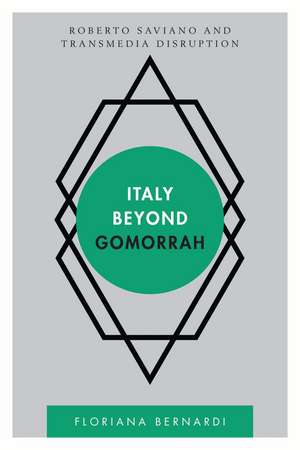
Italy beyond Gomorrah: Roberto Saviano and Transmedia Disruption
Autor Floriana Bernardien Limba Engleză Paperback – 10 aug 2017
Italy beyond Gomorrah investigates the conditions and modalities by which the huge media phenomenon developed around Roberto Saviano after the publication of Gomorrah and the ways in which this has engendered a political discourse starting from his 'denuncia' of the mechanisms of the modern mafia and its bosses. Focusing on Saviano's disruptive work and the representation of his 'charismatic body', redefining the figure and task of the modern intellectual, the book stresses the agency of literature and the relevance of the internet and major social networks in the creation of networks of subjectivities and establishing ethical-political duties which are grounded in a 'passional communication' between the writer and his audience, as well as on a micropolitics of affects. Through the interpretation of Saviano's work it also provides provide a cross sectional insight into Italy in the post-Berlusconi age.
| Toate formatele și edițiile | Preț | Express |
|---|---|---|
| Paperback (1) | 296.33 lei 6-8 săpt. | |
| Bloomsbury Publishing – 10 aug 2017 | 296.33 lei 6-8 săpt. | |
| Hardback (1) | 726.04 lei 6-8 săpt. | |
| Bloomsbury Publishing – 24 aug 2017 | 726.04 lei 6-8 săpt. |
Preț: 296.33 lei
Preț vechi: 393.02 lei
-25%
Puncte Express: 444
Preț estimativ în valută:
52.39€ • 61.73$ • 45.68£
52.39€ • 61.73$ • 45.68£
Carte tipărită la comandă
Livrare economică 10-24 aprilie
Specificații
ISBN-13: 9781786600189
ISBN-10: 1786600188
Pagini: 224
Dimensiuni: 136 x 218 x 11 mm
Greutate: 0.19 kg
Editura: Bloomsbury Publishing
Colecția Rowman & Littlefield
Locul publicării:New York, United States
ISBN-10: 1786600188
Pagini: 224
Dimensiuni: 136 x 218 x 11 mm
Greutate: 0.19 kg
Editura: Bloomsbury Publishing
Colecția Rowman & Littlefield
Locul publicării:New York, United States
Cuprins
Introduction/ 1. Who is Saviano? Undecidability of an Intellectual-Popstar/ 2. Gomorrah: Event, (Con)Text, Reviews/ 3. Disseminations: the End Justifies the Media/ 4. People Have the Power: OltreGomorra and the Network Society/ Bibliography/ Index
Recenzii
In a detailed analysis of the media constructions and framing of Roberto Saviano's Gomorrah, Floriana Bernardi semiotically confronts the globally entangled politics and power of crime and corruption. Passionately argued, this incisive book contests the entrenched conservatism of Italian literary culture, finding in the deliberate discontinuity of the figure of Saviano an organic intellectual exposing the cultural and political crisis of the present.
Bernardi provides an authoritative and comprehensive account of the Saviano phenomenon that extends beyond either the content or critical success of Gomorrah to the author's status as intellectual, celebrity, popular icon and symbol of protest, demonstrating in the process the author's significant impact on Italian culture and politics through his interventions in journalism, television, radio, theatre, cinema and the Web.
Bernardi offers a very interesting perspective on the case of Roberto Saviano, analysing his figure as a writer, citizen journalist, and phenomenon of mass culture. Italy Beyond Gomorrah provides an original analysis of contemporary Italian culture in the international scenario.
Beyond Gomorrah is a compelling inquiry into the contemporary phenomena of author-branding. In her analysis of Roberto Saviano's public persona and the transmedia narratives that originated from his best-selling book, Bernardi engages with major figures in cultural studies and philosophy, including Hall, Foucault, and Derrida. Beyond Gomorrah, Bernardi's book is a timely contribution to the debate on intellectual engagement in the Third Millenium.
Who is Roberto Saviano? Those interested in learning (more) about the complexity of the 'Saviano Phenomenon' find answers in this interdisciplinary study that scrutinizes Saviano's transmedia interventions, his often-controversial engagement with civic issues, his national and global appeal. The author offers a thought-provoking analysis of this key intellectual figure and his impact on the contemporary Italian cultural scene.
This book is an original look at the Gomorrah cultural mass phenomenon, and at Roberto Saviano as a new example of a transmedia intellectual. It reconfigures and complicates the one-sided dimension through which Gomorrah and Saviano have been generally considered and discussed to date, particularly in Italy. Bernardi's analysis of Saviano's alterdisciplinary work compellingly shows how new forms of intellectual and critical engagement are possible within the contemporary multimedia ecosystem.
A timely and captivating reading of Roberto Saviano as a writer and media phenomenon, this book brilliantly illuminates how, after the publication of his bestseller Gomorrah (2006), Saviano's persona developed through the agency of literature and the relevance of his transmedia work, redefining values such as legality, ethical and political responsibility, and the figure and task of the modern intellectual.
The case of Roberto Saviano as "hero", "pop star", "brand", "media phenomenon" etc., as intelligently
analysed by Bernardi in her book, should not only interest scholars working on social semiotics and
cultural studies. It should also or especially be read and considered by scholars interested in the
public role of intellectuals, and particularly in the public role of sociologists and criminologists.
Bernardi provides an authoritative and comprehensive account of the Saviano phenomenon that extends beyond either the content or critical success of Gomorrah to the author's status as intellectual, celebrity, popular icon and symbol of protest, demonstrating in the process the author's significant impact on Italian culture and politics through his interventions in journalism, television, radio, theatre, cinema and the Web.
Bernardi offers a very interesting perspective on the case of Roberto Saviano, analysing his figure as a writer, citizen journalist, and phenomenon of mass culture. Italy Beyond Gomorrah provides an original analysis of contemporary Italian culture in the international scenario.
Beyond Gomorrah is a compelling inquiry into the contemporary phenomena of author-branding. In her analysis of Roberto Saviano's public persona and the transmedia narratives that originated from his best-selling book, Bernardi engages with major figures in cultural studies and philosophy, including Hall, Foucault, and Derrida. Beyond Gomorrah, Bernardi's book is a timely contribution to the debate on intellectual engagement in the Third Millenium.
Who is Roberto Saviano? Those interested in learning (more) about the complexity of the 'Saviano Phenomenon' find answers in this interdisciplinary study that scrutinizes Saviano's transmedia interventions, his often-controversial engagement with civic issues, his national and global appeal. The author offers a thought-provoking analysis of this key intellectual figure and his impact on the contemporary Italian cultural scene.
This book is an original look at the Gomorrah cultural mass phenomenon, and at Roberto Saviano as a new example of a transmedia intellectual. It reconfigures and complicates the one-sided dimension through which Gomorrah and Saviano have been generally considered and discussed to date, particularly in Italy. Bernardi's analysis of Saviano's alterdisciplinary work compellingly shows how new forms of intellectual and critical engagement are possible within the contemporary multimedia ecosystem.
A timely and captivating reading of Roberto Saviano as a writer and media phenomenon, this book brilliantly illuminates how, after the publication of his bestseller Gomorrah (2006), Saviano's persona developed through the agency of literature and the relevance of his transmedia work, redefining values such as legality, ethical and political responsibility, and the figure and task of the modern intellectual.
The case of Roberto Saviano as "hero", "pop star", "brand", "media phenomenon" etc., as intelligently
analysed by Bernardi in her book, should not only interest scholars working on social semiotics and
cultural studies. It should also or especially be read and considered by scholars interested in the
public role of intellectuals, and particularly in the public role of sociologists and criminologists.