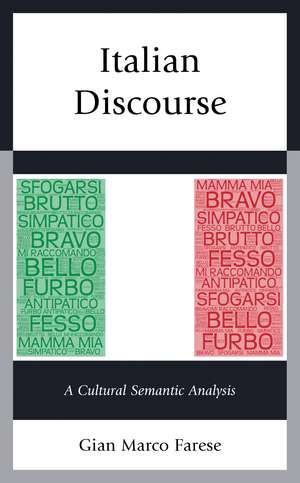
Italian Discourse: A Cultural Semantic Analysis
Autor Gian Marco Fareseen Limba Engleză Hardback – 21 oct 2019
Preț: 556.73 lei
Preț vechi: 837.96 lei
-34%
Puncte Express: 835
Carte tipărită la comandă
Livrare economică 24 noiembrie-08 decembrie
Livrare prin curier în România Termenul estimat este afișat lângă disponibilitate.
Transport gratuit pentru acest produs Plată online sau ramburs, în funcție de opțiunile comenzii.
Retur gratuit în 14 zile Comandă securizată și suport în română.
Specificații
ISBN-13: 9781793603166
ISBN-10: 1793603162
Pagini: 292
Ilustrații: 6 tables;
Dimensiuni: 160 x 228 x 26 mm
Greutate: 0.57 kg
Editura: Bloomsbury Publishing
Colecția Lexington Books
Locul publicării:New York, United States
ISBN-10: 1793603162
Pagini: 292
Ilustrații: 6 tables;
Dimensiuni: 160 x 228 x 26 mm
Greutate: 0.57 kg
Editura: Bloomsbury Publishing
Colecția Lexington Books
Locul publicării:New York, United States
V-ar putea interesa
-
 The Red-Hot Book of Spanish SlangMary McVey Gill-18%Preț: 168.26 lei205.27 lei
 -
 Preț: 117.13 lei
 -
 French Verbs & Essentials of Grammar, 2ESimone Oudot-13%Preț: 92.94 lei106.42 lei
 -
 Schaum's Outline of Chinese VocabularyYanping Xie-23%Preț: 168.30 lei219.87 lei
 -
 Schaum's Outline of German Vocabulary, 3edEdda Weiss-18%Preț: 170.98 lei209.50 lei
 -
 Schaum's Outline of Chinese GrammarClaudia Ross-18%Preț: 157.82 lei191.53 lei
 -
 Say It Right in ThaiNA EPLSPreț: 87.66 lei
 -
 Practice Makes Perfect French Past-Tense Verbs Up CloseAnnie HeminwayPreț: 100.13 lei
 -
 -11%Preț: 114.41 lei128.45 lei
 -
 Schaum's Easy Outline of Spanish, Second EditionConrad Schmitt-14%Preț: 86.98 lei101.14 lei
 -
 Perfect Phrases for ESL Everyday SituationsNatalie Gast-13%Preț: 96.97 lei111.79 lei
 -
 Better Reading Italian, 2nd EditionDaniela Gobetti-13%Preț: 119.21 lei136.80 lei
 -
 Side by Side Italian and English GrammarPaola Nanni-Tate-11%Preț: 109.21 lei122.62 lei
 -
 -18%Preț: 126.06 lei152.80 lei
 -
 German Vocabulary DrillsDavid Stillman-16%Preț: 149.32 lei178.71 lei
 -
 Applying Cognitive Linguistics to Second Language Learning and TeachingJeannette Littlemore-18%Preț: 747.59 lei911.69 lei
 -
 -18%Preț: 1127.04 lei1374.44 lei
 -
 Spanish Business Situations: A Spoken Language GuideMichael Gorman-18%Preț: 1109.92 lei1353.57 lei
 -
 Stannert, K: Impact Foundation: Workbook + WB Audio CDKatherine et al StannertPreț: 85.40 lei
 -
 -36%Preț: 730.77 lei1149.52 lei
 -
 Applied Linguistics Research and MethodologySanda Lucija Udier-23%Preț: 531.79 lei690.63 lei
 -
 Intercultural MasqueradeRegis MachartPreț: 382.81 lei
Cuprins
Contents
Acknowledgements
Chapter 1. Parlami e Ti Dirò Chi Sei
Chapter 2. Che Bello!
Chapter 3. Una Brutta Storia
Chapter 4. Italiani, Brava Gente
Chapter 5. Italiani Sapientoni
Chapter 6. Italiani Attori
Chapter 7. Italiani Comandanti
Chapter 8. Conclusione
Bibliography
Index
About the Author
Acknowledgements
Chapter 1. Parlami e Ti Dirò Chi Sei
Chapter 2. Che Bello!
Chapter 3. Una Brutta Storia
Chapter 4. Italiani, Brava Gente
Chapter 5. Italiani Sapientoni
Chapter 6. Italiani Attori
Chapter 7. Italiani Comandanti
Chapter 8. Conclusione
Bibliography
Index
About the Author
Recenzii
This is a courageous book. It shows how something as elusive as 'national character' can be subjected to empirical analysis, using a universal theory of communication to define Cultural Keywords of one specific culture. Using close logical argument, it skips nimbly through a minefield, avoiding the dangers of generalization and stereotype. This book sets a high standard of scientific rigor for any future conversation on the topic. Personally, I have been learning Italian for nearly fifty years and I loved this investigation by a native Italian speaker who writes in English to help me understand things I had intuited but never grasped so clearly before.
This book is a bold and original attempt to see Italian culture in the mirror of Italian cultural key words and associated "cultural scripts." I know of no other "language and culture" book which would be similarly rich in fresh observations and insights grounded in a careful analysis of word meanings. This highly readable and enjoyable book is a priceless resource for Italian language learners and an eye-opener for Italians themselves. It also provides an invaluable model for exploring cultural semantics of other languages and for teaching culture through language.
This book is a bold and original attempt to see Italian culture in the mirror of Italian cultural key words and associated "cultural scripts." I know of no other "language and culture" book which would be similarly rich in fresh observations and insights grounded in a careful analysis of word meanings. This highly readable and enjoyable book is a priceless resource for Italian language learners and an eye-opener for Italians themselves. It also provides an invaluable model for exploring cultural semantics of other languages and for teaching culture through language.