Cantitate/Preț
Produs

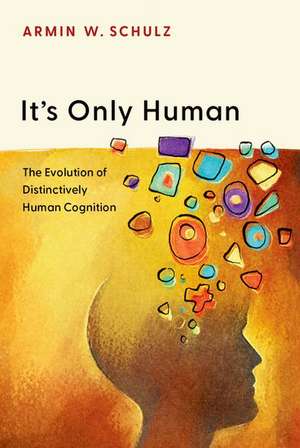
It's Only Human: The Evolution of Distinctively Human Cognition

Autor Armin W. Schulz
en Limba Engleză Hardback – 21 mai 2025

Considerăm că punctul forte al lucrării It's Only Human rezidă în modul în care Armin W. Schulz utilizează studiile de caz privind comerțul, moralitatea și religia pentru a demonstra cum mecanisme cognitive aparent simple au generat o complexitate socială unică. Autorul nu se limitează la teorie, ci aplică modelul său interacționist asupra unor dileme stringente, precum impactul inteligenței artificiale și relația dintre brevetele de invenție și progresul tehnologic. Din perspectiva structurii, textul reușește să sintetizeze trei piloni fundamentali: așteptările reprezentative evoluate, predispoziția pentru învățare culturală și utilizarea tehnologiei.

Această abordare reprezintă o evoluție firească a temelor explorate de Schulz în lucrări anterioare. Dacă în Efficient Cognition autorul argumenta eficiența luării deciziilor prin reprezentări mentale, iar în Structure, Evidence, and Heuristic evalua valoarea biologiei evoluționiste în economie, It's Only Human integrează aceste direcții într-o viziune unitară asupra minții umane. Recomandăm acest volum ca o alternativă la The Evolution of Human Cleverness pentru cursurile de filozofia minții sau antropologie cognitivă, având avantajul unei analize mai riguroase a buclelor de feedback tehnologic care lipsesc adesea din abordările pur biologice. Spre deosebire de Cognitive Adaptation, care pune accent pe agenție și animitate, Schulz oferă o perspectivă mai tehnică asupra modului în care cultura și tehnologia se auto-potențează. Stilul este unul academic precis, ancorat în filozofia științei, oferind o claritate conceptuală necesară înțelegerii saltului de la inteligența animală la civilizația umană.

Citește tot Restrânge

Preț: 41283 lei

Preț vechi: 59749 lei
-31%

Puncte Express: 619

Carte disponibilă

Livrare economică 07-13 mai


Specificații

ISBN-13: 9780197800157
ISBN-10: 0197800157
Pagini: 272
Ilustrații: 8 b/w illustrations
Dimensiuni: 149 x 217 x 29 mm
Greutate: 0.39 kg
Editura: Oxford University Press
Colecția OUP USA
Locul publicării:New York, United States

De ce să citești această carte

Recomandăm această carte cititorilor care doresc să înțeleagă mecanismele evolutive din spatele comportamentelor umane complexe. Veți câștiga o perspectivă nouă asupra modului în care tehnologia și cultura ne-au modelat creierul, nu doar invers. Este o lectură esențială pentru studenții și cercetătorii din domeniul științelor cognitive și filozofiei, oferind instrumente teoretice pentru a evalua viitorul interacțiunii dintre om și inteligența artificială.


Despre autor

Armin W. Schulz este un cercetător recunoscut în domeniul filozofiei științei și filozofiei minții, cu un interes marcat pentru biologia evoluționistă și economia politică. Opera sa se distinge prin rigoarea cu care aplică modelele biologice în științele sociale, fapt demonstrat în volume precum Presentist Social Functionalism. Prin contribuțiile sale la Oxford University Press, Schulz s-a stabilit ca o voce importantă în analiza eficienței cognitive și a fundamentelor evolutive ale comportamentului social uman.


Descriere

What makes humans cognitively unique, and why are we unique in these ways? Armin W. Schulz suggests that the singularity of our ways of thinking is based in a positive feedback loop that joins innate representations, forms of cultural learning, and technology. This feedback loop explains a number of key applications of our cognitive abilities, from our industriousness through trade, our conceptions of morality, and our ability to engage with the thoughts of others. Discussing the evolution of human cognition is complicated by the fact that it must be recognized to be multi-dimensional, culturally variable, and only differing in degree from non-human cognition. Taking this complexity into account, Schulz develops an interactionist theory of the evolution and nature of distinctively human cognition. At the core of this theory is the idea that underlying human cognitive uniqueness is a complex, interlocking interplay between three different elements: (1) a set of evolved representational expectations; (2) a pronounced disposition for cultural learning, and (3) complex and variegated technology. All three are further underwritten by a unique set of lower-level cognitive abilities, which are in turn influenced by the feedback loop created by the major three.With the help of this feedback loop, key examples of uniquely human cognition can be explained: distinctively human mindreading, distinctively human moral cognition, and the distinctively human propensity for trade. Schulz concludes with an application of this interactionist theory of distinctively human cognition to some issues of contemporary importance: the relationship between distinctively human cognition and increasingly sophisticated artificial intelligence, the role of religion in human thought and action, and the relationship between extensive patent regimes and human innovation.It's Only Human makes clear how human cognition can end up differing quite markedly from non-human cognition, even though its individual elements might initially and intrinsically only differ in relatively small degrees.

Recenzii

Armin Schulz offers a new deep history in It's Only Human: The Evolution of Distinctively Human Cognition. His core thesis is that distinctively human cognition emerged through positive feedback loops between three basic elements: cognitive representations, technology, and cultural learning. He develops his account through a range of case studies-the evolution of mindreading, morality, trade, religion, patents, and AI-each of which is interesting in its own right.

Notă biografică

Armin W. Schulz is an interdisciplinary researcher investigating what we can learn from linking evolutionary biology and the cognitive and social sciences. He completed his PhD in philosophy at the University of Wisconsin-Madison, studying evolutionary biology along the way. He has been a member of the Philosophy Department at University of Kansas since 2014.