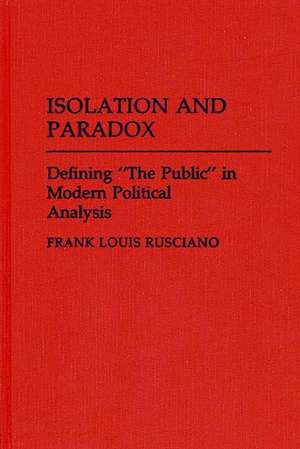
Isolation and Paradox
Autor Frank Louis Ruscianoen Limba Engleză Hardback – 26 iun 1989
Isolation and Paradox evolved from lectures and seminars delivered while Professor Rusciano was Visiting Professor at the Institut fur Publizistik at the University of Mainz, the German Federal Republic. Political and social scientists, as well as students in political theory, contemporary political analysis, comparative politics, public opinion, and political methodology will find this careful, logical study and its full complement of tables and charts necessary and informative reading.
Preț: 386.24 lei
Preț vechi: 631.53 lei
-39%
Puncte Express: 579
Carte tipărită la comandă
Livrare economică 25 decembrie 26 - 08 ianuarie 27
Livrare prin curier în România Termenul estimat este afișat lângă disponibilitate.
Transport gratuit de la 400.00 lei Plată online sau ramburs, în funcție de opțiunile comenzii.
Retur gratuit în 14 zile Comandă securizată și suport în română.
Specificații
ISBN-13: 9780313264924
ISBN-10: 0313264929
Pagini: 192
Dimensiuni: 161 x 240 x 15 mm
Greutate: 0.41 kg
Editura: Praeger
ISBN-10: 0313264929
Pagini: 192
Dimensiuni: 161 x 240 x 15 mm
Greutate: 0.41 kg
Editura: Praeger
V-ar putea interesa
-
 They Can't Kill Us AllWesley Lowery-18%Preț: 58.99 lei71.76 lei
-
 A System of RightsRex Martin-31%Preț: 736.62 lei1073.56 lei
-
 -27%Preț: 359.11 lei491.52 lei
-
 Peoples' RightsPhilip Alston-27%Preț: 367.29 lei501.76 lei
-
 -28%Preț: 393.86 lei548.42 lei
-
 The Oxford Handbook of American Public Opinion and the MediaRobert Y. Shapiro-17%Preț: 328.93 lei398.13 lei
-
 -30%Preț: 884.75 lei1261.44 lei
-
 -30%Preț: 642.41 lei915.49 lei
-
 Public Participation in Foreign PolicyJ. HeadleyPreț: 410.39 lei
-
 The Nature and Origins of Mass OpinionJohn R. ZallerPreț: 267.49 lei
-
 The 5000 Year LeapW Cleon SkousenPreț: 118.49 lei
-
 Prejudice - Its Social Psychology 2eRupert BrownPreț: 302.01 lei
-
 Nothing to Lose But Our FearFiona Jeffries-12%Preț: 123.34 lei140.81 lei
Descriere
The controlling idea for this study, and a major theme in classical and modern social analysis, is the distinction between public and private sectors in liberal societies. Professor Rusciano's purpose is to consider how the common ground defined by the use of the notion public in public opinion and public choice can lead to a revitalization of the term in modern social analysis. In Chapter 1, the author shows that no public choice procedure may distinguish consistently between public and private issues, public and private goods, and public and private decision rules. He also shows that no procedure may consistently define the public realm implied by the term public choice. To illustrate this problem, the author scrutinizes three paradoxes of public choice: Arrow's General Possibility theorem, Olson's logic of collective action, and Barry's problem of legitimizing responsive choice procedures. Succeeding chapters discuss the definition of public advanced in Elisabeth Noelle-Neumann's spiral of silence theory of public opinion; elaborate on the notion of public and the Arrow problem; and apply the theorems derived from Noelle-Neumann's theory to the three paradoxes of public choice. Chapter 5 theoretically applies the argument developed in previous chapters to economic behavior through a critique of Fred Hirsch's Social Limits to Growth and to the problem of collective action. The chapter concludes with a formal model and three hypotheses which are tested in Chapters 6 and 7 through empirical analyses of classic problems in collective action and choice, and as models of a revised notion of social preference. Finally, the revised notion is illustrated by observations about consumer behavior, conventions of language, and the definitions and functions of social and state institutions.
Isolation and Paradox evolved from lectures and seminars delivered while Professor Rusciano was Visiting Professor at the Institut fur Publizistik at the University of Mainz, the German Federal Republic. Political and social scientists, as well as students in political theory, contemporary political analysis, comparative politics, public opinion, and political methodology will find this careful, logical study and its full complement of tables and charts necessary and informative reading.
Isolation and Paradox evolved from lectures and seminars delivered while Professor Rusciano was Visiting Professor at the Institut fur Publizistik at the University of Mainz, the German Federal Republic. Political and social scientists, as well as students in political theory, contemporary political analysis, comparative politics, public opinion, and political methodology will find this careful, logical study and its full complement of tables and charts necessary and informative reading.
Notă biografică
FRANK LOUIS RUSCIANO is Assistant Professor of Political Science at Rider College.