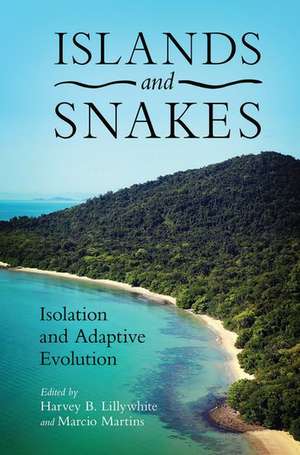
Islands and Snakes: Isolation and Adaptive Evolution
Editat de Harvey Lillywhite, Marcio Martinsen Limba Engleză Hardback – 13 aug 2019
Preț: 827.51 lei
Preț vechi: 1027.38 lei
-19%
Puncte Express: 1241
Carte tipărită la comandă
Livrare economică 03-09 decembrie
Livrare prin curier în România Termenul estimat este afișat lângă disponibilitate.
Transport gratuit pentru acest produs Plată online sau ramburs, în funcție de opțiunile comenzii.
Retur gratuit în 14 zile Comandă securizată și suport în română.
Specificații
ISBN-13: 9780190676414
ISBN-10: 0190676418
Pagini: 360
Dimensiuni: 160 x 236 x 20 mm
Greutate: 0.73 kg
Editura: Oxford University Press
Colecția OUP USA
Locul publicării:New York, United States
ISBN-10: 0190676418
Pagini: 360
Dimensiuni: 160 x 236 x 20 mm
Greutate: 0.73 kg
Editura: Oxford University Press
Colecția OUP USA
Locul publicării:New York, United States
Recenzii
This fascinating book is highly recommended
Martins and Lillywhite's meta-analysis of snakes on islands includes several factors that would appeal to most students of island including the size and distance of the island from the mainland, species richness, diversity, andinstances of endemism. In many cases their compiled data support the traditional paradigms, thereby providing the reader a reassuring comfort...The taxonomic coverage is broad and includes boids, elapids, viperids, colubrids, and less well-studied clades, such as blind snakes and aquatic file snakes. The reader is assumed to have a working knowledge of the overall taxonomic layout of the snake families and subfamilies, as well as some of the most common genera therein.
Bottom line: The book is well written by all the authors, the pictures are for the most part quite good, and the information is fun and exciting. BUY IT!
Making this book a must-read for everybody interested in snakes on islands.
Martins and Lillywhite's meta-analysis of snakes on islands includes several factors that would appeal to most students of island including the size and distance of the island from the mainland, species richness, diversity, andinstances of endemism. In many cases their compiled data support the traditional paradigms, thereby providing the reader a reassuring comfort...The taxonomic coverage is broad and includes boids, elapids, viperids, colubrids, and less well-studied clades, such as blind snakes and aquatic file snakes. The reader is assumed to have a working knowledge of the overall taxonomic layout of the snake families and subfamilies, as well as some of the most common genera therein.
Bottom line: The book is well written by all the authors, the pictures are for the most part quite good, and the information is fun and exciting. BUY IT!
Making this book a must-read for everybody interested in snakes on islands.
Notă biografică
Harvey B. Lillywhite is a Professor of Biology at the University of Florida, Gainesville. He has published numerous scientific articles on snakes, including those living on islands in many parts of the world. His research has been featured in Science, Nature, Scientific American, Natural History, Proceedings of the Royal Society, and many other publications. He is author of the book How Snakes Work, published by Oxford University Press in 2014. Marcio Martins is a Professor of Ecology at the University of São Paulo, Brazil. He has published numerous scientific articles on the natural history, ecology, evolution and conservation of frogs and snakes, including studies on island snakes from Brazil and Mexico. His research has been featured in Nature Ecology & Evolution, Biological Conservation, Global Ecology and Biogeography, Oecologia, Proceedings of the Royal Society, and many other publications.