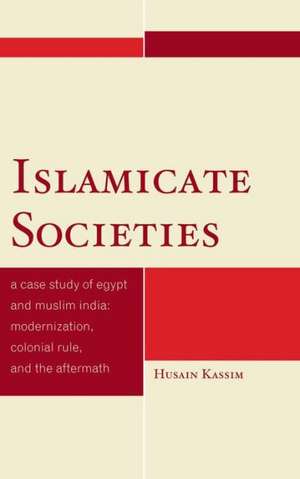
Islamicate Societies: A Case Study of Egypt and Muslim India Modernization, Colonial Rule, and the Aftermath
Autor Husain Kassimen Limba Engleză Hardback – 20 iul 2012
Preț: 592.78 lei
Preț vechi: 909.50 lei
-35%
Puncte Express: 889
Carte tipărită la comandă
Livrare economică 03-17 decembrie
Livrare prin curier în România Termenul estimat este afișat lângă disponibilitate.
Transport gratuit pentru acest produs Plată online sau ramburs, în funcție de opțiunile comenzii.
Retur gratuit în 14 zile Comandă securizată și suport în română.
Specificații
ISBN-13: 9780739165812
ISBN-10: 073916581X
Pagini: 143
Dimensiuni: 157 x 235 x 18 mm
Greutate: 0.36 kg
Editura: Bloomsbury Publishing
Colecția Lexington Books
Locul publicării:New York, United States
ISBN-10: 073916581X
Pagini: 143
Dimensiuni: 157 x 235 x 18 mm
Greutate: 0.36 kg
Editura: Bloomsbury Publishing
Colecția Lexington Books
Locul publicării:New York, United States
Descriere
The basic contention of this study is that the colonial rule had far more serious consequence than it has been realized. It radically transformed the nature of the Islamic societies of Egypt and Muslim India to that of an 'Islamicate'societies. This affected the religious, cultural, social, and legal aspects including ethnic and minority relations, gender relations and even their educational system. The phrase 'Islamicate' is here borrowed from Marshall Hodgson, who used it in his The Ventures of Islam to indicate the changes that took place due to the modernization under the impact of the West and colonial rule. However, our investigation takes it into a different direction, demonstrating how and what ways this phenomenon of the 'Islamicate' has changed the Islamic identity of Egypt and Muslim India. This study analyzes varied aspects such as religious, social, cultural, legal, and other aspects of the Egyptian and Muslim Indian societies through the mechanisms of change that the colonial rule brought to them.
Cuprins
Introduction: What this study is about
Chapter 1: The Historical Landscape of Egypt and Muslim India as Islamic Societies Prior to Colonial Rule
Chapter 2: Shifting Identities: The 'Islamicate' Societies of Egypt, Muslim India (Pakistan), Muslims in India, and its Aftermath
Chapter 3: Ethnicity and Minorities
Chapter 4: Transformation of Traditional Islamic Language and Literature into a Modern 'Islamicate' Literature
Chapter 5: Legal System and Judicial Institutions of Egypt and Muslim India
Chapter 6: Education, Educational System and Islamization Project of Knowledge
Chapter 7:An 'Islamicate' Woman: Gender Relations and Women's Rights
Chapter 1: The Historical Landscape of Egypt and Muslim India as Islamic Societies Prior to Colonial Rule
Chapter 2: Shifting Identities: The 'Islamicate' Societies of Egypt, Muslim India (Pakistan), Muslims in India, and its Aftermath
Chapter 3: Ethnicity and Minorities
Chapter 4: Transformation of Traditional Islamic Language and Literature into a Modern 'Islamicate' Literature
Chapter 5: Legal System and Judicial Institutions of Egypt and Muslim India
Chapter 6: Education, Educational System and Islamization Project of Knowledge
Chapter 7:An 'Islamicate' Woman: Gender Relations and Women's Rights
Recenzii
At a time when Islamic identities are contested in the Muslim world, Husain Kassim's Islamicate Societies argues that, in the cases of Egypt and Muslim India, insufficient attention has been paid to the impact of colonialism. Both modernizing trends that reject the colonial past and attempts to return to pre-colonial forms of Islamic identity are unlikely to succeed. With insight, Kassim sifts and sorts what a sound recovery of the colonial past entails for Islamic identities, a project with implications that reach far and wide within and beyond Muslim communities.
Professor Kassim's comparative study examines the process in which outside powers, through their colonial policies, change the internal dynamics of Muslims in India and Egypt. The book is an attempt to understand the transition from Islamic to Islamicate identity. The author's creative use of the term 'Islamicate' is most interesting and will surely cause healthy debates among scholars of Islam. As such, the book will surely be of interest to students of history, philosophy and sociology of Islam.
Husain Kassim's study is a much-needed analysis of the question of the relationship between culture, religion, and social structures within Egypt and India. His appropriation of the term "Islamicate" drives a wedge between religious accounts of society and accounts in which religion stands in for forces of modernization and colonialism. His thesis is provocative - that colonialism ushered in a transformation of Islamic social thought through the introduction of Western ideas and modern institutions, and this change produced a crisis of identity in these cultures. This crisis extends to every institution in society, from social and political to legal, cultural, and religious. The result, the 'Islamicate' society, is a new object of social and philosophical analysis and the basis for this compelling and persuasive comparative study. Kassim's synoptic historical and cultural analysis deserves close attention.
Professor Kassim's comparative study examines the process in which outside powers, through their colonial policies, change the internal dynamics of Muslims in India and Egypt. The book is an attempt to understand the transition from Islamic to Islamicate identity. The author's creative use of the term 'Islamicate' is most interesting and will surely cause healthy debates among scholars of Islam. As such, the book will surely be of interest to students of history, philosophy and sociology of Islam.
Husain Kassim's study is a much-needed analysis of the question of the relationship between culture, religion, and social structures within Egypt and India. His appropriation of the term "Islamicate" drives a wedge between religious accounts of society and accounts in which religion stands in for forces of modernization and colonialism. His thesis is provocative - that colonialism ushered in a transformation of Islamic social thought through the introduction of Western ideas and modern institutions, and this change produced a crisis of identity in these cultures. This crisis extends to every institution in society, from social and political to legal, cultural, and religious. The result, the 'Islamicate' society, is a new object of social and philosophical analysis and the basis for this compelling and persuasive comparative study. Kassim's synoptic historical and cultural analysis deserves close attention.