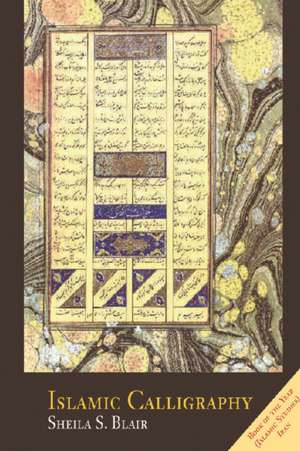
Islamic Calligraphy
Autor Sheila S Blairen Limba Engleză Paperback – 23 oct 2008
Apreciem Islamic Calligraphy ca fiind piesa centrală a oricărei biblioteci dedicate istoriei artei, un volum monumental de 720 de pagini publicat de EDINBURGH UNIVERSITY PRESS. Ne-a atras atenția rigoarea cu care Sheila S Blair abordează acest sistem complex, oferind cititorului un pachet complet de resurse: de la glosarul de termeni tehnici și lista de abrevieri, până la analize detaliate ale manuscriselor și contextul materialelor folosite. Spre deosebire de un ghid introductiv, acest volum funcționează ca un manual de referință care standardizează terminologia pentru stilurile caligrafice, facilitând identificarea precisă a execuției și provenienței. Structura cărții urmărește o progresie istorică și geografică logică. Începând cu principiile scrierii arabe și standardizarea timpurie a Coranului, autoarea ne ghidează prin ascensiunea stilurilor cursive din perioada medievală până la stilurile dinastice ale Safavizilor și Otomanilor. Acest parcurs este susținut vizual de peste 150 de ilustrații color, selectate strategic din exemple datate sigur pentru a evita confuzia cu falsurile medievale sau moderne. Considerăm că Islamic Calligraphy completează excelent titlul How to Read Islamic Calligraphy de Maryam Ekhtiar. În timp ce volumul lui Ekhtiar oferă o introducere accesibilă și vizuală pentru publicul larg, lucrarea Sheilei Blair adaugă profunzime academică și o analiză tehnică exhaustivă a evoluției scriptului. În contextul operei sale, această carte rafinează temele explorate în Iranian Art from the Sasanians to the Islamic Republic, mutând focusul de la diversitatea mediilor artistice către disciplina specifică și sacră a caligrafiei, considerată coloana vertebrală a civilizației islamice.
Preț: 467.91 lei
Preț vechi: 581.86 lei
-20%
Carte disponibilă
Livrare economică 13-27 noiembrie
Specificații
ISBN-10: 0748635408
Pagini: 720
Ilustrații: over 150 colour illustrations, over 100 b+w illustrations
Dimensiuni: 190 x 247 x 41 mm
Greutate: 2 kg
Editura: EDINBURGH UNIVERSITY PRESS
V-ar putea interesa
-
 Computers & Typesetting, Volume BDonald KnuthPreț: 510.07 lei
 -
 Shady CharactersKeith Houston-18%Preț: 77.01 lei94.21 lei
 -
 -23%Preț: 666.34 lei865.38 lei
 -
 Transforming Type: New Directions in Kinetic TypographyBarbara Brownie-24%Preț: 786.67 lei1039.25 lei
 -
 Type Specimens: A Visual History of Typesetting and PrintingProfessor Dori Griffin-5%Preț: 194.29 lei205.31 lei
 -
 Everyday Acts of Design: Learning in a Time of EmergencyZoy Anastassakis-21%Preț: 124.68 lei157.69 lei
 -
 -8%Preț: 432.12 lei469.70 lei
 -
 -23%Preț: 238.63 lei311.73 lei
 -
 Preț: 230.04 lei
 -
 Preț: 458.69 lei
De ce să citești această carte
Recomandăm această lucrare istoricilor de artă, colecționarilor și studenților care doresc să înțeleagă mecanismele din spatele celei mai înalte forme de expresie artistică islamică. Cititorul câștigă capacitatea de a distinge între stilurile regionale (precum cel mameluc sau otoman) și de a descifra calitatea unui manuscris prin analize vizuale ghidate. Este o resursă esențială pentru oricine caută o terminologie academică precisă și o perspectivă cronologică completă asupra caligrafiei arabe.
Despre autor
Sheila S Blair este o autoritate incontestabilă în domeniul artei islamice, fiind lăudată de specialiști de la universități de prestigiu precum Harvard și Edinburgh. Cu o carieră dedicată cercetării culturii vizuale din spațiul islamic, Blair s-a remarcat prin capacitatea de a sintetiza subiecte complexe în lucrări de referință. Opera sa, care include studii vaste despre arta iraniană și manuscrise iluminate, reflectă o expertiză profundă în interpretarea textelor și obiectelor de artă. Islamic Calligraphy, premiată în 2007, reprezintă apogeul cercetărilor sale asupra scrierii ca formă supremă de artă.
Descriere scurtă
'I can think of no one more qualified to produce such a volume... She is a recognised and highly-regarded expert in the field..' - Professor W. M. Thackston, Harvard University
This stunning book is an important contribution to a key area of non-western art, being the first reference work on art of beautiful writing in Arabic script.
The extensive use of writing is a hallmark of Islamic civilization. Calligraphy, the art of beautiful writing, became one of the main methods of artistic expression from the seventh century to the present in almost all regions from the far Maghrib, or Islamic West, to India and beyond. Arabic script was adopted for other languages from Persian and Turkish to Kanembu and Malay. Sheila Blair's groundbreaking book explains this art form to modern readers and shows them how to identify, understand and appreciate its varied styles and modes. The book is designed to offer a standardized terminology for identifying and describing various styles of Islamic calligraphy, and to help Westerners appreciate why calligraphy has long been so important in Islamic civilization.
The argument is enhanced by the inclusion of more than 150 colour illustrations, as well as over 100 black-and-white details that highlight the salient features of the individual scripts and hands. Examples are chosen from dated or datable examples with secure provenance, for the problem of forgeries and copies (both medieval and modern) is rampant. The illustrations are accompanied by detailed analyses telling the reader what to look for in determining both style and quality of script.
This beautiful book is an ideal reference for anyone with an interest in Islamic art.
Winner of the British-Kuwait Friendship Society Prize 2007.
Cuprins
List of Abbreviations
Glossary
Index
Part I: Introduction
Chapter 1: Arabic Script: Its Role and Principles
Chapter 2: Materials
Part II: The Development of Arabic Script in Early Islamic Times
Chapter 3: The Standardization of Arabic Script
Chapter 4: Early Manuscripts of the Koran
Part III: The Pre-Eminence of Round Scripts in the Early Middle Period
Chapter 5: The Adoption of Round Scripts
Chapter 6: The Proliferation of Round Scripts
Part IV: The Emergence of Regional Styles in the Later Middle Period
Chapter 7: Calligraphy in Iran and its Environs under the Mongols and Turkomans
Chapter 8: Rectilinear and Curvilinear Scripts in Egypt and Syria under the Mamluks
Chapter 9: Other Styles and Centers
Part V: Dynastic Styles in the Age of Empires
Chapter 10: The Safavids, the Qajars, and their Contemporaries in Iran and Central Asia
Chapter 11: The Ottomans in Anatolia, the Balkans, and the Eastern Mediterranean
Chapter 12: Other Styles and Centers
Part VI: The Many Faces of Islamic Calligraphy in Modern Times
Chapter 13: From Traditional Styles to Graphic Design and Calligraphic Art
Bibliography
Copyright Acknowledgements
Index