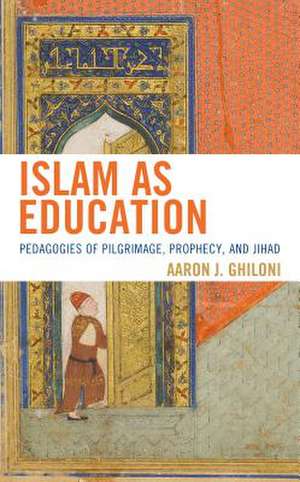
Islam as Education: Pedagogies of Pilgrimage, Prophecy, and Jihad
Autor Aaron J. Ghilonien Limba Engleză Hardback – aug 2019
Preț: 677.18 lei
Preț vechi: 1052.89 lei
-36%
Puncte Express: 1016
Carte tipărită la comandă
Livrare economică 19 noiembrie-03 decembrie
Livrare prin curier în România Termenul estimat este afișat lângă disponibilitate.
Transport gratuit pentru acest produs Plată online sau ramburs, în funcție de opțiunile comenzii.
Retur gratuit în 14 zile Comandă securizată și suport în română.
Specificații
ISBN-13: 9781978707597
ISBN-10: 1978707592
Pagini: 240
Ilustrații: 2 b/w photos;
Dimensiuni: 162 x 227 x 22 mm
Greutate: 0.48 kg
Editura: Bloomsbury Publishing
Colecția Fortress Academic
Locul publicării:New York, United States
ISBN-10: 1978707592
Pagini: 240
Ilustrații: 2 b/w photos;
Dimensiuni: 162 x 227 x 22 mm
Greutate: 0.48 kg
Editura: Bloomsbury Publishing
Colecția Fortress Academic
Locul publicării:New York, United States
Descriere
Motivated by the intellectual historian Shahab Ahmed's observation that "the history of Islamic paideia has yet to be written," Islam as Education explores multiple forms that the search for knowledge and the transmission of wisdom have taken in Islam, focusing on the classical period (800-1500 CE). Ghiloni draws on a wide range of Islamic primary source material, ranging from sacred texts and parables to neglected pedagogical literature and paintings. He depicts three Islamic religious practices-pilgrimage, prophecy, and jihad-as modes of pedagogy: embodied ways of defining, defusing, and defending sacred knowledge.
Islam as Education's educational heuristic not only aids in understanding Islam, but also provides guidance for intercultural and interreligious relations. Ghiloni argues that Islam's grand (knowledge) tradition serves as a bridge between Muslims and non-Muslims, and compares it with the educational theory of John Dewey, the celebrated American pragmatist. Based on this discussion, a final chapter develops practical tools for learning from cultural and religious difference.
Islam as Education's educational heuristic not only aids in understanding Islam, but also provides guidance for intercultural and interreligious relations. Ghiloni argues that Islam's grand (knowledge) tradition serves as a bridge between Muslims and non-Muslims, and compares it with the educational theory of John Dewey, the celebrated American pragmatist. Based on this discussion, a final chapter develops practical tools for learning from cultural and religious difference.
Cuprins
Part I: Paideia
1.Loving Knowledge
2.Civilizing Knowledge
3.Preserving and Adapting Knowledge
Part II: Pedagogies
Introduction to Part II
4.Seeking Knowledge: Pilgrimage
5.Defending Knowledge: Jihad
6.Limiting Knowledge: Prophecy
Conclusion: Knowledge from Difference
1.Loving Knowledge
2.Civilizing Knowledge
3.Preserving and Adapting Knowledge
Part II: Pedagogies
Introduction to Part II
4.Seeking Knowledge: Pilgrimage
5.Defending Knowledge: Jihad
6.Limiting Knowledge: Prophecy
Conclusion: Knowledge from Difference
Recenzii
Aaron Ghiloni succeeds in raising important insights that advance the ongoing practical theological conversation. . . Ghiloni opens exciting possibilities for including new interdisciplinary dimensions, as well as the potential for gaining layers of unanticipated insights from other religious traditions that have typically not been sufficiently explored. . . . Ghiloni certainly succeeds in reaching a broad audience interested in Islam, as well as specialist readers who are interested in the theory of education as a bridge to existing religious traditions. Moreover, he makes an important contribution by identifying the importance of an approach that remains rigorous, while simultaneously open for multiple perspectives 'even as far away as China', which certainly has the potential to enrich the field of practical theology with unexpected, yet significant new insights.
Aaron J. Ghiloni did not merely write a book, but crystallises a unique methodology of intellectual writing. . . . I found Ghiloni is like a bee, which collects pollen from every flower. He sought the wisdom of educational pedagogy in the East and West, then collected it from anywhere he could find it. His book does not neglect the heart, while also addressing the mind. . . . Islam as Education: Pedagogies of Pilgrimage, Prophecy, and Jihad sheds light on the discipline of educational pedagogy by injecting wisdom into a universal language of teaching. The book can be a handbook for any teacher or educator who believes in educational values. This book can trigger more research in the field of educational pedagogy.
Islam as Education: Pedagogies of Pilgrimage, Prophecy, and Jihad is a well-structured, uniquely written, valuable scholarly contribution to the fields of Islamic education, theology and intercultural communication. . . . Ghiloni's writing style is unique, almost as if a poet is posing as a theologian. . . . Ghiloni's work is a welcome addition to the fields of Islamic education, theology and intercultural communication. It is well-structured, very informative and delightfully written.
Islam as Education takes the reader from the West to the East on a sublime journey of discovery into the universal depths of educational philosophy. Aaron J. Ghiloni paves the way for building bridges between educational philosophy of Islam and enlightened philosophy of the West. He superbly illustrates Islam's pedagogical foundations of loving knowledge. Ghiloni travels on the journey along with the reader to seek the pearls of wisdom amidst the great ocean of knowledge. This is done with careful consideration of Islamic primary texts and scholarly works. This book connects the past to the present through the universal values of education.
Aaron J. Ghiloni pushes past the 'Islam versus the West' theme that has long dominated political and media narratives by presenting Islamic theology as a source of wisdom and insight with great potential to enhance Western educational philosophy and pedagogy. Islam as Education represents a substantial contribution to the ongoing scholarly conversations about the importance of learning from and across religious difference.
This book is original, meticulously researched, and lucidly presented. In a time when discussions on Islam remain highly politicised and polarising, it offers a promising and fresh perspective: an educational reading of Muslim tradition.Aaron Ghiloni's cross-disciplinary educational hermeneutics reveals the presence of a humanising pedagogic imagination at the heart of Muslim faith shaping its past civilizational expressions and, most significantly, capable of engaging with modern Western educational thought. A must read for anyone who wishes to deepen their understanding of Islam and its polyvalent traditions of education.
Aaron J. Ghiloni did not merely write a book, but crystallises a unique methodology of intellectual writing. . . . I found Ghiloni is like a bee, which collects pollen from every flower. He sought the wisdom of educational pedagogy in the East and West, then collected it from anywhere he could find it. His book does not neglect the heart, while also addressing the mind. . . . Islam as Education: Pedagogies of Pilgrimage, Prophecy, and Jihad sheds light on the discipline of educational pedagogy by injecting wisdom into a universal language of teaching. The book can be a handbook for any teacher or educator who believes in educational values. This book can trigger more research in the field of educational pedagogy.
Islam as Education: Pedagogies of Pilgrimage, Prophecy, and Jihad is a well-structured, uniquely written, valuable scholarly contribution to the fields of Islamic education, theology and intercultural communication. . . . Ghiloni's writing style is unique, almost as if a poet is posing as a theologian. . . . Ghiloni's work is a welcome addition to the fields of Islamic education, theology and intercultural communication. It is well-structured, very informative and delightfully written.
Islam as Education takes the reader from the West to the East on a sublime journey of discovery into the universal depths of educational philosophy. Aaron J. Ghiloni paves the way for building bridges between educational philosophy of Islam and enlightened philosophy of the West. He superbly illustrates Islam's pedagogical foundations of loving knowledge. Ghiloni travels on the journey along with the reader to seek the pearls of wisdom amidst the great ocean of knowledge. This is done with careful consideration of Islamic primary texts and scholarly works. This book connects the past to the present through the universal values of education.
Aaron J. Ghiloni pushes past the 'Islam versus the West' theme that has long dominated political and media narratives by presenting Islamic theology as a source of wisdom and insight with great potential to enhance Western educational philosophy and pedagogy. Islam as Education represents a substantial contribution to the ongoing scholarly conversations about the importance of learning from and across religious difference.
This book is original, meticulously researched, and lucidly presented. In a time when discussions on Islam remain highly politicised and polarising, it offers a promising and fresh perspective: an educational reading of Muslim tradition.Aaron Ghiloni's cross-disciplinary educational hermeneutics reveals the presence of a humanising pedagogic imagination at the heart of Muslim faith shaping its past civilizational expressions and, most significantly, capable of engaging with modern Western educational thought. A must read for anyone who wishes to deepen their understanding of Islam and its polyvalent traditions of education.