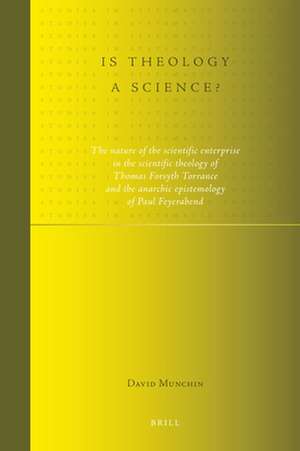
Is Theology a Science?
Autor David Munchinen Limba Engleză Hardback – 21 apr 2011
Observăm în literatura academică recentă o lacună persistentă în ceea ce privește validarea epistemologică a teologiei în fața criticilor postmoderne radicale. Volumul Is Theology a Science?, semnat de David Munchin, vine să completeze exact acest spațiu, analizând dacă viziunea lui Thomas F. Torrance despre teologie ca disciplină științifică poate supraviețui deconstrucției propuse de Paul Feyerabend. Autorul pornește de la premisa că, deși Karl Barth a respins dialogul cu o știință pozitivistă, Torrance a identificat în fizica modernă un partener de dialog fertil. Descoperim aici o structură riguroasă, organizată în cinci capitole care facilitează o progresie logică de la contextul istoric la provocările contemporane. Primele capitole stabilesc cadrul dialogului dintre Torrance și Feyerabend, în timp ce capitolul al treilea reprezintă nucleul tehnic al lucrării, examinând modul în care teologia coabitează cu teoria relativității, fizica cuantică și teorema lui Gödel. Cititorii familiarizați cu Reality and Scientific Theology vor aprecia modul în care David Munchin aduce un suflu nou prin introducerea perspectivei lui Feyerabend ca „prieten critic”, testând rezistența „noii obiectivități” a lui Torrance în fața conceptelor de incommensurabilitate și pluralism teoretic. Spre deosebire de Incarnation and Physics, care se concentrează pe fundamentul hristologic, lucrarea de față este o investigație pur epistemologică. Remarcăm un ton precis și o analiză care nu evită dificultățile argumentării, oferind o evaluare critică a modului în care teologia își poate menține statutul intelectual într-o eră a „cunoașterii fără fundații”. Este o lectură densă, esențială pentru înțelegerea raportului dintre raționalitatea teologică și filozofia științei din secolul XX.
Preț: 1008.20 lei
Preț vechi: 1309.36 lei
-23%
Carte disponibilă
Livrare economică 18 mai-01 iunie
Specificații
ISBN-10: 9004194592
Pagini: 300
Dimensiuni: 165 x 241 x 28 mm
Greutate: 0.64 kg
Editura: Brill
V-ar putea interesa
-
 The Life of the Virgin: Maximus the ConfessorStephen J. ShoemakerPreț: 208.40 lei
 -
 Preț: 433.01 lei
 -
 The Sacrifice of Africa: A Political Theology for AfricaEmmanuel KatongolePreț: 127.77 lei
 -
 Theological Highlights of Vatican IIJoserph RatzingerPreț: 89.59 lei
 -
 Keys to the Council: Unlocking the Teaching of Vatican IIRick GaillardetzPreț: 134.18 lei
 -
 Anthropology: Seeking Light and BeautySusan A. RossPreț: 132.16 lei
 -
 The Reason WhyMark MittelbergPreț: 41.25 lei
 -
 The God of Jesus Christ: New EditionWalter Kasper-27%Preț: 211.06 lei288.38 lei
 -
 The Reason for GodTimothy J. KellerPreț: 106.38 lei
De ce să citești această carte
Această lucrare se adresează cercetătorilor și studenților la teologie și filozofie care doresc să înțeleagă fundamentele epistemologice ale credinței în dialog cu știința. Cititorul câștigă o perspectivă clară asupra modului în care fizica modernă a influențat gândirea teologică și primește instrumente critice pentru a naviga între rigoarea științifică și pluralismul postmodern. Este o resursă valoroasă pentru oricine studiază opera lui Thomas F. Torrance sau filozofia lui Paul Feyerabend.
Despre autor
David Munchin este un cercetător preocupat de intersecția dintre teologie, filozofia științei și istoria ideilor. În volumul de față, el demonstrează o cunoaștere profundă a tradiției reformate, în special a influenței lui Karl Barth și a succesorului său, Thomas F. Torrance. Abordarea sa analitică reflectă rigoarea academică specifică publicațiilor Brill, reușind să pună în dialog figuri aparent divergente precum teologul scoțian Torrance și filozoful austriac al științei, Paul Feyerabend.
Notă biografică
Descriere
Recenzii
A fresh look at a neglected historical question. Thomas Torrance’s ambition that theology should be a ‘science’ has been much discussed, but David Munchin detects a potential exposed flank. Torrance expended much effort in defending Systematic Theology against the charges of a positivist view of science; but how will he fare under the anarchic attacks of Paul Feyerabend, who famously found science itself problematic when it comes to its much-vaunted claims for objectivity and rationality? In a time when advocates of science are once more challenging religious belief and theological claims, the insights of Munchin’s book are topical, insightful, and challenging. - Prof Gwen Griffith-Dickson, King's College University of London.
Anyone interested in the question, can Christian theology contribute to the search for truth in our post-modern context?, needs to read this book. Placing Thomas Torrance and Paul Feyerabend in critical dialogue over the question, Is theology a science?, David Munchin creates an insightful work that takes the reader on an ever expanding journey into the big questions of life. By examining the work of these two philosophers of science, Munchin continues the ongoing exploration of the relationship between theology and natural science. This book presents a clear argument that Torrance’s approach (even with its weaknesses) enables theology to engage sharply and critically with the current philosophical and scientific trends that attempt to sideline theological discourse in the search for truth. The book is a specialist tome that is at times a challenging read, but it is just as often elegant and compelling. - The Revd Canon Dr Dennis Stamps, University of Chichester.
This is a carefully argued text that helpfully sets into relief the few similarities and many differences between the thinking of Feyerabend and Torrance. [...] This is a book that certainly will stimulate readers to think more rigorously about science and theology today. - Paul D. Molnar, St John's University, Queens, NY, USA.
Cuprins
Preface ... ix
Acknowledgements ... xi
Chapter One Introduction: Context and history ... 1
Contextual background on the scientific status of theology until Torrance ... 9
Barth and natural science ... 13
Chapter Two Introducing the dialogue partners: Torrance and Feyerabend ... 18
Thomas Forsyth Torrance ... 18
Paul Feyerabend ... 20
Feyerabend as critical friend to Torrance ... 36
Chapter Three Torrance: theology co-habiting with natural science ... 50
The theory of general relativity ... 54
Quantum physics ... 60
Gödel’s theorem ... 66
Conclusion ... 70
Chapter Four Torrance’s Proposal – A new objectivity ... 75
A new objectivity ... 75
Similarities and Diff erences ... 84
Conclusion ... 113
Chapter Five Feyerabend’s Challenge – ‘Knowledge without Foundations’ ... 116
Theory and observation: counter-inductivism, theoretical pluralism and the rejection of empirical cumulativism ... 117
The incommensurability thesis ... 138
Against Method and Farewell to Reason ... 143
Destination relativism ... 146
Voluntarism ... 148
Chapter Six Two excurses ... 153
Hermeneutics and science ... 153
Realism ... 186
Chapter Seven Coherence and Language ... 205
Epistemic coherence and correspondence ... 205
Religious and scientifi c language ... 209
Coherence in theology and Scripture – witnesses to a single truth? ... 213
Chapter Eight From foundations to spirals ... 220
Enlightenment foundationalism and reductionism ... 220
Progressive foundationalism and ordered strata ... 225
Fluid axioms ... 227
Evident to the senses – the wrong foundations ... 234
Spirals and iterations – the search for a new metaphor of knowledge ... 255
Conclusion ... 261
Conclusion ... 263
Bibliography ... 283
Index ... 295