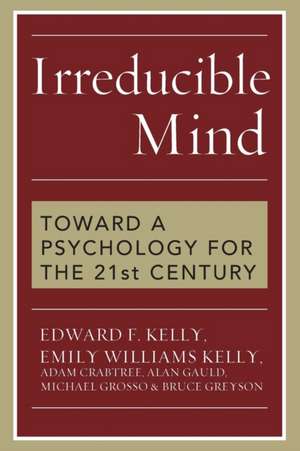
Irreducible Mind: Toward a Psychology for the 21st Century
Autor Edward F. Kelly, Emily Williams Kelly, Adam Crabtree, Alan Gauld, Michael Grosso, Bruce Greysonen Limba Engleză Paperback – 16 noi 2009
Bazându-ne pe datele furnizate de cercetările Departamentului de Medicină Psihiatrică de la University of Virginia, apreciem Irreducible Mind ca fiind o provocare riguroasă la adresa curentului dominant din neuroștiințele cognitive contemporane. Premisa centrală a volumului nu este una speculativă, ci empirică: autorii demonstrează că materialismul reductiv, care consideră mintea un simplu produs al proceselor cerebrale, nu poate explica fenomene umane complexe precum automatismul psihologic, personalitățile secundare sau stările mistice. Considerăm esențială recuperarea figurii lui F. W. H. Myers, a cărui teorie a „filtrului” este utilizată aici pentru a reîncadra relația minte-corp într-un mod compatibil cu fizica modernă.
Structura cărții este una progresivă, pornind de la o istorie compactă a psihologiei secolului XX în primul capitol, trecând prin analiza influențelor psihofiziologice (precum stigmata sau hipnoza) și culminând cu studiul stărilor alterate de conștiință. Această abordare sistematică oferă o bază solidă pentru a înțelege cum procesele mentale pot exercita o influență cauzală asupra corpului. Irreducible Mind acoperă o arie similară cu Exploring Frontiers of the Mind-Brain Relationship, însă se distinge prin dimensiunea sa enciclopedică (peste 800 de pagini) și prin ancorarea profundă în istoria psihologiei de secol XIX. În contextul operei lui Edward F. Kelly, acest titlu reprezintă pilonul teoretic pe care s-au construit lucrări ulterioare precum Consciousness Unbound sau Beyond Physicalism, rafinând tranziția de la critica materialismului spre un nou model al realității.
Preț: 365.58 lei
Preț vechi: 519.86 lei
-30%
Carte tipărită la comandă
Livrare economică 27 noiembrie-11 decembrie
Specificații
ISBN-10: 1442202068
Pagini: 832
Dimensiuni: 150 x 228 x 46 mm
Greutate: 1.36 kg
Editura: Bloomsbury Publishing
Colecția Rowman & Littlefield
Locul publicării:New York, United States
De ce să citești această carte
Recomandăm această carte cititorilor interesați de filozofia minții și neuroștiințe care caută o alternativă argumentată științific la modelul „creierul ca un computer”. Veți câștiga o perspectivă documentată asupra fenomenelor care depășesc explicațiile fizicaliste clasice, beneficiind de expertiza unei echipe multidisciplinare de profesori și cercetători. Este o resursă fundamentală pentru a înțelege limitele psihologiei actuale și potențialul unei abordări extinse a conștiinței umane.
Despre autor
Edward F. Kelly este profesor de cercetare în cadrul Departamentului de Medicină Psihiatrică la Universitatea din Virginia, având o carieră dedicată studiului relației minte-creier și neuroimagisticii stărilor neobișnuite de conștiință. Printre lucrările sale anterioare se numără „Computer Recognition of English Word Senses” și „Altered States of Consciousness and Psi”. În Irreducible Mind, colaborează cu o echipă de experți precum Emily Williams Kelly, Bruce Greyson (specialist în psihiatrie) și Adam Crabtree, formând un colectiv ce îmbină psihologia experimentală, psihiatria și istoria ideilor pentru a reevalua natura minții umane.
Descriere
Cuprins
Chapter 0 Preface and Acknowledgements
Chapter 1 A View from the Mainstream: Contemporary Cognitive Neuroscience and the Consciousness Debates: - A compact history of 20th-century psychology from behaviorism to present-day cognitive neuroscience, emphasizing the inability of these theories to account fo
Chapter 2 F. W. H. Myers and the Empirical Study of the Mind-Body Problem: - An introduction to Myers, an important but neglected figure in 19th-century psychology whose work supports the view that mind is not generated by the brain but instead limited and constrai
Chapter 3 Psychophysiological Influence: - A review of numerous phenomena such as placebo, stigmata, and hypnotic suggestion that demonstrate the influence of mental states on the body. Beginning with phenomena now generally accepted because they appear compatible
Chapter 4 Memory: - A critique of "trace" theories of memory, which have been taken as axiomatic by generations of psychologists and neuroscientists but are fraught with profound empirical and conceptual difficulties including those posed by a substantial body of w
Chapter 5 Automatism and Secondary Centers of Consciousness: - An examination of phenomena such as automatic writing and multiple personality that involve conscious psychological processes occurring outside, and often simultaneously with, ordinary waking consciousn
Chapter 6 Unusual Experiences Near Death and Related Phenomena: - An overview of near-death experiences, out-of-body experiences, apparitions and deathbed visions, and related phenomena, emphasizing near-death experiences that occur under general anesthesia or duri
Chapter 7 Genius: - A discussion of the importance and challenge of genius level creativity for scientific psychology, emphasizing the need to move beyond pathologizing and to situate genius within an adequate general theory of human mind and personality
Chapter 8 Mystical Experience: - An overview of psychological and physiological dimensions of this large and humanly vital - but scientifically neglected - family of "ecstatic" states of consciousness, which sometimes occur spontaneously or in response to psychede
Chapter 9 Toward a Psychology for the 21st Century: - Having argued throughout for an enlarged scientific psychology that returns to psychology's great central problems and addresses the mind-body problem empirically, the authors conclude by showing that the theore
Chapter 10 About the Authors
Chapter 11 References
Chapter 12 Appendix: An Annotated Introductory Bibliography of Psychical Research
Recenzii
a comprehensive review of empirical evidence that questions the assumption that "properties of minds will ultimately be fully explained by those of brains"...Kelly et al. deserve to be praised for their courage and scholarship in dealing with such a controversial topic.
Thoroughly scientific, systematically reasoned and courageous... as exciting and enjoyable as it is provocative and profound!
Irreducible Mind is an enormous and daring enterprise. Its scholarship is impressive... and made me think long and hard about many issues.
a must-read for anyone working in consciousness studies, psychology and the history of science.
a monumental work...Only a very resistant observer will remain unpersuaded that a proportion, as least, of all this carefully evaluated data presents a significant challenge to conventional views
a sustained, sophisticated, and empirically based critique of contemporary cognitive psychology and mainstream neuroscience... the implications for the study of mind, consciousness, and religion border on the unspeakable.
...brilliant, heroic and astonishing ... a scientifically rigorous and philosophically informed critique of various contemporary orthodoxies in mainstream psychology, especially the idea that the human mind (including consciousness and our sense of free will and personal agency) is nothing more than a material entity and can be fully explained in terms of brain processes.
Irreducible Mind [is] yet another book on the mind-body problem. However, this book is different, very different, from all the rest... In the future history of the science of mind, Irreducible Mind may well prove a book of landmark significance, one that helped spark a revolution in the scientific investigation of the nature of consciousness... In the arena of neuroscience of mind, it is the most exciting reading to have crossed my path in years.
Irreducible Mind is well written, detailed, and passionately argued, and should be central to parapyschology for some years to come. Its great value is that it helps to close the gap between the conventional view of mind on the one hand, and on the other, responsible research into phenomena which are utterly antithetical to that view. In that sense, it greatly advances the process that Myers began more than a century ago, but was so rudely interrupted by behaviourism and the virtual outlawing of consciousness as a scientific entity.
The author's sincerity and the extent of their labors are beyond question.