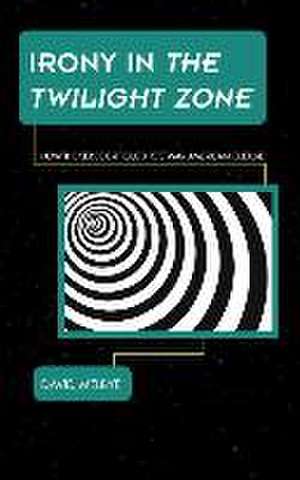
Irony in The Twilight Zone: How the Series Critiqued Postwar American Culture: Science Fiction Television
Autor David Melbyeen Limba Engleză Hardback – 14 dec 2015



Preț: 583.08 lei
Preț vechi: 863.91 lei
-33%
Puncte Express: 875
Carte tipărită la comandă
Livrare economică 21 noiembrie-05 decembrie
Livrare prin curier în România Termenul estimat este afișat lângă disponibilitate.
Transport gratuit pentru acest produs Plată online sau ramburs, în funcție de opțiunile comenzii.
Retur gratuit în 14 zile Comandă securizată și suport în română.
Specificații
ISBN-13: 9781442260313
ISBN-10: 1442260319
Pagini: 254
Dimensiuni: 156 x 240 x 25 mm
Greutate: 0.52 kg
Editura: Bloomsbury Publishing
Colecția Rowman & Littlefield
Seria Science Fiction Television
Locul publicării:New York, United States
ISBN-10: 1442260319
Pagini: 254
Dimensiuni: 156 x 240 x 25 mm
Greutate: 0.52 kg
Editura: Bloomsbury Publishing
Colecția Rowman & Littlefield
Seria Science Fiction Television
Locul publicării:New York, United States
V-ar putea interesa
-
 -27%Preț: 352.04 lei483.54 lei
 -
 -30%Preț: 539.62 lei770.12 lei
 -
 -33%Preț: 581.47 lei862.95 lei
 -
 -33%Preț: 581.66 lei864.61 lei
 -
 -33%Preț: 550.17 lei815.75 lei
 -
 -32%Preț: 592.93 lei869.90 lei
 -
 -33%Preț: 582.81 lei863.75 lei
 -
 The Big Book of New York Ghost StoriesCheri FarnsworthPreț: 116.59 lei
 -
 Duck DynastyMichael E. KeneskiPreț: 55.36 lei
 -
 Methods of Science and ReligionTiddy Smith-33%Preț: 583.16 lei863.96 lei
 -
 From Bad Girl to Grown WomanNatalie NunnPreț: 90.72 lei
 -
 Vworp!2Earl GreenPreț: 195.14 lei
 -
 Lost - VerschollenPeter OsteriedPreț: 135.65 lei
 -
 From Paw Paw to Sesame StreetDr Loretta LongPreț: 89.21 lei
 -
 Faux NewsSandra J. TillmanPreț: 119.57 lei
 -
 103 Ways to Get Into TVJim McKairnesPreț: 103.66 lei
 -
 The Great Desilu Series of the 1960sJon AbbottPreț: 158.24 lei
 -
 Firefly: Back From the BlackJoey Spiotto-18%Preț: 60.32 lei73.17 lei
 -
 Star Trek: Lost ScenesDavid Tilotta-19%Preț: 198.67 lei244.48 lei
 -
 Rick and Morty Official Coloring BookTitan BooksPreț: 81.26 lei
Descriere
Rod Serling's pioneering series TheTwilight Zone (1959 to 1964) is remembered for its surprise twist endings and pervading sense of irony.While other American television series of the time also experimented with ironic surprises, none depended on these as much as Serling's. However, irony was not used merely as a structural device-Serling and his writers used it as a provocative means by which to comment on the cultural landscape of the time.
Irony in The Twilight Zone: How the Series Critiqued Postwar American Culture explores the multiple types of irony-such as technological, invasive, martial, sociopolitical, and domestic-that Serling, Richard Matheson, Charles Beaumont, and other contributors employed in the show. David Melbye explains how each kind of irony critiqued of a specific aspect of American culture and how all of them informed one another, creating a larger social commentary. This book also places the show's use of irony in historical and philosophical contexts, connecting it to a rich cultural tradition reaching back to ancient Greece.
The Twilight Zone endures because it uses irony to negotiate its definitively modernist moment of "high" social consciousness and "low" cultural escapism. With its richly detailed, frequently unexpected readings of episodes, Irony in The Twilight Zone offers scholars and fans a fresh and unique lens through which to view the classic series.
Irony in The Twilight Zone: How the Series Critiqued Postwar American Culture explores the multiple types of irony-such as technological, invasive, martial, sociopolitical, and domestic-that Serling, Richard Matheson, Charles Beaumont, and other contributors employed in the show. David Melbye explains how each kind of irony critiqued of a specific aspect of American culture and how all of them informed one another, creating a larger social commentary. This book also places the show's use of irony in historical and philosophical contexts, connecting it to a rich cultural tradition reaching back to ancient Greece.
The Twilight Zone endures because it uses irony to negotiate its definitively modernist moment of "high" social consciousness and "low" cultural escapism. With its richly detailed, frequently unexpected readings of episodes, Irony in The Twilight Zone offers scholars and fans a fresh and unique lens through which to view the classic series.
Recenzii
David Melbye provides meticulous analyses of the groundbreaking television series's use of irony as a narrative strategy to critique postwar America.. Melbye's book is often compelling reading and offers an important contribution to the reader's understanding of The Twilight Zone and to the use of irony as a tool of social critique. As such, this book could be used in numerous popular culture, American studies, and cultural studies courses and on reading lists.
While The Twilight Zone's stylistic reliance on irony, particularly in its twist endings, has often been noted, David Melbye is the first to effectively extend this observation, as he seizes upon irony as a useful trope for laying bare a host of cultural issues with which America, as well as much of the postwar world, was struggling in the 1950s and early 1960s. The story he tells of the various sorts of irony that Rod Serling and other writerswove into his series reminds us that the show bulks beyond the traditional genre boundaries of science fiction to form an influential critique of the various cultural pressures that were shaping contemporary America, including the new medium of television wherein serious commentary had to be spoken somewhat obliquely. Irony in The Twilight Zone is a significant addition to the literature on this series and on television itself.
While The Twilight Zone's stylistic reliance on irony, particularly in its twist endings, has often been noted, David Melbye is the first to effectively extend this observation, as he seizes upon irony as a useful trope for laying bare a host of cultural issues with which America, as well as much of the postwar world, was struggling in the 1950s and early 1960s. The story he tells of the various sorts of irony that Rod Serling and other writerswove into his series reminds us that the show bulks beyond the traditional genre boundaries of science fiction to form an influential critique of the various cultural pressures that were shaping contemporary America, including the new medium of television wherein serious commentary had to be spoken somewhat obliquely. Irony in The Twilight Zone is a significant addition to the literature on this series and on television itself.