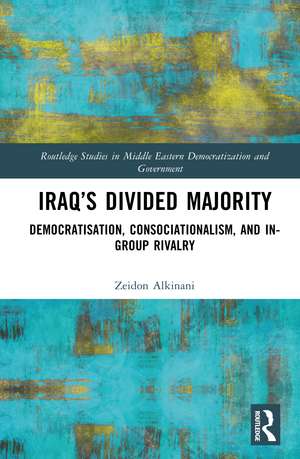
Iraq’s Divided Majority: Democratisation, Consociationalism, and In-Group Rivalry: Routledge Studies in Middle Eastern Democratization and Government
Autor Zeidon Alkinanien Limba Engleză Hardback – 23 sep 2026
Shifting the focus from inter-group accommodation to intra-group rivalry, the book argues that consociational systems often compress diverse constituencies into artificially homogeneous blocs, distorting representation and generating instability from within. Adopting a constructivist understanding of identity, it explores how political actors mobilise and contest sectarian identity in post-2003 Iraq. Focusing on intra-Shia rivalry - the most consequential arena of political competition in the Iraqi system - the study traces developments from 2003 to 2022 across four key themes: electoral politics and government formation, the role of the Marjaʿiyah, Iranian influence, and the Tishreen protest movement. Drawing on Critical Discourse Analysis of elite speeches alongside in-depth interviews, it demonstrates how Iraq’s Muhasasa system falters not simply because of poor performance, but because it assumes cohesion where fragmentation persists.
This book will appeal to scholars and students of Middle East politics, comparative politics, and democratic theory, as well as policymakers and analysts interested in power-sharing, identity politics, and institutional reform in divided societies.
Din seria Routledge Studies in Middle Eastern Democratization and Government
-
 Preț: 456.14 lei
 -
 Preț: 372.52 lei
 - 18%
 Preț: 1289.25 lei
 - 15%
 Preț: 422.92 lei
 - 15%
 Preț: 437.55 lei
 - 15%
 Preț: 447.37 lei
 - 18%
 Preț: 1057.06 lei
 - 15%
 Preț: 449.00 lei
 -
 Preț: 453.52 lei
 - 18%
 Preț: 1113.64 lei
 - 15%
 Preț: 415.95 lei
 - 18%
 Preț: 1114.12 lei
 - 18%
 Preț: 1260.05 lei
 -
 Preț: 424.32 lei
 -
 Preț: 405.59 lei
 -
 Preț: 411.77 lei
 - 18%
 Preț: 1057.86 lei
 -
 Preț: 450.55 lei
 -
 Preț: 473.25 lei
 - 18%
 Preț: 1251.34 lei
 -
 Preț: 443.83 lei
 - 18%
 Preț: 1117.25 lei
 -
 Preț: 413.08 lei
 -
 Preț: 438.69 lei
 - 18%
 Preț: 1057.86 lei
 - 18%
 Preț: 1112.72 lei
 -
 Preț: 424.32 lei
 -
 Preț: 347.11 lei
 - 18%
 Preț: 1115.17 lei
 - 18%
 Preț: 1145.00 lei
 - 18%
 Preț: 1117.60 lei
 - 18%
 Preț: 1150.77 lei
 - 18%
 Preț: 1118.66 lei
 -
 Preț: 462.35 lei
 -
 Preț: 479.44 lei
Preț: 1312.43 lei
Preț vechi: 1600.52 lei
-18% Nou
Puncte Express: 1969
Carte tipărită la comandă
Livrare economică 08-22 decembrie
Livrare prin curier în România Termenul estimat este afișat lângă disponibilitate.
Transport gratuit pentru acest produs Plată online sau ramburs, în funcție de opțiunile comenzii.
Retur gratuit în 14 zile Comandă securizată și suport în română.
Specificații
ISBN-13: 9781041323495
ISBN-10: 1041323492
Pagini: 294
Dimensiuni: 156 x 234 mm
Greutate: 0.59 kg
Ediția:1
Editura: Taylor & Francis
Colecția Routledge
Seria Routledge Studies in Middle Eastern Democratization and Government
Locul publicării:Oxford, United Kingdom
ISBN-10: 1041323492
Pagini: 294
Dimensiuni: 156 x 234 mm
Greutate: 0.59 kg
Ediția:1
Editura: Taylor & Francis
Colecția Routledge
Seria Routledge Studies in Middle Eastern Democratization and Government
Locul publicării:Oxford, United Kingdom
Public țintă
Postgraduate and Undergraduate AdvancedCuprins
Table of Contents
Acknowledgements
List of Abbreviations
List of Definitions
1. Chapter: Introduction
1.1. Introduction
1.2. Existing Scholarly Debate
1.3. Current Situation
1.4. Research Importance and Identified Gap
1.5. Research Question
1.6. Theoretical and Methodological Framework
1.6.1. Primary Data A – Elite Speeches
1.6.2. The Selected Shia Iraqi Elite Actors
1.6.3. The Core Themes
1.6.4. Primary Data B – Semi-Structured Interviews
1.6.5. Secondary Data – Academic Literature
1.6.6. Data Analysis: Critical Discourse Analysis
1.7. Structure of the Book
2. Chapter: Consociationalism and State Building in the Aftermath of Regime Change in Iraq
2.1. Introduction
2.2. Consociationalism – Proportional Representation or Enforced Homogenisation?
2.2.1. An Evolving Debate
2.2.2. Theoretical Definitions
2.2.3. Limitations and Potentials
2.2.4. From Consociational Theory to Practice
2.2.5. Centripetalism
2.2.6. Consociation and Identity
2.2.7. Ethnic Outbidding: Identity Over Issue
2.2.8. Consociationalism and Intra-Group Rivalries
2.3. Consociationalism in Iraq – Between Democratisation and Power-Sharing
2.3.1. Foundational Systemic Loopholes
2.3.2. The (Early) Noticed Potentials
2.3.3. The Current Status-Quo of Iraq’s Consociationalism
2.4. Imagining Iraq’s ‘Muhasasa’ Consociational Democracy
2.4.1. Liberation or Occupation? The Militarised Democratisation
2.4.2. Democratisation or Sectarianisation?
2.4.3. International Regime-Change vs. Religious Democratisation: The Rise of Sistani
2.4.4. Imposed Consociation
2.5. Research Gap and Contribution
3. Chapter: Imagining Iraq’s ‘Muhasasa’ Consociational Democracy
3.1. Introduction
3.2. The Intra-Shia Rivalry in Post-2003 Iraq
3.2.1. Authority and Governance in Shia Political Thought: Origins, Evolution, and Khomeinism
3.2.2. Najaf’s New and Old Elites: Early Majoritarian Breakup
3.2.3. The Iran Factor
3.2.4. The (Un)divided Popular Mobilisation Forces: From Battlefields to Ballot Boxes
3.2.5. Investigating the Intra-Shia Rivalry through Tishreen’s Protest Movement
3.3. Modern Exploitation of Religious Identities
3.3.1. Re-Constructing Post-2003 Iraq’s Sectarian Mobilisation
3.3.2. Secularisation and Modernisation Thesis
3.3.3. Modernity, A Factor of Religious Evolution
3.3.4. Religious Worldviews
3.4. Muhasasa’s Theoretical Rationale and Practical Implementation
3.4.1. The Assumed Demographics
3.4.2. Recognising Muhasasa’s Implementation and Exploiting its Unpopularity
3.4.3. Sectarianism and Intra-Sectarianism Facilitated by Muhasasa
3.5. Ingroup Legitimacy Rivalry
3.5.1. Sadr’s Political-Religious Discourse
3.6. The New Shia Majority-Rule
3.6.1. The Imagined Homogenous Community
3.6.2. Iraq’s Muhasasa and the Regional Sectarianisation
3.7. Conclusion
4. Chapter: The Dynamic Transformation of the Shia Political Camp
4.1. Introduction
4.2. The Early Majoritarian Schism
4.2.1. The Early Najaf–Qom Theological Divide in Post-2003 Iraq
4.2.2. The Incorporation of Iran’s Proxies into Iraq’s Political System
4.3. The Exploitation and Limitations of Shia Victimhood
4.4. Political Repositioning: Ideology versus Interests
4.4.1. Sadr: Nationalist or Pragmatist?
4.4.2. Maliki: State of Law versus Deep State
4.4.3. Amiri and Khazali: The Dilemma of Paramilitarism and Politics
4.5. Iran: The Ally, the Enemy, or the Neighbour?
4.5.1. Najaf–Qom Shia Theological Quietist Rivalry
4.5.2. Da‘wa: From Islamist Ideology to Communalism
4.5.3. Badr and Supreme Council: Balancing Iran’s Changing Influence
4.5.4. The Multilateral Intra-Shia Rivalry: The Sadrist Factor
4.6. Popular Mobilisation Forces and Re-Emerging Shia Militancy
4.7. Competition over Resources and Power
4.8. Conclusion
5. Chapter: Tishreen’s Shia Popular Rebellion against Shia Rule
5.1. Introduction
5.2. The Shiasation of Tishreen
5.3. The Shadow of the Intra-Shia Political Rivalry over Tishreen
5.3.1. Shia Constituents versus Shia Representatives
5.3.2. The Sadrist Shadow over Tishreen
5.4. Reshaping Iraq’s Intra-Shia Political Rivalry through Declining Iranian Influence
5.4.1. Tishreen’s Anti-Iran Sentiment: Why and How?
5.4.2. Post-Tishreen Iraq’s Reconciliation with the Arab World
5.5. Silent or Accomplice Marja‘iyah?
5.6. Tishreen versus Muhasasa: De-Legitimising the Consociational Rationale
5.7. Political Change versus Political Deadlock
5.7.1. Infiltrating Tishreen
5.8. Conclusion
6. Chapter: Conclusion Chapter
6.1. Introduction
6.2. Finding
6.3. Contribution
6.4. Recommendations
6.4.1. Recommendations from Empirical Evidence
6.4.2. Recommendations for Future Research
6.5. Conclusion
6.5.1. Consociational Reflections on the Intra-Shia Rivalry
6.5.2. Reconstruction of Political Identity in Iraq’s Intra-Shia Rivalry
6.5.3. Concluding Statement
7. Bibliography
7.1. Primary Data A (Speeches)
7.2. Primary Data B (Interviews)
7.3. Secondary Data
8. Appendix
8.1. List of Interviewees
8.2. List of Speeches
Index
Acknowledgements
List of Abbreviations
List of Definitions
1. Chapter: Introduction
1.1. Introduction
1.2. Existing Scholarly Debate
1.3. Current Situation
1.4. Research Importance and Identified Gap
1.5. Research Question
1.6. Theoretical and Methodological Framework
1.6.1. Primary Data A – Elite Speeches
1.6.2. The Selected Shia Iraqi Elite Actors
1.6.3. The Core Themes
1.6.4. Primary Data B – Semi-Structured Interviews
1.6.5. Secondary Data – Academic Literature
1.6.6. Data Analysis: Critical Discourse Analysis
1.7. Structure of the Book
2. Chapter: Consociationalism and State Building in the Aftermath of Regime Change in Iraq
2.1. Introduction
2.2. Consociationalism – Proportional Representation or Enforced Homogenisation?
2.2.1. An Evolving Debate
2.2.2. Theoretical Definitions
2.2.3. Limitations and Potentials
2.2.4. From Consociational Theory to Practice
2.2.5. Centripetalism
2.2.6. Consociation and Identity
2.2.7. Ethnic Outbidding: Identity Over Issue
2.2.8. Consociationalism and Intra-Group Rivalries
2.3. Consociationalism in Iraq – Between Democratisation and Power-Sharing
2.3.1. Foundational Systemic Loopholes
2.3.2. The (Early) Noticed Potentials
2.3.3. The Current Status-Quo of Iraq’s Consociationalism
2.4. Imagining Iraq’s ‘Muhasasa’ Consociational Democracy
2.4.1. Liberation or Occupation? The Militarised Democratisation
2.4.2. Democratisation or Sectarianisation?
2.4.3. International Regime-Change vs. Religious Democratisation: The Rise of Sistani
2.4.4. Imposed Consociation
2.5. Research Gap and Contribution
3. Chapter: Imagining Iraq’s ‘Muhasasa’ Consociational Democracy
3.1. Introduction
3.2. The Intra-Shia Rivalry in Post-2003 Iraq
3.2.1. Authority and Governance in Shia Political Thought: Origins, Evolution, and Khomeinism
3.2.2. Najaf’s New and Old Elites: Early Majoritarian Breakup
3.2.3. The Iran Factor
3.2.4. The (Un)divided Popular Mobilisation Forces: From Battlefields to Ballot Boxes
3.2.5. Investigating the Intra-Shia Rivalry through Tishreen’s Protest Movement
3.3. Modern Exploitation of Religious Identities
3.3.1. Re-Constructing Post-2003 Iraq’s Sectarian Mobilisation
3.3.2. Secularisation and Modernisation Thesis
3.3.3. Modernity, A Factor of Religious Evolution
3.3.4. Religious Worldviews
3.4. Muhasasa’s Theoretical Rationale and Practical Implementation
3.4.1. The Assumed Demographics
3.4.2. Recognising Muhasasa’s Implementation and Exploiting its Unpopularity
3.4.3. Sectarianism and Intra-Sectarianism Facilitated by Muhasasa
3.5. Ingroup Legitimacy Rivalry
3.5.1. Sadr’s Political-Religious Discourse
3.6. The New Shia Majority-Rule
3.6.1. The Imagined Homogenous Community
3.6.2. Iraq’s Muhasasa and the Regional Sectarianisation
3.7. Conclusion
4. Chapter: The Dynamic Transformation of the Shia Political Camp
4.1. Introduction
4.2. The Early Majoritarian Schism
4.2.1. The Early Najaf–Qom Theological Divide in Post-2003 Iraq
4.2.2. The Incorporation of Iran’s Proxies into Iraq’s Political System
4.3. The Exploitation and Limitations of Shia Victimhood
4.4. Political Repositioning: Ideology versus Interests
4.4.1. Sadr: Nationalist or Pragmatist?
4.4.2. Maliki: State of Law versus Deep State
4.4.3. Amiri and Khazali: The Dilemma of Paramilitarism and Politics
4.5. Iran: The Ally, the Enemy, or the Neighbour?
4.5.1. Najaf–Qom Shia Theological Quietist Rivalry
4.5.2. Da‘wa: From Islamist Ideology to Communalism
4.5.3. Badr and Supreme Council: Balancing Iran’s Changing Influence
4.5.4. The Multilateral Intra-Shia Rivalry: The Sadrist Factor
4.6. Popular Mobilisation Forces and Re-Emerging Shia Militancy
4.7. Competition over Resources and Power
4.8. Conclusion
5. Chapter: Tishreen’s Shia Popular Rebellion against Shia Rule
5.1. Introduction
5.2. The Shiasation of Tishreen
5.3. The Shadow of the Intra-Shia Political Rivalry over Tishreen
5.3.1. Shia Constituents versus Shia Representatives
5.3.2. The Sadrist Shadow over Tishreen
5.4. Reshaping Iraq’s Intra-Shia Political Rivalry through Declining Iranian Influence
5.4.1. Tishreen’s Anti-Iran Sentiment: Why and How?
5.4.2. Post-Tishreen Iraq’s Reconciliation with the Arab World
5.5. Silent or Accomplice Marja‘iyah?
5.6. Tishreen versus Muhasasa: De-Legitimising the Consociational Rationale
5.7. Political Change versus Political Deadlock
5.7.1. Infiltrating Tishreen
5.8. Conclusion
6. Chapter: Conclusion Chapter
6.1. Introduction
6.2. Finding
6.3. Contribution
6.4. Recommendations
6.4.1. Recommendations from Empirical Evidence
6.4.2. Recommendations for Future Research
6.5. Conclusion
6.5.1. Consociational Reflections on the Intra-Shia Rivalry
6.5.2. Reconstruction of Political Identity in Iraq’s Intra-Shia Rivalry
6.5.3. Concluding Statement
7. Bibliography
7.1. Primary Data A (Speeches)
7.2. Primary Data B (Interviews)
7.3. Secondary Data
8. Appendix
8.1. List of Interviewees
8.2. List of Speeches
Index
Notă biografică
Zeidon Alkinani is a Middle East Analyst and Founding Director of the Arab Perspectives Institute. He previously served as Lecturer in Middle East Politics at Georgetown University in Qatar (2024–2026), Non-Resident Fellow at the Arab Center Washington (2021–2024), Teaching Fellow at the University of Aberdeen (2021–2022), and Non-Resident Fellow at the Center for Iranian Studies in Ankara (iRAM) (2021–2022). He is leading strategic initiatives at an educational non-profit organization in Qatar. He holds a PhD in Politics and International Relations from the University of Aberdeen, an MSc in International Public Policy from University College London (UCL), and a BA in Politics and International Relations from the University of Westminster.
Descriere
Iraq’s Divided Majority: Democratisation, Consociationalism, and In-Group Rivalry challenges conventional accounts of consociational democracy by examining how power-sharing arrangements can intensify political competition within, rather than between, groups.