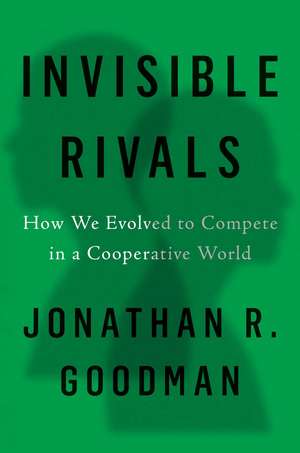
Invisible Rivals: How We Evolved to Compete in a Cooperative World
Autor Jonathan R Goodman Cuvânt înainte de Robert A. Foleyen Limba Engleză Hardback – 17 iun 2025
Adresat studenților la antropologie și psihologie, cercetătorilor în științe sociale și practicienilor interesați de dinamica organizațională, volumul Invisible Rivals oferă o perspectivă riguroasă asupra naturii umane duale. Remarcăm efortul lui Jonathan R Goodman de a depăși dezbaterea clasică despre bunătatea sau egoismul înnăscut al omului, propunând în schimb un model în care cooperarea și competiția nu sunt opuse, ci coexistă strategic.
Autorul analizează mecanismele prin care indivizii își conving semenii (și pe ei înșiși) de burtă-credința lor, în timp ce manipulează contextul social pentru avantaje personale. Această „rivalitate invizibilă” este prezentată nu doar ca o trăsătură biologică, ci ca o barieră în calea rezolvării unor crize globale precum inegalitatea sau schimbările climatice. Din punct de vedere stilistic, textul păstrează o rigoare academică specifică editurii Yale University Press, dar este structurat pentru a fi accesibil și celor care doresc să înțeleagă rădăcinile evoluționiste ale comportamentului social.
Comparativ cu alte lucrări de referință, Invisible Rivals acoperă aceeași arie tematică precum The Origins of Virtue de Matt Ridley, dar cu o abordare mai centrată pe intersecția dintre biologia evoluționistă și etica modernă. În timp ce Humankind de Rutger Bregman tinde spre o viziune mai optimistă asupra altruismului uman, Goodman oferă un cadru mai pragmatic și critic, subliniind capacitatea noastră de exploatare reciprocă sub masca cooperării.
Preț: 191.08 lei
Carte disponibilă
Livrare economică 14-28 noiembrie
Livrare express 31 octombrie-06 noiembrie pentru 55.82 lei
Specificații
ISBN-10: 0300274351
Pagini: 256
Ilustrații: 8 b-w illus.
Dimensiuni: 140 x 216 x 26 mm
Greutate: 0.41 kg
Editura: Yale University Press
Colecția Yale University Press
V-ar putea interesa
-
 ProgressSamuel Miller McDonaldPreț: 161.19 lei
 -
 The Origins of VirtueMatt Ridley-19%Preț: 75.49 lei93.16 lei
 -
 Deceit and Self-DeceptionRobert Trivers-30%Preț: 65.92 lei94.07 lei
 -
 TogetherRichard SennettPreț: 91.86 lei
 -
 The Righteous MindJonathan Haidt-28%Preț: 78.29 lei108.70 lei
 -
 Mutual AidPeter Kropotkin-25%Preț: 59.65 lei79.33 lei
 -
 When Everyone Knows That Everyone Knows...Steven PinkerPreț: 137.96 lei
 -
 -15%Preț: 106.02 lei124.73 lei
 -
 Against the MachinePaul KingsnorthPreț: 194.17 lei
 -
 A Theory of Everyone: Who We Are, How We Got Here, and Where We’re GoingMichael Muthukrishna-25%Preț: 70.22 lei94.24 lei
 -
 -23%Preț: 62.48 lei81.32 lei
 -
 My Manager and Other AnimalsDr Richard Robinson-27%Preț: 46.88 lei63.85 lei
 -
 -18%Preț: 59.55 lei72.53 lei
 -
 The Evolution of CooperationRobert AxelrodPreț: 105.12 lei
 -
 When Everyone Knows That Everyone Knows . . .Steven PinkerPreț: 184.59 lei
 -
 Preț: 112.43 leiRecomandat
 -
 Preț: 193.55 lei
 -
 SuperCooperatorsMartin NowakPreț: 105.32 lei
 -
 Friend and FoeAdam Galinsky-30%Preț: 75.44 lei107.04 lei
De ce să citești această carte
Recomandăm această carte cititorilor care doresc să înțeleagă mecanismele psihologice din spatele încrederii și trădării. Veți câștiga o perspectivă nouă asupra modului în care evoluția ne-a modelat să navigăm într-o lume cooperantă prin strategii competitive. Este un instrument teoretic util pentru a descifra de ce structurile sociale actuale se confruntă cu o criză de încredere și cum putem folosi biologia umană pentru a genera soluții colective reale.
Despre autor
Jonathan R Goodman este un cercetător preocupat de intersecția dintre antropologie și biologia evoluționistă, explorând modul în care trăsăturile umane ancestrale influențează structurile sociale contemporane. În Invisible Rivals, el colaborează cu Robert A. Foley, un specialist de renume în evoluția umană, care semnează prefața volumului. Goodman se distinge prin capacitatea de a sintetiza date complexe din științele naturii și filozofie pentru a oferi explicații coerente asupra comportamentului moral și social, fiind o voce emergentă în analiza mecanismelor de adaptare umană la mediile tehnologice și politice moderne.
Descriere scurtă
For centuries, people have argued about whether humans are moral animals—good or bad, cooperative or competitive, altruistic or selfish. The debates continue today, dressed up in the language of modern science. In this book, Jonathan R. Goodman makes the case for synthesizing the two sides. Drawing on insights from anthropology, evolutionary biology, and philosophy, he argues that rather than being fundamentally cooperative or competitive, we are capable of being both—and of exploiting each other when there is an opportunity to do so.
The core of invisible rivalry is how we make ourselves and others believe that we are acting cooperatively even as we manipulate those around us for our own benefit. In confronting this collective tendency toward self-interest, Goodman says, we can make the fundamental first step in fixing the breakdown of trust in society. Consequently, we will be better able to combat the myriad issues we face today, including widespread inequality, misinformation in a new technological environment, and climate change.
Recenzii
“A timely, erudite, and provocative book that is fun and an inspiring call to arms. Jonathan Goodman uses history, evolutionary biology, and anthropology to explain why humans are hard-wired to cooperate—but also designed to embrace conflict and competition, with potentially dark outcomes.”—Gillian Tett, provost, King’s College, Cambridge, and author of Fool’s Gold and Anthro-Vision
“In his fascinating debut Invisible Rivals, Goodman debunks simplistic theories of human selfishness, providing a highly nuanced and contextual account of human competition and cooperation with important implications for how to solve some of the world’s biggest challenges, from global climate change to the spread of disinformation.”—Sander van der Linden, author of Foolproof: Why Misinformation Infects Our Minds and How to Build Immunity
“This fascinating, unique book links theories about our individual willingness or reluctance to cooperate, which is tied to how we manage global challenges of our time. Working across philosophy, evolutionary biology, public policy, and politics, Invisible Rivals is unlike any other book I’ve read.”—Devi Sridhar, author of How Not to Die (Too Soon): The Lies We’ve Been Sold and the Policies That Could Save Us
“A timely and devastating exposé by a brilliant evolutionary psychologist. Jonathan Goodman argues that evil will triumph so long as good people fail to see that selfishness and double-dealing are basic human traits to be found in everyone, including themselves.”—Nicholas Humphrey, author of Sentience: The Invention of Consciousness
“Competitive or cooperative? We are both, inextricably so; but what follows? Invisible Rivals takes us on a fascinating journey spanning anthropology, philosophy, evolutionary biology, and more. Goodman’s argument is highly approachable, yet also original, eloquent and persuasive. Both lack of trust and trust without discernment endanger the public sphere. The message could hardly be more timely and urgent.”—Robert Attenborough, University of Cambridge and Australian National University
“Humans are inherently neither nice nor nasty, but we use cooperative and competitive tools like choosing irons in golf. It is as unsettling a point as it is important, and Jonathan Goodman makes it all but incontrovertible.”—David C. Lahti, City University of New York