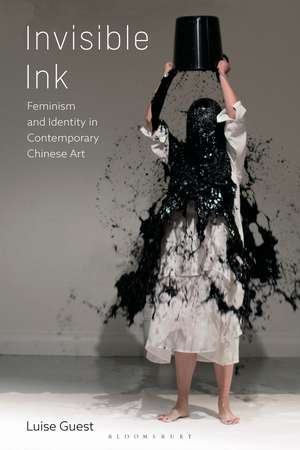
Invisible Ink: Feminism and Identity in Contemporary Chinese Art
Autor Luise Guesten Limba Engleză Hardback – 19 feb 2026
The book explores how the work of Bingyi, Ma Yanling, Tao Aimin, Xiao Lu and Xie Rong invoke contemporary manifestations of the traditional Chinese form of ink and brush painting to explore themes of the embodied, gendered experience of Chinese identity, including: motherhood and daughterhood; the exercise of state control over fertility in the implementation of the One Child Policy; and the experience of menopause in a society that prizes youth and beauty.
Each chapter examines one artist, analysing carefully selected key works and drawing on interviews with the artists themselves. It positions the artists as intervening, not only in historically exclusive, elitist literati traditions, but also in contemporary art discourses in which their contributions have been similarly marginalised. It explores the ambivalent views of the artists towards (Western) feminism and positions their work as counter-hegemonic expressions of a specifically Chinese experience of patriarchy.
Addressing an understudied aspect of contemporary Chinese art, this book powerfully illuminates the material culture of ink and brush painting through a transcultural, intersectional feminist lens, revealing the ways in which the form bridges Chinese history and the present day.
Preț: 571.42 lei
Preț vechi: 831.80 lei
-31%
Puncte Express: 857
Carte disponibilă
Livrare economică 19-25 noiembrie
Livrare prin curier în România Termenul estimat este afișat lângă disponibilitate.
Transport gratuit pentru acest produs Plată online sau ramburs, în funcție de opțiunile comenzii.
Retur gratuit în 14 zile Comandă securizată și suport în română.
Specificații
ISBN-13: 9781350433953
ISBN-10: 1350433950
Pagini: 216
Ilustrații: 50 colour illus.
Dimensiuni: 158 x 234 x 18 mm
Greutate: 0.58 kg
Editura: Bloomsbury Publishing
Colecția Bloomsbury Visual Arts
Locul publicării:London, United Kingdom
ISBN-10: 1350433950
Pagini: 216
Ilustrații: 50 colour illus.
Dimensiuni: 158 x 234 x 18 mm
Greutate: 0.58 kg
Editura: Bloomsbury Publishing
Colecția Bloomsbury Visual Arts
Locul publicării:London, United Kingdom
V-ar putea interesa
-
 The Art of Contemporary ChinaJiang Jiehong-18%Preț: 90.55 lei109.81 lei
 -
 Feminism. Art. Capitalism.Angela DimitrakakiPreț: 190.68 lei
 -
 -26%Preț: 148.07 lei199.08 lei
 -
 Preț: 256.90 lei
 -
 -20%Preț: 144.39 lei181.54 lei
 -
 Artemisia Gentileschi and Feminism in Early Modern EuropeMary D. Garrard-11%Preț: 112.11 lei125.77 lei
 -
 -25%Preț: 209.05 lei279.34 lei
 -
 Preț: 162.28 lei
 -
 Korean Feminist ArtistsKim Hong-Hee-19%Preț: 410.32 lei506.33 lei
 -
 Preț: 193.44 lei
 -
 Reframing Women PrintmakersP L HendersonPreț: 157.85 lei
 -
 -23%Preț: 86.11 lei111.72 lei
 -
 Chinese Art TodayJoshua GongPreț: 400.55 lei
 -
 Pissing WomenSophy RickettPreț: 101.39 lei
 -
 New Women's WorkAngelik Vizcarrondo-Laboy-14%Preț: 248.63 lei290.55 lei
 -
 Preț: 110.27 lei
 -
 Human Marks: Tattooing in Contemporary ArtCarrie Cushman-16%Preț: 299.19 lei358.04 lei
 -
 Preț: 250.16 lei
Cuprins
List of illustrations
Preface
Acknowledgements
Glossary
Introduction
1. Hiding in plain sight: where are the women?
2. Rituals of ink and water: painting as performance in the work of Xiao Lu
3. 'Upstairs girls': nüshu reinvented in the work of Tao Aimin
4. From silence to speech: mothers and daughters in the work of Ma Yanling
5. A trespasser in the literati garden: Bingyi's poetics of ink
6. Body calligraphy: Xie Rong's autobiographies
7. Conclusion: Ink art as a feminist praxis
Afterword
References
Index
Preface
Acknowledgements
Glossary
Introduction
1. Hiding in plain sight: where are the women?
2. Rituals of ink and water: painting as performance in the work of Xiao Lu
3. 'Upstairs girls': nüshu reinvented in the work of Tao Aimin
4. From silence to speech: mothers and daughters in the work of Ma Yanling
5. A trespasser in the literati garden: Bingyi's poetics of ink
6. Body calligraphy: Xie Rong's autobiographies
7. Conclusion: Ink art as a feminist praxis
Afterword
References
Index
Recenzii
Invisible Ink is a unique contribution to the study of women artists and contemporary art. With innovative and in-depth research, Luise Guest uncovers the multi-layered meanings of ink as both medium and creative space in the feminist practice of five Chinese women artists.
Weaves together a wealth of insights gathered from conversations with women artists across China. This vital expansion of the material turn in writing on contemporary Chinese art introduces a much-needed gendered lens to our understanding of cultural traditions and their reinvention.
Invisible Ink does not argue for simply adding women into the picture, but rather for how serious attention to their art remakes our understanding of both experimental ink painting and feminist art as expansive fields of practice.
Weaves together a wealth of insights gathered from conversations with women artists across China. This vital expansion of the material turn in writing on contemporary Chinese art introduces a much-needed gendered lens to our understanding of cultural traditions and their reinvention.
Invisible Ink does not argue for simply adding women into the picture, but rather for how serious attention to their art remakes our understanding of both experimental ink painting and feminist art as expansive fields of practice.