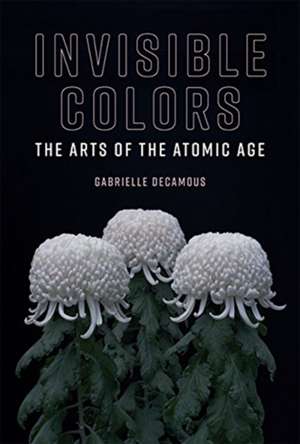
Invisible Colors
Autor Gabrielle Decamousen Limba Engleză Hardback – 5 feb 2019
Decamous looks at the "Radium Literature” based on the work and life of Marie Curie; "A-Bomb literature” by Hibakusha (bomb survivor) artists from Nagasaki and Hiroshima; responses to the bombings by Western artists and writers; art from the irradiated landscapes of the Cold War—nuclear test sites and uranium mines, mainly in the Pacific and some African nations; and nuclear accidents in Fukushima, Chernobyl, and Three Mile Island. She finds that the artistic voices of the East are often drowned out by those of the West. Hibakusha art and Japanese photographs of the bombing are little known in the West and were censored; poetry from the Marshall Islands and Moruroa is also largely unknown; Western theatrical and cinematic works focus on heroic scientists, military men, and the atomic mushroom cloud rather than the aftermath of the bombings.
Emphasizing art by artists who were present at these nuclear events—the "global Hibakusha”—rather than those reacting at a distance, Decamous puts Eastern and Western art in dialogue, analyzing the aesthetics and the ethics of nuclear representation.
Preț: 214.15 lei
Puncte Express: 321
Preț estimativ în valută:
37.91€ • 44.29$ • 32.90£
37.91€ • 44.29$ • 32.90£
Carte disponibilă
Livrare economică 04-18 februarie
Preluare comenzi: 021 569.72.76
Specificații
ISBN-13: 9780262038546
ISBN-10: 0262038544
Pagini: 480
Dimensiuni: 164 x 236 x 37 mm
Greutate: 0.95 kg
Editura: Mit Press
ISBN-10: 0262038544
Pagini: 480
Dimensiuni: 164 x 236 x 37 mm
Greutate: 0.95 kg
Editura: Mit Press
V-ar putea interesa
-
 -17%Preț: 349.16 lei422.78 lei
 -
 Imagery in the 21st CenturyOliver Grau-23%Preț: 466.17 lei605.41 lei
 -
 Aliens R Us: The Other in Science Fiction CinemaZiauddin SardarPreț: 244.06 lei
 -
 Digital AestheticsSean Cubitt-15%Preț: 460.88 lei542.21 lei
 -
 Simulation and Social TheorySean Cubitt-15%Preț: 459.77 lei540.90 lei
 -
 Finite MediaSean CubittPreț: 224.92 lei
 -
 The "Third Text" Reader on Art, Culture and TheoryZiauddin SardarPreț: 213.16 lei
 -
 Preț: 224.66 lei
 -
 Preț: 295.68 lei
 -
 Preț: 244.89 lei
 -
 Preț: 201.64 lei
 -
 Preț: 89.45 lei
 -
 Preț: 140.13 lei
 -
 Digital LightSean CubittPreț: 313.70 lei
 -
 TruthSean Cubitt-8%Preț: 242.66 lei265.10 lei
 -
 Preț: 228.30 lei
 -
 Preț: 236.22 lei
 -
 Les Peintres de La Vie (Ed.1888)Lemonnier C.Preț: 162.83 lei
 -
 Les Vignettes Romantiques: Histoire de La Litterature Et de L'Art, 1825-1840 (Ed.1883)Jules Francois ChampfleuryPreț: 206.36 lei
 -
 Lettres de Marie Bashkirtseff (Ed.1891)Marie BashkirtseffPreț: 135.39 lei
 -
 Preț: 170.11 lei
 -
 Preț: 214.57 lei
 -
 Manuel de Perspective Du Dessinateur Et Du Peintre (3e Éd.) (Éd.1829)Amand-Denis VergnaudPreț: 139.80 lei
 -
 Preț: 191.32 lei
 -
 Mémoires d'Un Artiste (Éd.1896)Charles GounodPreț: 177.29 lei
 -
 -18%Preț: 923.78 lei1126.56 lei
Notă biografică
Gabrielle Decamous is Associate Professor in the Faculty of Languages and Cultures at Kyushu University in Fukuoka, Japan. She has taught at Goldsmiths, University of London, and was the recipient of a Hilla Rebay International Fellowship, working with curators at museums in New York, Bilbao, and Venice and the recipient of a KAKENHI (Grants-in-aid for Scientific Research) in Japan.
Descriere
How art makes visible what had been invisible-the effects of radiation, the lives of atomic bomb survivors, and the politics of the atomic age.