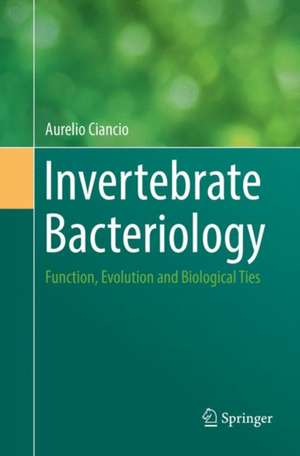
Invertebrate Bacteriology
Autor Aurelio Ciancioen Limba Engleză Paperback – 22 apr 2018
Manualul Invertebrate Bacteriology, semnat de Aurelio Ciancio, reprezintă o sinteză riguroasă a interacțiunilor complexe dintre grupurile bacteriene și principalele încrengături de nevertebrate. Subliniem faptul că autorul a ales o abordare inovatoare, organizând volumul în funcție de procesele biologice — precum patogenitatea, simbioza sau speciația — și nu pe criterii taxonomice rigide. Această structură permite o analiză comparativă a rolurilor funcționale pe care bacteriile le joacă în diverse linii evolutive, de la mediile abisale până la ecosistemele agricole. Remarcăm progresia logică a conținutului, care debutează cu principiile de bază ale celulei bacteriene și evoluția eucariotelor, avansând spre mecanisme moleculare sofisticate. Capitolele dedicate transferului orizontal de gene și sistemelor imunitare oferă o perspectivă actualizată asupra modului în care nevertebratele s-au adaptat la prezența microorganismelor. Lucrarea completează perspectiva oferită de Insect Symbiosis, Volume 3 de Kostas Bourtzis, adăugând o analiză extinsă asupra nematodelor și a altor taxoni care nu sunt limitați la clasa insectelor, precum și o secțiune vitală despre aplicațiile în farming. În contextul operei sale anterioare, precum Integrated Management of Arthropod Pests and Insect Borne Diseases, Aurelio Ciancio își rafinează aici viziunea multidisciplinară, legând biologia moleculară de ecologia aplicată. Considerăm că includerea temelor contemporane, precum efectele încălzirii globale asupra interacțiunilor gazdă-simbiont, transformă acest tratat într-un instrument esențial pentru înțelegerea dinamicii biomasei eucariote. Textul este dens, susținut de date recente din era „-omics”, fiind calibrat pentru a servi atât cercetării fundamentale, cât și specialiștilor în protecția plantelor și sănătate publică.
Preț: 844.72 lei
Preț vechi: 928.27 lei
-9%
Carte indisponibilă temporar
Specificații
ISBN-10: 9402414274
Pagini: 349
Ilustrații: XII, 349 p. 45 illus., 25 illus. in color.
Dimensiuni: 155 x 235 x 19 mm
Greutate: 0.62 kg
Ediția:Softcover Reprint of the Original 1st 2016 edition
Editura: Springer
Locul publicării:Dordrecht, Netherlands
V-ar putea interesa
-
 Imms' Outlines of EntomologyO. W. Richards-15%Preț: 614.92 lei723.43 lei
 -
 The Cyst NematodesS.B. Sharma-18%Preț: 1183.40 lei1443.18 lei
 -
 Carabid Beetles: Ecology and EvolutionK. Desender-24%Preț: 1711.80 lei2252.37 lei
 -
 -18%Preț: 1777.99 lei2168.27 lei
 -
 -18%Preț: 905.13 lei1103.82 lei
 -
 Attachment Devices of Insect CuticleStanislav S. N. Gorb-18%Preț: 918.59 lei1120.23 lei
 -
 History of InsectsDonald L. Quicke-18%Preț: 2929.75 lei3572.86 lei
 -
 EntomologyCedric Gillott-18%Preț: 1281.68 lei1563.02 lei
 -
 Pests of Crops in Warmer Climates and Their ControlDennis S. Hill-24%Preț: 1742.13 lei2292.28 lei
 -
 -18%Preț: 1679.73 lei2048.45 lei
 -
 Integrated Management of Fruit Crops and Forest NematodesAurelio Ciancio-18%Preț: 956.63 lei1166.62 lei
 -
 Fabre - Poet of ScienceC. V. LegrosPreț: 194.06 lei
 -
 The Mosquitoes of the United StatesHarrison G. DyarPreț: 82.34 lei
 -
 Preț: 85.79 lei
 -
 Preț: 136.32 lei
 -
 EntomologyP. C. Jain-9%Preț: 715.51 lei786.27 lei
 -
 Illustrated Dictionary of EntomologyParas Nath-8%Preț: 602.72 lei655.13 lei
 -
 Common Infectious Diseases of Insects in CultureVladimir GouliPreț: 376.55 lei
 -
 -18%Preț: 953.08 lei1162.29 lei
De ce să citești această carte
Recomandăm acest volum specialiștilor în zoologie și microbiologie care doresc să depășească barierele taxonomice tradiționale. Cititorul câștigă o înțelegere profundă a mecanismelor moleculare prin care bacteriile influențează evoluția nevertebratelor. Este o resursă esențială pentru cercetătorii care studiază vectorii de boli și managementul integrat al dăunătorilor, oferind soluții bazate pe biotehnologie și analize de mediu actualizate.