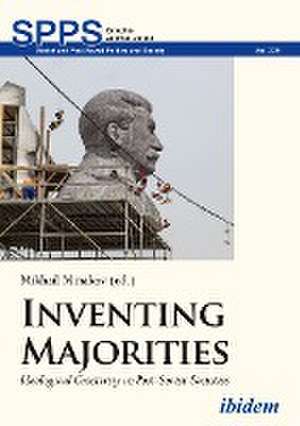
Inventing Majorities: Ideological Creativity in Post-Soviet Societies
Editat de Mikhail Minakov Andreas Umland Contribuţii de Petra Colmorgen, Augusto Dala Costa, Oleksandr Fisun, Roman Horbyk, Ivan Gomza, Nadiia Koval, Natalia Kudriavtseva, Mielkov Yurii, Yana Prymachenko, Gulnara Shaikhutdinova, Nataliya Vinnykova, Yuliya Yurchuk, Ruslan Zaporozhchenkoen Limba Engleză Paperback – 22 mar 2022
Preț: 332.90 lei
Preț vechi: 379.45 lei
-12%
Puncte Express: 499
Carte disponibilă
Livrare economică 14-28 mai
Specificații
ISBN-13: 9783838216416
ISBN-10: 3838216415
Pagini: 388
Dimensiuni: 148 x 210 x 21 mm
Greutate: 0.51 kg
Ediția:Nouă
Editura: Ibidem
Colecția ibidem
Locul publicării:Hannover, Germany
ISBN-10: 3838216415
Pagini: 388
Dimensiuni: 148 x 210 x 21 mm
Greutate: 0.51 kg
Ediția:Nouă
Editura: Ibidem
Colecția ibidem
Locul publicării:Hannover, Germany
Recenzii
"The three decades of political turmoil in the post-Soviet states, hollowed by their fleeting and fleeing elites while still presumed to be transitioning towards something more civilized, does not mean only a lasting crisis. In the countries with the once formidable intelligentsia like Ukraine and Georgia, the same disorderly conditions can sometimes foster intellectual creativity of the highest world mark. Read this book and marvel at the potent phrases such as: Legitimacy now belongs to the global Maidan which exists outside the modern state."—Georgi Derluguian, sociologist, New York University Abu Dhabi
"Combining philosophy, sociology, political science, and public history, this volume focuses on the powers of imagination in the mastery of everyday life—individual, national, and global. Consisting of ten research papers, the collection documents the panorama of broad East-European “ideological creativity”, which is manifested in construction of new sovereign majorities. Combining universal meanings with post-Soviet specificities, these stories present the current debates about state sovereignty and ideological sovereigntism in the wider contexts of post-transition, demodernization, and deglobalization. Sophisticated and complex, these analyses will inspire generations of researchers who will be puzzled by the mysteries of our time."—Alexander Etkind, professor of history, European University Institute
“This volume offers multiple perspectives on the process of (re-)imagining post-Soviet identities. Framed by the original concept of ‘ideological creativity’, several case studies explore how majorities define the ‘self’ and ‘the other’, how identities are shaped by particular spaces, and how claims to sovereignty remain contested. A thoughtful contribution to ongoing debates.”—Gwendolyn Sasse, Director, Centre for East European and International Studies (ZOiS), Berlin
“In this volume Mikhail Minakov has carefully selected a unique group of experts to assemble a path-breaking and challenging volume. The volume focuses on perhaps the most critical and most neglected question in the field today—the invention and construction of "majorities" in post-Soviet space. The brilliance of the volume is in this: instead of viewing majorities as solely reductions, as impositions from outside powers, Minakov and the collection's authors underscore that majorities, for good and ill, are the consequence of political imaginaries by active, self-fashioning political agents. Thus, the authors present the post-Soviet space as a place of articulated and rearticulated ideologies, and of self and group conceptions, symbolic developments of worldview and of collective space.”—Christopher Donohue, Historian, National Human Genome Research Institute, Bethesda, MD
"Democratic politics creates changing majorities. Nation states comes with the promise of permanent majorities. The game of majorities is at the center of this original and important book focused on the study of political imagination in the post-soviet space."—Ivan Krastev, Centre for Liberal Strategies, Sofia
"Combining philosophy, sociology, political science, and public history, this volume focuses on the powers of imagination in the mastery of everyday life—individual, national, and global. Consisting of ten research papers, the collection documents the panorama of broad East-European “ideological creativity”, which is manifested in construction of new sovereign majorities. Combining universal meanings with post-Soviet specificities, these stories present the current debates about state sovereignty and ideological sovereigntism in the wider contexts of post-transition, demodernization, and deglobalization. Sophisticated and complex, these analyses will inspire generations of researchers who will be puzzled by the mysteries of our time."—Alexander Etkind, professor of history, European University Institute
“This volume offers multiple perspectives on the process of (re-)imagining post-Soviet identities. Framed by the original concept of ‘ideological creativity’, several case studies explore how majorities define the ‘self’ and ‘the other’, how identities are shaped by particular spaces, and how claims to sovereignty remain contested. A thoughtful contribution to ongoing debates.”—Gwendolyn Sasse, Director, Centre for East European and International Studies (ZOiS), Berlin
“In this volume Mikhail Minakov has carefully selected a unique group of experts to assemble a path-breaking and challenging volume. The volume focuses on perhaps the most critical and most neglected question in the field today—the invention and construction of "majorities" in post-Soviet space. The brilliance of the volume is in this: instead of viewing majorities as solely reductions, as impositions from outside powers, Minakov and the collection's authors underscore that majorities, for good and ill, are the consequence of political imaginaries by active, self-fashioning political agents. Thus, the authors present the post-Soviet space as a place of articulated and rearticulated ideologies, and of self and group conceptions, symbolic developments of worldview and of collective space.”—Christopher Donohue, Historian, National Human Genome Research Institute, Bethesda, MD
"Democratic politics creates changing majorities. Nation states comes with the promise of permanent majorities. The game of majorities is at the center of this original and important book focused on the study of political imagination in the post-soviet space."—Ivan Krastev, Centre for Liberal Strategies, Sofia