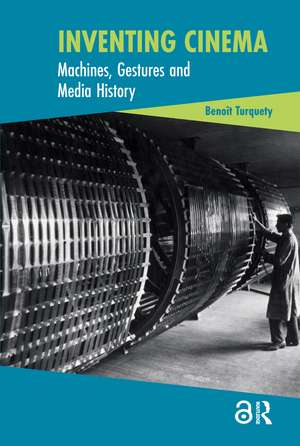
Inventing Cinema: Machines, Gestures and Media History: Cinema and Technology
Autor Benoît Turquetyen Limba Engleză Hardback – 17 oct 2019


Preț: 808.04 lei
Preț vechi: 985.41 lei
-18%
Puncte Express: 1212
Preț estimativ în valută:
143.03€ • 166.86$ • 123.85£
143.03€ • 166.86$ • 123.85£
Carte tipărită la comandă
Livrare economică 26 februarie-12 martie
Preluare comenzi: 021 569.72.76
Specificații
ISBN-13: 9789463724623
ISBN-10: 9463724621
Pagini: 268
Dimensiuni: 156 x 234 x 21 mm
Greutate: 0.56 kg
Ediția:1
Editura: Taylor & Francis
Colecția Routledge
Seria Cinema and Technology
Locul publicării:Oxford, United Kingdom
ISBN-10: 9463724621
Pagini: 268
Dimensiuni: 156 x 234 x 21 mm
Greutate: 0.56 kg
Ediția:1
Editura: Taylor & Francis
Colecția Routledge
Seria Cinema and Technology
Locul publicării:Oxford, United Kingdom
V-ar putea interesa
-
 Reflexions Critiques Sur Les Différentes Écoles de PeintureJean-Baptiste De Boyer ArgensPreț: 139.65 lei
 -
 Preț: 76.96 lei
 -
 Preț: 76.41 lei
 -
 Reflexions Nouvelles d'Un Amateur Des Beaux Arts, Adressées À Me de ***Cyprien-Antoine de Lieudé de SepmanvillePreț: 82.63 lei
 -
 Réflexions Sur La Peinture. T. 1Christian Ludwig Von HagedornPreț: 221.38 lei
 -
 Réflexions Sur La Peinture. T. 2Christian Ludwig Von HagedornPreț: 184.39 lei
 -
 Preț: 82.83 lei
 -
 Preț: 97.10 lei
 -
 Preț: 97.10 lei
 -
 Preț: 97.10 lei
 -
 Preț: 104.64 lei
 -
 Preț: 82.63 lei
 -
 Preț: 96.74 lei
 -
 Réponse À M. Vitet, À Propos de l'Enseignement Des Arts Du DessinEugène-Emmanuel Viollet-Le-DucPreț: 76.96 lei
 -
 Preț: 89.60 lei
 -
 Preț: 76.21 lei
 -
 Preț: 76.41 lei
 -
 Preț: 236.75 lei
 -
 Preț: 82.63 lei
 -
 Preț: 83.94 lei
 -
 Preț: 76.21 lei
 -
 Preț: 89.97 lei
 -
 Preț: 83.36 lei
 -
 Preț: 76.59 lei
 -
 Preț: 76.41 lei
 -
 Preț: 90.33 lei
 -
 Preț: 75.48 lei
 -
 Preț: 161.89 lei
 -
 Danièle Huillet, Jean-Marie Straub: Objectivists in CinemaBenoît Turquety-18%Preț: 862.36 lei1051.66 lei
Public țintă
AcademicCuprins
Introduction The Problems of Digital Cinema, Part One The Why and How of Machines A FEW DEFINITIONS Technique/Technology Machines/Dispositifs MACHINES, IMAGES, MOVEMENT The Machines of Filippo Brunelleschi Machines and Movement, Machines and Images The Machine and the Non-verbal THE PERFORMANCE AND THE DEVICE: MACHINES-ARCHIVES MACHINES/SYSTEMS AN EXAMPLE: THE PRINCIPLE AND MACHINES - THE CAMERA OBSCURA Part Two Invention, Innovation, History INNOVATION IN CINEMA AND THE FILM SPECTATOR INNOVATIVE TECHNIQUES INVENTION AND THE SHAPE OF HISTORY INNOVATIONS AND INVENTIONS IN CINEMA Viewfinders and Those Viewed (The Camera Operator's Body 1: The Eye) Editing FOR AN EPISTEMOLOGY OF MACHINES An Example: An Invention and its Epistemological Conditions, Wheatstone's Stereoscope Part Three The Invention of the Problem THE IDEA AND THE QUESTION OF ORIGINS: ANDRÉ BAZIN AS HISTORIOGRAPHER THE IDEA AND THE QUESTION OF ORIGINS: AFTER PHOTOGRAPHY THE INVENTION AND EVOLUTION OF PROBLEMS: SIMONDON WITH BACHELARD A LOUIS DUCOS DU HAURON PATENT (1864) CHARLES CROS AND 'SCENES IN MOTION' (1867) THE 'CINEMA' PROBLEM Part Four The Invention of the Cinématographe THE CINÉMATOGRAPHE AND THE QUESTION OF INVENTION THE SITE OF THE INVENTION THE EDISON SYSTEM AND THE QUESTION OF CELLULOID REVERSIBILITY, INSTANTANEOUSNESS AND PHOTOGRAM: THE QUESTION OF THE ADJUSTABLE SHUTTER A CONCRETE MACHINE OTHER ASPECTS OF THE CINÉMATOGRAPHE The Crank (The Operator's Body Part Two: The Hand) The Lens Part Five 'Natural Colour Kinematography', a New Cinema Invention: Kinemacolor, Technical Network and Commercial Policies A TECHNOLOGY OF KINEMACOLOR THE CINEMA ACCORDING TO CHARLES URBAN TECHNICS AND THE COMMERCIAL Compatibility and Specialisation Constraints or Coherence Part Six and Epilogue From the Trembling of Film to the Stability of the Digital TOWARDS A TECHNOLOGY AND ARCHAEOLOGY OF THE DIGITAL, BIBLIOGRAPHY, INDEX.
Notă biografică
Benoît Turquety is a professor in the film department at the University of Lausanne and director of the SNF research project on Bolex and amateur cinema. He is a founding member of the Material Archival Studies Network, and a member of the Dispositives research group, of the Network for Experimental Media Archaeology, and the Technology and the Humanities project.
Descriere
With machines mediating most of our cultural practices, and innovations, obsolescence and revivals constantly transforming our relation with images and sounds, media feel more unstable than ever. But was there ever a 'stable' moment in media history? This book approaches this question through an archaeology and epistemology of media machines.