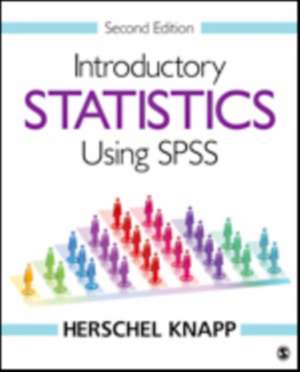
Introductory Statistics Using SPSS
Autor Herschel Knappen Limba Engleză Paperback – 19 oct 2016
Using examples, screenshots, and intuitive illustrations, students "get the story" from their data and learn by doing, completing practice exercises at the end of each chapter using prepared downloadable datasets.
New to this edition:
- Test) have been added to Chapters 5 – 9 to facilitate more versatile analyses
- New illustrations help to clarify abstract concepts, such as Treatment/Control groups and various forms of probability and non-probability sampling techniques.
- Pretest Checklist criteria for each statistical test are now presented in easy-to-read dialogue boxes to help ensure robust statistical processing.
- Multiple downloadable resources on an accompanying website include prepared SPSS data sets for all examples and exercises (eliminating data entry time and errors) and solutions to all odd-numbered exercises.
- A combined Pretest Checklist/Run Procedure video allows students to navigate directly to the section of interest to make video study more efficient.
Preț: 829.69 lei
Preț vechi: 1077.52 lei
-23%
Puncte Express: 1245
Carte tipărită la comandă
Livrare economică 28 decembrie 26 - 11 ianuarie 27
Livrare prin curier în România Termenul estimat este afișat lângă disponibilitate.
Transport gratuit pentru acest produs Plată online sau ramburs, în funcție de opțiunile comenzii.
Retur gratuit în 14 zile Comandă securizată și suport în română.
Specificații
ISBN-13: 9781506341002
ISBN-10: 1506341004
Pagini: 314
Dimensiuni: 191 x 235 x 17 mm
Greutate: 0.59 kg
Ediția:2. Auflage
Editura: Sage Publications, Inc
Locul publicării:Thousand Oaks, United States
ISBN-10: 1506341004
Pagini: 314
Dimensiuni: 191 x 235 x 17 mm
Greutate: 0.59 kg
Ediția:2. Auflage
Editura: Sage Publications, Inc
Locul publicării:Thousand Oaks, United States
V-ar putea interesa
-
 Applied Multivariate Statistical ConceptsDebbie L. Hahs-Vaughn-18%Preț: 1713.07 lei2089.12 lei
-
 Applied Multivariate Statistical ConceptsDebbie L. Hahs-Vaughn-18%Preț: 809.02 lei986.61 lei
-
 -15%Preț: 553.28 lei650.92 lei
-
 Preț: 370.96 lei
-
 Ethnographies in Sport and Exercise ResearchGyozo Molnar-15%Preț: 472.48 lei555.87 lei
-
 -15%Preț: 653.35 lei768.64 lei
-
 Introduction to Social Work PracticeHerschel Knapp-18%Preț: 809.73 lei987.48 lei
-
 Event History and Survival AnalysisPaul D. AllisonPreț: 293.37 lei
-
 A Practical Guide to Using Panel DataSimonetta LonghiPreț: 486.01 lei
-
 Researching OrganizationsMatthew Jones-27%Preț: 702.73 lei962.65 lei
-
 Epistemology and Metaphysics for Qualitative ResearchTomas PerneckyPreț: 447.61 lei
-
 The SAGE Handbook of Survey MethodologyChristof Wolf-27%Preț: 1277.53 lei1750.04 lei
-
 Designing Research in EducationJon SwainPreț: 405.58 lei
-
 Evaluation FundamentalsArlene Fink-13%Preț: 584.12 lei671.39 lei
-
 Preț: 454.61 lei
-
 Therapeutic CommunicationHerschel Knapp-5%Preț: 767.54 lei807.94 lei
-
 Practical Statistics for Nursing Using SPSSHerschel Knapp-5%Preț: 1030.80 lei1085.06 lei
-
 Intermediate Statistics Using SPSSHerschel Knapp-9%Preț: 988.33 lei1086.08 lei
Recenzii
"This student-friendly text, coupled with an ample number of practice exercises and instructional videos for each chapter, provided my students with the resources to become proficient in using SPSS to perform and interpret the statistical analyses covered in the course. In addition, this text emphasizes and models the written communication of results and conclusions derived from research."
“I find the videos extremely helpful. Of particular note was the pre-test checklist. This list helps students to understand what criteria need to be met for the test to be used. The directions provided are incredibly detailed and provide ample guidance to students with limited computer skills….Overall, I found this book to be the best of those that I have used or reviewed.”
“This is one of the best introductory SPSS texts on the market. It is easy to read, clear, concise and does not overwhelm the reader with abstract statistical theory. The exercises and examples are good and will be really useful both in class and for homework assignments. The online resources are a great addition and really help in understanding the material in the text.”
Cuprins
Preface
Acknowledgments
About the Author
PART I: STATISTICAL PRINCIPLES
1. Research Principles
Learning Objectives
Overview—Research Principles
Rationale for Statistics
Research Questions
Treatment and Control Groups
Rationale for Random Assignment
Hypothesis Formulation
Reading Statistical Outcomes
Accept or Reject Hypotheses
Variable Types and Levels of Measure
Continuous
Interval
Ratio
Categorical
Nominal
Ordinal
Good Common Sense
Key Concepts
Practice Exercises
2. Sampling
Learning Objectives
Overview—Sampling
Rationale for Sampling
Time
Cost
Feasibility
Extrapolation
Sampling Terminology
Population
Sample Frame
Sample
Representative Sample
Probability Sampling
Simple Random Sampling
Stratified Sampling
Proportionate and Disproportionate Sampling
Systematic Sampling
Area Sampling
Nonprobability Sampling
Convenience Sampling
Purposive Sampling
Quota Sampling
Snowball Sampling
Sampling Bias
Optimal Sample Size
Good Common Sense
Key Concepts
Practice Exercises
3. Working in SPSS
Learning Objectives
Video
Overview—SPSS
Two Views: Variable View and Data View
Variable View
Name
Type
Width
Decimals
Label
Values
Missing
Columns
Align
Measure
Role
Data View
Value Labels Icon
Codebook
Saving Data Files
Good Common Sense
Key Concepts
Practice Exercises
PART II: STATISTICAL PROCESSES
4. Descriptive Statistics
Learning Objectives
Videos
Overview—Descriptive Statistics
Descriptive Statistics
Number (n)
Mean (µ)
Median
Mode
Standard Deviation (SD)
Variance
Minimum
Maximum
Range
SPSS—Loading an SPSS Data File
Run SPSS
Data Set
Test Run
SPSS—Descriptive Statistics: Continuous Variables (age)
Statistics Tables
Histogram With Normal Curve
Skewed Distribution
SPSS—Descriptive Statistics: Categorical Variables (gender)
Statistics Tables
Bar Chart
SPSS—Descriptive Statistics: Continuous Variable (age) Select by Categorical Variable (gender)—Female or Male Only
SPSS—(Re)Selecting All Variables
Good Common Sense
Key Concepts
Practice Exercises
5. t Test and Mann-Whitney U Test
Learning Objectives
Videos
Overview—t Test
Example
Research Question
Groups
Procedure
Hypotheses
Data Set
Pretest Checklist
Pretest Checklist Criterion 1—Normality
Pretest Checklist Criterion 2—n Quota
Pretest Checklist Criterion 3—Homogeneity of Variance
Test Run
Results
Pretest Checklist Criterion 2—n Quota
Pretest Checklist Criterion 3—Homogeneity of Variance
p Value
Hypothesis Resolution
a Level
Documenting Results
Type I and Type II Errors
Type I Error
Type II Error
Overview—Mann-Whitney U Test
Test Run
Results
Good Common Sense
Key Concepts
Practice Exercises
6. ANOVA and Kruskal-Wallis Test
Learning Objectives
Videos
Layered Learning
Overview—ANOVA
Example
Research Question
Groups
Procedure
Hypotheses
Data Set
Pretest Checklist
Pretest Checklist Criterion 1—Normality
Pretest Checklist Criterion 2—n Quota
Pretest Checklist Criterion 3—Homogeneity of Variance
Test Run
Results
Pretest Checklist Criterion 2—n Quota
Pretest Checklist Criterion 3—Homogeneity of Variance
Comparison 1—Text : Text With Illustrations
Comparison 2—Text : Video
Comparison 3—Text With Illustrations : Video
Hypothesis Resolution
Documenting Results
Overview—Kruskal-Wallis Test
Test Run
Results
Good Common Sense
Key Concepts
Practice Exercises
7. Paired t Test and Wilcoxon Test
Learning Objectives
Videos
Overview—Paired t Test
Pretest/Posttest Design
Step 1: Pretest
Step 2: Treatment
Step 3: Posttest
Example
Research Question
Groups
Procedure
Step 1: Pretest
Step 2: Treatment
Step 3: Posttest
Hypotheses
Data Set
Pretest Checklist
Pretest Checklist Criterion 1—Normality of Difference
Test Run
Results
Hypothesis Resolution
Documenting Results
?% Formula
Overview—Wilcoxon Test
Test Run
Results
Good Common Sense
Key Concepts
Practice Exercises
8. Correlation and Regression—Pearson and Spearman
Learning Objectives
Videos
Overview—Pearson Correlation
Example 1—Pearson Regression
Research Question
Groups
Procedure
Hypotheses
Data Set
Pretest Checklist
Pretest Checklist Criterion 1—Normality
Test Run
Correlation
Regression (Scatterplot With Regression Line)
Results
Scatterplot Points
Scatterplot Regression Line
Pretest Checklist Criterion 2—Linearity
Pretest Checklist Criterion 3—Homoscedasticity
Correlation
Hypothesis Resolution
Documenting Results
Negative Correlation
No Correlation
Overview—Spearman Correlation
Example 2—Spearman Correlation
Research Question
Groups
Procedure
Hypotheses
Data Set
Pretest Checklist
Test Run
Results
Hypothesis Resolution
Documenting Results
Alternative Use for Spearman Correlation
Correlation Versus Causation
Overview—Other Types of Statistical Regression: Multiple Regression and Logistic Regression
Multiple Regression (R2)
Logistic Regression
Good Common Sense
Key Concepts
Practice Exercises
9. Chi-Square
Learning Objectives
Video
Overview—Chi-Square
Example
Research Question
Groups
Procedure
Hypotheses
Data Set
Pretest Checklist
Pretest Checklist Criterion 1—n = 5 per Cell
Test Run
Results
Pretest Checklist Criterion 1—n = 5 per Cell
Hypothesis Resolution
Documenting Results
Good Common Sense
Key Concepts
Practice Exercises
PART III: DATA HANDLING
10. Supplemental SPSS Operations
Learning Objectives
Data Sets
Overview—Supplemental SPSS Operations
Generating Random Numbers
Sort Cases
Data Set
Select Cases
Data Set
Recoding
Data Set
Importing Data
Importing Excel Data
Data Set
Importing ASCII Data (Generic Text File)
Data Set
SPSS Syntax
Data Set
Data Sets
Good Common Sense
Key Concepts
Practice Exercises
Glossary
Index
Notă biografică
Herschel Knapp, PhD, MSSW, has more than 25 years of experience as a health care professional in a variety of domains. In addition to his clinical work as a psychotherapist, primarily in hospital settings, he has provided project management for innovative implementations designed to improve the quality of patient care via multisite, health science implementations. He teaches master¿s-level courses at the University of Southern California; he has also taught at the University of California, Los Angeles and California State University, Los Angeles. Dr. Knapp has served as the lead statistician on a longitudinal cancer research project and managed the program evaluation metrics for a multisite, nonprofit children¿s center. His clinical work includes emergency/trauma therapy in hospital settings. Dr. Knapp has developed and implemented innovative telehealth systems, utilizing videoconferencing technology to facilitate optimal health care service delivery to remote patients and to coordinate specialty consultations among health care providers, including interventions to diagnose and treat people with HIV and hepatitis, with special outreach to the homeless. He is currently leading a nurse research mentorship program and providing research and analytic services to promote excellence within a health care system. The author of numerous articles in peer-reviewed health science journals, he is also the author of other textbooks, including Introductory Statistics Using SPSS (2nd ed., 2017), Practical Statistics for Nursing Using SPSS (2017), Therapeutic Communication: Developing Professional Skills (2nd ed., 2014), and Introduction to Social Work Practice: A Practical Workbook (2010).
Descriere
Shows students how to properly select, process, and interpret statistics without heavy emphasis on theory, formula derivations, or abstract mathematical concepts