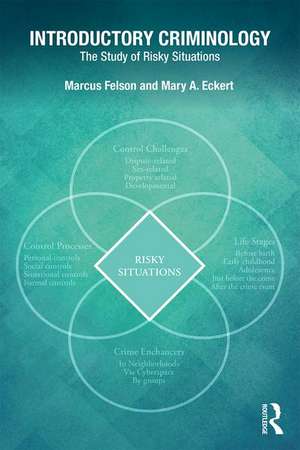
Introductory Criminology: The Study of Risky Situations
Autor Marcus Felson, Mary A. Eckerten Limba Engleză Paperback – 4 dec 2017
Considerăm că Introductory Criminology marchează o schimbare de paradigmă în predarea disciplinei, propunând o structură unificată care elimină fragmentarea ideilor specifică manualelor clasice. Această ediție se distinge prin renunțarea la organizarea bazată pe etichete filozofice abstracte, precum „pozitivismul” sau „clasicismul”, în favoarea unei analize a situațiilor concrete de risc în care infracțiunea devine probabilă. Reținem organizarea riguroasă în cinci părți, de la „Provocarea criminalității” la „Zonele de criminalitate manifestă”, care ghidează studentul prin mecanismele controlului social și personal.
Fiecare unitate este calibrată pentru a combate aversiunea față de teorie, utilizând un limbaj accesibil și o progresie logică: se înțelege întâi fenomenul și abia apoi se aplică eticheta teoretică. Merită menționat că autorii au optat pentru o prezentare vizuală funcțională, incluzând 68 de ilustrații color și diagrame originale care explică dinamica infracțională, evitând estetica decorativă a fotografiilor de stoc. Introductory Criminology reprezintă o alternativă pragmatică la Criminology de Stephen E. Brown pentru cursurile de sociologie și justiție penală, având avantajul unei structuri „lean”, fără balast informațional, care prioritizează retenția pe termen lung a conceptelor.
În contextul operei lui Marcus Felson, acest volum integrează viziunea sa din Crime and Everyday Life și Crime and Nature, dar o adaptează pentru nivelul licență și master prin unități specifice despre „Justiția realistă” și „Vârstele de risc”. Dacă în Routine Activity and Rational Choice autorul analiza evenimentul infracțional, aici el extinde cadrul către controlul social și limitele sancțiunilor formale, oferind o viziune de ansamblu asupra ecosistemului criminalității.
Preț: 567.82 lei
Preț vechi: 638.01 lei
-11%
Carte disponibilă
Livrare economică 25 mai-08 iunie
Specificații
ISBN-10: 1138668249
Pagini: 480
Ilustrații: 13 Tables, color; 68 Line drawings, color; 68 Illustrations, color
Dimensiuni: 187 x 235 x 24 mm
Greutate: 0.97 kg
Ediția:1
Editura: Taylor & Francis
Colecția Routledge
Locul publicării:Oxford, United Kingdom
Public țintă
Postgraduate and UndergraduateDe ce să citești această carte
Această lucrare este esențială pentru studenții la criminologie care doresc să depășească memorarea unor liste de teorii deconectate. Prin abordarea axată pe „situații de risc”, cititorul câștigă o înțelegere practică a modului în care mediul și interacțiunile sociale facilitează sau previn crima. Este un instrument de lucru modern, cu grafice clare și capitole concise, ideal pentru cei care caută claritate teoretică aplicată direct în realitatea justiției penale.
Despre autor
Marcus Felson este profesor la School of Criminal Justice din cadrul Universității Rutgers, Newark, fiind recunoscut la nivel mondial pentru teoriile sale inovatoare în criminologie, în special pentru abordarea „activităților de rutină”. Este autorul lucrării de referință Crime and Everyday Life. Mary A. Eckert este cercetător experimentat în domeniul justiției penale. Împreună, cei doi autori combină rigoarea academică cu datele de teren pentru a redefini modul în care este predată criminologia, punând accent pe prevenție și pe analiza contextului situațional al infracțiunii.
Descriere scurtă
This fresh new text was created by two professors to address the main points they encounter in teaching their own criminology courses. Problems solved include: reluctant readers, aversion to abstract thinking, fear of theory, and boredom with laundry lists of disconnected ideas. Felson, a leader in criminology theory with a global reputation for innovative thinking, and Eckert, an experienced criminal justice researcher, are uniquely qualified to reframe criminology in a unified arc. By design, they offer abstractions that are useful and not overbearing; their prose is readable, and their concepts are easy to comprehend and remember. This new textbook challenges instructors to re-engage with theory and present the essence of criminological thought for adult learners, coaching students to grasp the concept before any label is attached and allowing them to emerge with deeper understanding of what each theory means and offers. Lean, with no filler or fluff like stock photos, Introductory Criminology includes the authors’ graphics to crystallize and expand concepts from the text.
Cuprins
Notă biografică
Mary A. Eckert has devoted an active career to applied research in criminal justice and program evaluation. She has an M.A. and Ph.D. from New York University. Her B.A. is from the College of New Rochelle. Dr. Eckert served as Research Director of the New York City Criminal Justice Agency, Inc., where she authored many research reports and guided that agency’s diverse research agenda, including work on pretrial risk assessment, court case processing, and evaluation of alternative-to-incarceration programs. She then served in the New Jersey Office of the Attorney General, with a special focus on statistical evaluation of vehicle stops to assist the New Jersey State Police in reducing the potential for racial profiling. Her work has been recognized by the New York Association of Pretrial Service Agencies and the State of New Jersey. She has also served as an adjunct professor at New York University, Montclair State University, and Texas State University. Marcus Felson’s wife and life partner, this book is her second collaboration with her husband.
Recenzii
'From the perspective of the community college, the true intersection of our neighborhoods, Felson and Eckert have added another rich layer to criminology with risky situations. Students will be able to better retain what is taught. A solidly structured textbook that supports your pedagogy.' – Randy S. Zimpfer, Jamestown Community College
'Marcus Felson and Mary Eckert have written a cutting-edge Criminology book that breaks through the often-stuffy presentation of seemingly endless and non-related criminology theories that leave students—and instructors—hoping just to complete the semester. With an innovative framework focusing on Risky Situations, readers will clearly understand and value the connection of criminological theory with real-world and personal experiences while acquiring practical ideas to understand, prevent, and respond to crime.' – Ben Stickle, Middle Tennessee State University