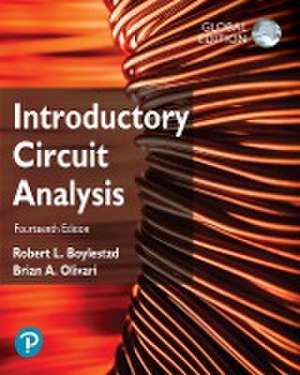
Introductory Circuit Analysis, Global Edition
Autor Robert Boylestaden Limba Engleză Paperback – 18 apr 2023
Ca și John O'Malley în Schaum's Outline of Basic Circuit Analysis, Second Edition, autorul distilează experiență reală în principii acționabile, oferind o bază solidă pentru inginerii în devenire. Credem că Introductory Circuit Analysis, Global Edition reușește să rămână un standard în domeniu de peste 50 de ani tocmai prin capacitatea de a evolua odată cu tehnologia, fără a sacrifica rigoarea teoretică. Față de abordarea schematică a seriei Schaum, Robert Boylestad propune o metodologie narativă și aplicată, integrând calculul numeric direct în fluxul de învățare.
Ne-a atras atenția modul în care această a 14-a ediție reechilibrează balanța între teorie și practică. Dacă în lucrările sale anterioare, precum Electronic Devices and Circuit Theory, accentul cădea pe componente și arhitecturi complexe, aici autorul se concentrează pe fundamente: factorul de putere, conceptele de „lead” și „lag” și legile fundamentale ale circuitelor. Structura cărții este didactică și progresivă, pornind de la conceptele de bază de tensiune, curent și rezistență, trecând prin teoreme de rețea în curent continuu, până la analiza avansată a circuitelor în curent alternativ, filtre și sisteme polifazate.
Recomandăm acest volum pentru integrarea excelentă a instrumentelor de calcul; ghidajul pentru TI 89 Titanium elimină necesitatea consultării manualelor separate, permițând cititorului să se concentreze pe rezolvarea problemelor de inginerie. Cele peste 2.000 de ilustrații și secțiunile de laborator transformă textul dintr-un simplu manual într-un instrument de lucru activ, adaptat cerințelor actuale din industria electronică.
Preț: 707.89 lei
Preț vechi: 795.38 lei
-11%
Carte disponibilă
Livrare economică 04-18 iulie
Livrare express 20-26 iunie pentru 109.62 lei
Specificații
ISBN-10: 1292720301
Pagini: 1144
Dimensiuni: 277 x 216 x 46 mm
Greutate: 2.47 kg
Ediția:14. Auflage
Editura: Pearson Education
V-ar putea interesa
-
 Schaum's Outline of Basic Electricity, Second EditionMilton Gussow-10%Preț: 132.52 lei147.25 lei
 -
 Preț: 131.20 lei
 -
 Microelectronic CircuitsAdel S. Sedra-24%Preț: 912.24 lei1203.00 lei
 -
 Basic ElectricityUnited States Bureau Of Naval Personnel-32%Preț: 102.94 lei152.00 lei
 -
 Preț: 227.66 lei
 -
 Circuit Analysis For DummiesJohn SantiagoPreț: 135.66 lei
 -
 Engineering Circuit Analysis, International AdaptationJ. David Irwin-19%Preț: 418.77 lei516.99 lei
 -
 ISE Fundamentals of Electric CircuitsCharles Alexander-8%Preț: 480.06 lei521.81 lei
 -
 Principles and Applications of Electrical Engineering ISEGiorgio Rizzoni-27%Preț: 371.98 lei506.73 lei
 -
 Engineering Circuit Analysis ISEWilliam Hayt-27%Preț: 369.99 lei505.64 lei
 -
 Grob's Basic Electronics: 2024 Release ISEMitchel Schultz-24%Preț: 402.29 lei530.42 lei
 -
 ElectronicsNeil Storey-9%Preț: 554.61 lei609.47 lei
 -
 Electronic Devices, Global EditionThomas Floyd-9%Preț: 614.20 lei674.94 lei
 -
 Electrical EngineeringAllan Hambley-11%Preț: 692.02 lei777.54 lei
 -
 -11%Preț: 680.94 lei765.10 lei
 -
 -20%Preț: 554.09 lei692.62 lei
 -
 Nilsson, J: Electric Circuits, Global EditionSusan Riedel-9%Preț: 636.73 lei699.70 lei
 -
 -28%Preț: 87.39 lei120.62 lei
 -
 Foundations of Analog and Digital Electronic CircuitsAnant Agarwal-29%Preț: 526.71 lei742.57 lei
 -
 Electric Circuit Analysis with EasyEDAFarzin AsadiPreț: 416.81 lei
De ce să citești această carte
Recomandăm această carte studenților și pasionaților de electronică care caută o înțelegere profundă a circuitelor DC/AC. Cititorul câștigă nu doar cunoștințe teoretice, ci și competențe practice în utilizarea instrumentelor de calcul și a echipamentelor de laborator. Este un manual complet care facilitează tranziția de la conceptele de bază la analize complexe de rețea, fiind esențial pentru pregătirea examenelor și pentru practica profesională.
Despre autor
Robert Boylestad este un autor de prestigiu și profesor emerit, recunoscut la nivel global pentru contribuțiile sale fundamentale în educația tehnică. Lucrările sale, publicate în principal prin Pearson Education, au devenit referințe standard în universitățile de profil. Cu o experiență de peste jumătate de secol în domeniu, Boylestad s-a remarcat prin capacitatea de a explica subiecte complexe de inginerie electrică și electronică într-o manieră accesibilă, punând mereu accent pe aplicațiile practice și pe evoluția instrumentelor de calcul moderne.
Descriere scurtă
The latest insights in circuit analysis, with detailed calculation guidance Introductory Circuit Analysis has been the number one acclaimed text in the field for over 50 years. Boylestad presents complex subject matter clearly and with an eye on practical applications. He provides detailed guidance in using the TI 89 Titanium calculator, the choice for this text, to perform all the required math techniques. Challenging chapter-ending review questions help learners build confidence and comprehension.
Updated with the most current, relevant content, the 14th Edition places greater emphasis on fundamentals and has been redesigned with a more modern, accessible layout.
Hallmark features of this title
Coverage with direct applications
- Clear, detailed guidance in using the TI 89 Titanium calculator helps students perform the required math techniques without having to refer to the calculator manual. In some cases, short-cut methods are introduced.
- Computer sections demonstrate how the computer can be used as lab equipment.
Engaging practice
- Problem sections at the end of each chapter reinforce understanding of major concepts.
Emphasis on fundamentals
- REVISED - The new edition turns attention to fundamental theories over the mechanics of applying computer methods.
- UPDATED - Topics requiring a solid understanding of Power Factor, Lead and Lag concepts have been significantly enhanced throughout the text.
Practice updates
- UPDATED - Accompanying lab experiments and summary of equations have been carefully reviewed for accuracy. Changes were made where required.
- UPDATED - Problems in each section were carefully reviewed to ensure they progressed from simple to more complex.
Visual reinforcement
- UPDATED - Many of the 2,000+ images are new or have been modified to reflect the latest industry practices.
- ENHANCED - The overall design has been updated for a more modern, accessible layout.
Optimize study time
- Find it fast. Enhanced search makes it easy to find a key term or topic to study. Students can also search videos, images and their own notes.
- Get organized and get results. Students can add their own notes, bookmarks and highlights directly in their eText.
- Study in a flash. Students can use pre-built flashcards or create their own to study how they like.
Meet students where they are
- Read online or offline. With the mobile app, you and your students can access your eText anytime, even offline.
- Listen anywhere. Learners can listen to the audio version of their eText for most titles, whether at home or on the go.
- Watch and learn. Videos and animations right within the eText help bring tricky concepts to life. Available in select titles.
Notă biografică
For the 14th edition, Professor Boylestad felt it wise to join hands with Professor Brian Olivari (Maine Maritime Academy) to be sure he was fully aware of recent trends in the scope and depth of coverage in various subject areas. He feels it has been a wonderful union in developing the content of this edition.
His history in the educational field includes some 45 years at various professorial ranks in the City University New York. There was also a period of some 10 years as assistant dean at the Thayer School of Engineering at Dartmouth.
During his teaching career, he was fortunate enough to find the time to write some 7 texts related to the electrical/electronics field. The two most successful are Introductory Circuit Analysis and Electronic Devices and Circuit Theory (co-authored with Professor Louis Nashelsky). The first is now in this 14th edition and the latter in its 11th edition. Both texts have been translated into foreign languages, with Introductory Circuit Analysis translated into 7 languages: Arabic, Chinese, French, Korean, Portuguese, Spanish and Taiwanese.
In addition to Introductory Circuit Analysis, there was the publication of manuals and texts related to computer languages: BASIC Applied to Circuit Analysis, Manual for the IBM PC jr and BASJC for Electronics and Computer Technologies.
Professor Boylestad looks forward to any response from users of this 14th edition to ensure the text remains current in the years to come.
Professor Brian A. Olivari is honored to have been asked by Professor Boylestad to collaborate on the 14th edition of Introductory Circuit Analysis. He could never have imagined being co-authors on the latest edition when he first used Professor Boylestad's Electronic Devices and Circuit Theory textbook as a student back in 1977, and then the 11th edition of Introductory Circuit Analysis as a professor in 2008.
As a faculty member at Maine Maritime Academy for over 15 years, Professor Olivari has focused his teaching on both electrical engineering and mathematics. In engineering, his primary interest has been in circuit analysis and power control electronics. In mathematics, he has been committed to preparing his math students to be successful at solving engineering problems.
Prior to teaching at Maine Maritime Academy, Professor Olivari gained much of his professional experience in the telecommunications industry. He worked at Western Electric, Rochester Telephone and, most notably, Bell Labs, where he was part of a team of engineers (systems, mechanical, electrical and software) that developed the first-of-its-kind stored-program controlled D5 Digital Channel Bank System. Additionally, he served as associate editor of the IEEE Solid-State Circuits Conference Digest of Technical Papers and taught briefly at Rochester Institute of Technology.
Cuprins
- Introduction
- Voltage and Current
- Resistance
- Ohm's Law, Power, and Energy
- Series dc Circuits
- Parallel dc Circuits
- Series-Parallel Circuits
- Methods of Analysis and Selected Topics (dc)
- Network Theorems
- Capacitors
- Inductors
- Magnetic Circuits
- Sinusoidal Alternating Waveforms
- The Basic Elements and Phasors
- Series ac Circuits
- Parallel ac Circuits
- Series-Parallel ac Networks
- Methods of Analysis and Selected Topics (ac)
- Network Theorems (ac)
- Power (ac)
- Resonance
- Decibels, Filters, and Bode Plots
- Transformers
- Polyphase Systems
- Pulse Waveforms and the R-C Response
- Nonsinusoidal Circuits
- Conversion Factors
- Determinants
- Greek Alphabet
- Magnetic Parameter Conversions
- Maximum Power Transfer Conditions
- Answers to Selected Odd-Numbered Problems