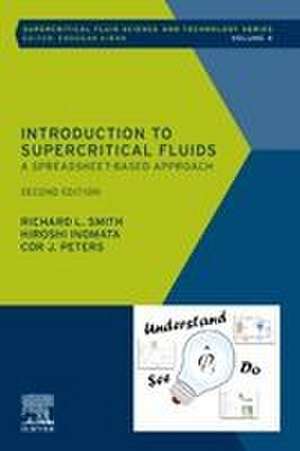
Introduction to Supercritical Fluids: A Spreadsheet-Based Approach: Supercritical Fluid Science and Technology, cartea 4
Autor Richard L. Smith, Hiroshi Inomata, Cor J. Petersen Limba Engleză Paperback – sep 2026
Part I covers web-based chemical information resources, applications and simplified theory presented in a way that allows students of all disciplines to delve into the properties of supercritical fluids and to design energy, extraction and materials formation systems for real-world processes that use supercritical water or supercritical carbon dioxide.
Part II takes a practical approach and addresses the thermodynamic framework, equations of state, fluid phase equilibria, mass transfer (newly added), heat transfer and cycle analysis (newly added), chemical equilibria and reaction kinetics of supercritical fluids. Spreadsheets are arranged as Visual Basic for Applications (VBA) functions and macros that are completely (source code) accessible for students who have interest in developing their own programs. Programming is not required to solve problems or to complete projects in the text.
Introduction to Supercritical Fluids, Second Edition is written primarily for graduate students and researchers in chemistry, chemical engineering, and materials science.
- Provides an overview of elementary supercritical fluid processes (extraction, particle formation, heat exchangers, phase equilibrium, chemical reaction equilibrium)
- Each chapter contains practical activities with worked examples, tip boxes and end-of-the-chapter problems and projects for the reader
- Contains new and updated worked examples suitable for both introductory and advanced level students and fully updated Excel VBA Worksheet functions that can be used "as-is" to perform "hands-on" calculations, simulations and analyses of supercritical fluid processes and allow users to design their own processes
- Includes helpful teaching aids that will simplify instruction of both introductory level students and advanced students about the merits and applications of supercritical fluids
- Fluid phase equilibria and chemical equilibria worksheets allow users to change conditions, study new solutes, co-solvents, chemical systems, or reactions
- New comprehensive chapters or sections on Mass transfer, Heat Transfer, Pinch analysis, AI-assisted approaches, Commercial applications, Phase Behavior, with all previous material and VBA Worksheets being fully updated
- New improved comprehensive property calculation worksheets for water and carbon dioxide that simplify teaching of supercritical fluid properties to large classes

Preț: 1079.94 lei
Preț vechi: 1186.75 lei
-9% Nou
Puncte Express: 1620
Carte disponibilă
Livrare economică 23 octombrie-06 noiembrie
Livrare prin curier în România Termenul estimat este afișat lângă disponibilitate.
Transport gratuit pentru acest produs Plată online sau ramburs, în funcție de opțiunile comenzii.
Retur gratuit în 14 zile Comandă securizată și suport în română.
Specificații
ISBN-13: 9780443137433
ISBN-10: 0443137439
Pagini: 912
Dimensiuni: 152 x 229 mm
Greutate: 1.56 kg
Ediția:2nd edition
Editura: ELSEVIER SCIENCE
Seria Supercritical Fluid Science and Technology
ISBN-10: 0443137439
Pagini: 912
Dimensiuni: 152 x 229 mm
Greutate: 1.56 kg
Ediția:2nd edition
Editura: ELSEVIER SCIENCE
Seria Supercritical Fluid Science and Technology
Cuprins
Part I – for Multi-disciplinary instruction
1. Supercritical Fluids: Fundamentals of State Changes, Processes, and Systems
1.1 State Changes, Processes and Systems
1.2 Organization of the text
1.3 Basic vocabulary
1.4 Some notes on pressure
1.5 Chapter Summary
1.6 References and Additional Reading
1.7 End of Chapter Problems
2. Material-Energy-Entropy Balances of Supercritical Fluid Processes
2.1 Introduction
2.2 Analysis of devices and processes
2.3 Practical process I: Transcritical CO2 hot water heating system
2.4 Practical process II: Flavor extraction with supercritical CO2
2.5 Practical process III: Fine particle formation with supercritical H2O
2.6 Chapter Summary
2.7 References and Additional Reading
2.8 End of Chapter Problems
2.9 End of Chapter Projects
2.10 Report format
3. Chemical Information for Supercritical Fluids with AI-assisted Approaches
3.1 Introduction
3.2 Search engines and AI tools
3.3 Reliable sources of chemical information
3.4 Chemical property databases: reference substances
3.5 Chemical property databases: non-reference substances
3.6 Chemical literature databases
3.7 Bibliometrics
3.8 Chapter Summary
3.9 References and Additional Reading
3.10 End of Chapter Problems
4. Commercial Applications of Supercritical Fluid Technology-Past and Present
4.1 Historical background
4.2 Characteristic features common to all supercritical fluids
4.3 Extraction with supercritical CO2
4.4 Commercial food products
4.5 Methods for improving yield and modifying selectivity
4.6 Dietary supplements
4.7 Green chemistry with supercritical CO2
4.8 Polymer synthesis
4.9 Separations
4.10 Characteristic features of supercritical water
4.11 Commercial chemical and waste recycling processes
4.12 Commercial hydrothermal and supercritical oxidation processes
4.13 Particle formation
4.14 Coating and Film Deposition
4.15 Polymer Processing
4.16 Food Processing
4.17 Chromatography
4.18 Gas-Expanded Liquids (GXLs)
4.19 List of companies involved with supercritical fluids
4.20 Chapter Summary
4.21 References and Additional Reading
4.22 End of Chapter Problems
Part II – for Specialized discipline instruction
5. Practical Thermodynamic Expressions for Supercritical Fluid Phase Equilibria
5.1 Introduction to thermodynamics 5-1
5.2 Thermodynamic state functions 5-4
5.3 Material, energy, and entropy balances 5-11
5.4 Thermodynamic systems 5-15
5.5 Basic thermodynamic relationships 5-26
5.6 Fugacity 5-30
5.7 Phase stability 5-39
5.8 Selected thermodynamic phase equilibrium criteria 5-44
5.9 Practical expressions 5-47
5.11 Chapter Summary 5-59
5.12 References and Additional Reading 5-60
5.13 End of Chapter Projects 5-60
5.14 Report Format 5-62
6. Fluid Property Calculations with Equations of State using Excel VBA Functions
6.1 Overview of equations of state (EoS)
6.2 Calculation of CO2 properties with Excel VBA functions
6.3 Calculation of H2O properties with Excel VBA functions
6.4 Mathematically simple equations of state
6.5 Cubic equations of state
6.6 Pure component fugacity from a cubic equation of state
6.7 Application of cubic EoS to mixtures
6.8 Modern cubic equation of state formulations
6.9 Relating EoS parameters to solution models
6.10 Molecular-based equations of state
6.11 Chapter Summary
6.12 References and Additional Reading
6.13 End of Chapter Problems
6.14 Report Format
7. Phase Equilibria and Phase Behavior of Supercritical Fluid Systems
7.1 Overview
7.2 Solid-vapor equilibria (SVE)
7.3 Solid-Liquid-Vapor equilibria (SLVE)
7.4 Vapor-Liquid equilibria (VLE)
7.5 Numerical solution method for vapor-liquid equilibria
7.6 Critical points of mixtures
7.7 Numerical solution method for critical points of mixtures
7.8 Three-dimensional visualization of phase equilibria
7.9 Phase behavior of binary mixtures
7.10 Phase behavior of ternary mixtures
7.11 Chapter Summary
7.12 References and Additional Reading
7.13 End of Chapter Problems
7.14 End of Chapter Projects
7.15 Report Format
8. Mass Transfer Models for Hydrothermal and Supercritical Fluid Systems
8.1 Overview
8.2 Extraction curves of botanicals
8.3 Simple mathematical models for extraction curves
8.4 Logistic models
8.5 Combination models
8.6 Momentum-diffusion transport models
8.7 Dimensionless groups commonly used in mass transfer
8.8 Mechanistic mass transfer models
8.9 Recommendations for extraction models
8.10 Chapter Summary
8.11 References and Additional Reading
8.12 End of Chapter Problems
8.13 End of Chapter Projects
8.14 Report Format
9. Heat Transfer in Transcritical Heat Exchangers and Cycle Analysis
9.1 Overview
9.2 Heat exchangers
9.3 Modes of heat transfer
9.4 Thermophysical properties of fluids in the critical region
9.5 Dimensionless groups commonly used in heat transfer
9.6 Analysis of shell-and-tube heat exchangers
9.7 Estimation of heat exchanger area
9.8 Cycle analysis
9.9 Equations of change
9.10 Chapter Summary
9.11 References and Additional Reading
9.12 End of Chapter Problems
9.13 End of Chapter Projects
9.14 Report Format
10. Chemical Equilibrium and Reaction Kinetics in Supercritical Fluid Systems
10.1 Overview
10.2 Thermochemistry
10.3 Chemical equilibrium
10.4 Le Chatlier's principle
10.5 Calculation of chemical equilibrium
10.6 Chemical reactors
10.7 Reaction kinetics
10.8 Chapter Summary
10.9 References and Additional Reading
10.10 End of Chapter Problems
10.11 End of Chapter Projects
10.12 Report Format
11. User's Guide to Programs in Introduction to Supercritical Fluids
11.1 Guide to Visual Basic for Applications (VBA) in Excel
11.2 Building User-Defined Functions, Subroutines and Macros in VBA
11.3 Guide to importing data into 3D Grapher
11.4 Guidance on Excel workbooks supplied with the text
1. Supercritical Fluids: Fundamentals of State Changes, Processes, and Systems
1.1 State Changes, Processes and Systems
1.2 Organization of the text
1.3 Basic vocabulary
1.4 Some notes on pressure
1.5 Chapter Summary
1.6 References and Additional Reading
1.7 End of Chapter Problems
2. Material-Energy-Entropy Balances of Supercritical Fluid Processes
2.1 Introduction
2.2 Analysis of devices and processes
2.3 Practical process I: Transcritical CO2 hot water heating system
2.4 Practical process II: Flavor extraction with supercritical CO2
2.5 Practical process III: Fine particle formation with supercritical H2O
2.6 Chapter Summary
2.7 References and Additional Reading
2.8 End of Chapter Problems
2.9 End of Chapter Projects
2.10 Report format
3. Chemical Information for Supercritical Fluids with AI-assisted Approaches
3.1 Introduction
3.2 Search engines and AI tools
3.3 Reliable sources of chemical information
3.4 Chemical property databases: reference substances
3.5 Chemical property databases: non-reference substances
3.6 Chemical literature databases
3.7 Bibliometrics
3.8 Chapter Summary
3.9 References and Additional Reading
3.10 End of Chapter Problems
4. Commercial Applications of Supercritical Fluid Technology-Past and Present
4.1 Historical background
4.2 Characteristic features common to all supercritical fluids
4.3 Extraction with supercritical CO2
4.4 Commercial food products
4.5 Methods for improving yield and modifying selectivity
4.6 Dietary supplements
4.7 Green chemistry with supercritical CO2
4.8 Polymer synthesis
4.9 Separations
4.10 Characteristic features of supercritical water
4.11 Commercial chemical and waste recycling processes
4.12 Commercial hydrothermal and supercritical oxidation processes
4.13 Particle formation
4.14 Coating and Film Deposition
4.15 Polymer Processing
4.16 Food Processing
4.17 Chromatography
4.18 Gas-Expanded Liquids (GXLs)
4.19 List of companies involved with supercritical fluids
4.20 Chapter Summary
4.21 References and Additional Reading
4.22 End of Chapter Problems
Part II – for Specialized discipline instruction
5. Practical Thermodynamic Expressions for Supercritical Fluid Phase Equilibria
5.1 Introduction to thermodynamics 5-1
5.2 Thermodynamic state functions 5-4
5.3 Material, energy, and entropy balances 5-11
5.4 Thermodynamic systems 5-15
5.5 Basic thermodynamic relationships 5-26
5.6 Fugacity 5-30
5.7 Phase stability 5-39
5.8 Selected thermodynamic phase equilibrium criteria 5-44
5.9 Practical expressions 5-47
5.11 Chapter Summary 5-59
5.12 References and Additional Reading 5-60
5.13 End of Chapter Projects 5-60
5.14 Report Format 5-62
6. Fluid Property Calculations with Equations of State using Excel VBA Functions
6.1 Overview of equations of state (EoS)
6.2 Calculation of CO2 properties with Excel VBA functions
6.3 Calculation of H2O properties with Excel VBA functions
6.4 Mathematically simple equations of state
6.5 Cubic equations of state
6.6 Pure component fugacity from a cubic equation of state
6.7 Application of cubic EoS to mixtures
6.8 Modern cubic equation of state formulations
6.9 Relating EoS parameters to solution models
6.10 Molecular-based equations of state
6.11 Chapter Summary
6.12 References and Additional Reading
6.13 End of Chapter Problems
6.14 Report Format
7. Phase Equilibria and Phase Behavior of Supercritical Fluid Systems
7.1 Overview
7.2 Solid-vapor equilibria (SVE)
7.3 Solid-Liquid-Vapor equilibria (SLVE)
7.4 Vapor-Liquid equilibria (VLE)
7.5 Numerical solution method for vapor-liquid equilibria
7.6 Critical points of mixtures
7.7 Numerical solution method for critical points of mixtures
7.8 Three-dimensional visualization of phase equilibria
7.9 Phase behavior of binary mixtures
7.10 Phase behavior of ternary mixtures
7.11 Chapter Summary
7.12 References and Additional Reading
7.13 End of Chapter Problems
7.14 End of Chapter Projects
7.15 Report Format
8. Mass Transfer Models for Hydrothermal and Supercritical Fluid Systems
8.1 Overview
8.2 Extraction curves of botanicals
8.3 Simple mathematical models for extraction curves
8.4 Logistic models
8.5 Combination models
8.6 Momentum-diffusion transport models
8.7 Dimensionless groups commonly used in mass transfer
8.8 Mechanistic mass transfer models
8.9 Recommendations for extraction models
8.10 Chapter Summary
8.11 References and Additional Reading
8.12 End of Chapter Problems
8.13 End of Chapter Projects
8.14 Report Format
9. Heat Transfer in Transcritical Heat Exchangers and Cycle Analysis
9.1 Overview
9.2 Heat exchangers
9.3 Modes of heat transfer
9.4 Thermophysical properties of fluids in the critical region
9.5 Dimensionless groups commonly used in heat transfer
9.6 Analysis of shell-and-tube heat exchangers
9.7 Estimation of heat exchanger area
9.8 Cycle analysis
9.9 Equations of change
9.10 Chapter Summary
9.11 References and Additional Reading
9.12 End of Chapter Problems
9.13 End of Chapter Projects
9.14 Report Format
10. Chemical Equilibrium and Reaction Kinetics in Supercritical Fluid Systems
10.1 Overview
10.2 Thermochemistry
10.3 Chemical equilibrium
10.4 Le Chatlier's principle
10.5 Calculation of chemical equilibrium
10.6 Chemical reactors
10.7 Reaction kinetics
10.8 Chapter Summary
10.9 References and Additional Reading
10.10 End of Chapter Problems
10.11 End of Chapter Projects
10.12 Report Format
11. User's Guide to Programs in Introduction to Supercritical Fluids
11.1 Guide to Visual Basic for Applications (VBA) in Excel
11.2 Building User-Defined Functions, Subroutines and Macros in VBA
11.3 Guide to importing data into 3D Grapher
11.4 Guidance on Excel workbooks supplied with the text