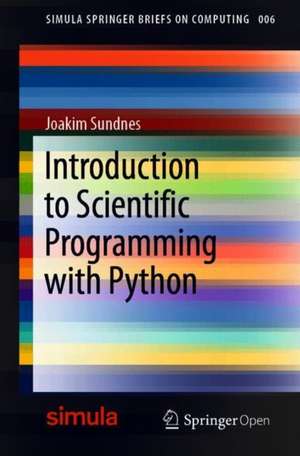
Introduction to Scientific Programming with Python: Simula SpringerBriefs on Computing, cartea 6
Autor Joakim Sundnesen Limba Engleză Paperback – 2 iul 2020
The book uses relevant examples from mathematics and the natural sciences to present programming as a practical toolbox that can quickly enable readers to write their own programs for data processing and mathematical modeling. These tools include file reading, plotting, simple text analysis, and using NumPy for numerical computations, which are fundamental building blocks of all programs in data science and computational science. At the same time, readers are introduced to the fundamental concepts of programming, including variables, functions, loops, classes, and object-oriented programming. Accordingly, the book provides a sound basis for further computer science and programming studies.




Preț: 273.10 lei
Puncte Express: 410
Carte tipărită la comandă
Livrare economică 16-30 decembrie
Livrare prin curier în România Termenul estimat este afișat lângă disponibilitate.
Transport gratuit de la 400.00 lei Plată online sau ramburs, în funcție de opțiunile comenzii.
Retur gratuit în 14 zile Comandă securizată și suport în română.
Specificații
ISBN-13: 9783030503550
ISBN-10: 3030503550
Pagini: 164
Ilustrații: XIV, 148 p.
Dimensiuni: 155 x 235 x 10 mm
Greutate: 0.26 kg
Ediția:1st edition 2020
Editura: Springer
Colecția Simula SpringerBriefs on Computing
Seria Simula SpringerBriefs on Computing
Locul publicării:Cham, Switzerland
ISBN-10: 3030503550
Pagini: 164
Ilustrații: XIV, 148 p.
Dimensiuni: 155 x 235 x 10 mm
Greutate: 0.26 kg
Ediția:1st edition 2020
Editura: Springer
Colecția Simula SpringerBriefs on Computing
Seria Simula SpringerBriefs on Computing
Locul publicării:Cham, Switzerland
Cuprins
Getting started with Python.- Computing with formulas.- Loops and lists.- Functions and branching.- User input and error handling.- Arrays and plotting.- Dictionaries and strings.- Classes.- Object-oriented programming.
Notă biografică
Joakim Sundnes is Chief Research Scientist at Simula Research Laboratory and teaches undergraduate programming at the University of Oslo. His research interests are scientific computing and computational science, particularly related to biomechanics and computational physiology. Mathematical models in these fields are typically formulated as differential equations, and he has spent more than two decades developing and implementing solvers for these models. He is also responsible for the main introductory programming class for natural science students at the University of Oslo, which includes a thorough introduction to ordinary differential equations.
Textul de pe ultima copertă
This open access book offers an initial introduction to programming for scientific and computational applications using the Python programming language. The presentation style is compact and example-based, making it suitable for students and researchers with little or no prior experience in programming.
The book uses relevant examples from mathematics and the natural sciences to present programming as a practical toolbox that can quickly enable readers to write their own programs for data processing and mathematical modeling. These tools include file reading, plotting, simple text analysis, and using NumPy for numerical computations, which are fundamental building blocks of all programs in data science and computational science. At the same time, readers are introduced to the fundamental concepts of programming, including variables, functions, loops, classes, and object-oriented programming. Accordingly, the book provides a sound basis for further computer science and programming studies.
The book uses relevant examples from mathematics and the natural sciences to present programming as a practical toolbox that can quickly enable readers to write their own programs for data processing and mathematical modeling. These tools include file reading, plotting, simple text analysis, and using NumPy for numerical computations, which are fundamental building blocks of all programs in data science and computational science. At the same time, readers are introduced to the fundamental concepts of programming, including variables, functions, loops, classes, and object-oriented programming. Accordingly, the book provides a sound basis for further computer science and programming studies.
Caracteristici
Practical and example-based presentation quickly enables readers to start writing their own programs The book combines practical tools of computational science with fundamental and generic programming concepts, including object-oriented programming Provides a compact introduction to the essential building blocks of programs for data-centric and computational applications