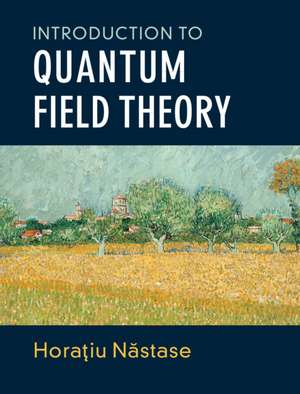
Introduction to Quantum Field Theory
Autor Horatiu Nastaseen Limba Engleză Hardback – 17 oct 2019
Preț: 583.26 lei
Preț vechi: 720.08 lei
-19%
Puncte Express: 875
Carte tipărită la comandă
Livrare economică 04-18 decembrie
Livrare prin curier în România Termenul estimat este afișat lângă disponibilitate.
Transport gratuit pentru acest produs Plată online sau ramburs, în funcție de opțiunile comenzii.
Retur gratuit în 14 zile Comandă securizată și suport în română.
Specificații
ISBN-13: 9781108493994
ISBN-10: 1108493998
Pagini: 734
Ilustrații: 5 b/w illus.
Dimensiuni: 208 x 260 x 44 mm
Greutate: 1.7 kg
Editura: Cambridge University Press
Locul publicării:Cambridge, United Kingdom
ISBN-10: 1108493998
Pagini: 734
Ilustrații: 5 b/w illus.
Dimensiuni: 208 x 260 x 44 mm
Greutate: 1.7 kg
Editura: Cambridge University Press
Locul publicării:Cambridge, United Kingdom
V-ar putea interesa
-
 Handbook of SuperconductivityCharles K. Poole-42%Preț: 727.76 lei1259.96 lei
 -
 -27%Preț: 1369.66 lei1876.24 lei
 -
 -27%Preț: 908.18 lei1244.08 lei
 -
 Quantum State DiffusionIan Percival-11%Preț: 622.39 lei699.31 lei
 -
 Q Is for QuantumJohn R. GribbinPreț: 325.71 lei
 -
 String Theory Methods for Condensed Matter PhysicsHoratiu Nastase-11%Preț: 740.53 lei832.06 lei
 -
 Quantum MechanicsHora¿iu N¿stase-19%Preț: 685.27 lei846.01 lei
 -
 DECOHERENCE & QUANTUM MEASUREMENTSNamiki M-15%Preț: 509.51 lei599.42 lei
 -
 -15%Preț: 610.53 lei718.27 lei
 -
 APPLIED QUANTUM MECHANICSHarrison Walter A-15%Preț: 545.03 lei641.21 lei
Cuprins
1. Review of classical field theory; 2. Quantum mechanics; 3. Canonical quantization of scalar fields; 4. Propagators for free scalar fields; 5. Interaction picture and wick theorem for Λφ4 in operator formalism; 6. Feynman rules for Λφ4 from the operator formalism; 7. The driven (forced) harmonic oscillator; 8. Euclidean formulation and finite temperature field theory; 9. The Feynman path integral for a scalar field; 10. Wick theorem for path integrals and Feynman rules part I; 11. Feynman rules in X-Space and P-Space; 12. Quantization of the Dirac field and Fermionic path integral; 13. Wick theorem, Gaussian integration and Feynman rules for fermions; 14. Spin sums, Dirac field bilinears and C,P,T symmetries for fermions; 15. Dirac quantization of constrained systems; 16. Quantization of gauge fields, their path integral, and the photon propagator; 17. Generating functional for connected Green's Functions and the effective action (1PI Diagrams); 18. Dyson–Schwinger equations and ward identities; 19. Cross sections and the S-Matrix; 20. The S-matrix and Feynman diagrams; 21. The optical theorem and the cutting rules; 22. Unitarity and the largest time equation; 23. QED; 24. Nonrelativistic processes; 25. E+E− → L¯ L unpolarized cross section; 26. E+E− →L¯ L polarized cross section; 27. (Unpolarized) Compton scattering; 28. The Helicity Spinor formalism; 29. Gluon amplitudes, the Parke–Taylor formula and the BCFW construction; 30. Review of path integral and operator formalism and the Feynman diagram expansion; 31. One-loop determinants, vacuum energy and zeta function regularization; 32. One-loop divergences for scalars; 33. Regularization, definitions; 34. One-loop renormalization for scalars and counterterms in dimensional regularization; 35. Renormalization conditions and the renormalization group; 36. One-loop renormalizability in QED; 37. Physical applications of one-loop results 1. Vacuum Polarization; 38. Physical applications of one-loop results 2. Anomalous magnetic moment and lamb shift; 39. Two-loop example and multiloop generalization; 40. The LSZ reduction formula; 41. The Coleman–Weinberg mechanism for one-loop potential; 42. Quantization of gauge theories I; 43. Quantization of gauge theories II; 44. One-loop renormalizability of gauge theories; 45. Asymptotic freedom. BRST symmetry; 46. Lee–Zinn–Justin identities and the structure of divergences (formal renormalization of gauge theories); 47. BRST quantization; 48. QCD; 49. Parton evolution and Altarelli-Parisi equation; 50. The Wilson Loop and the Makeenko–Migdal Loop equation. Order parameters; 'T Hooft Loop; 51. IR divergences in QED; 52. IR safety and renormalization in QCD; General IR-factorized form of amplitudes; 53. Factorization and the Kinoshita–Lee–Nauenberg theorem; 54. Perturbatives anomalies; 55. Anomalies in path integrals – the Fujikawa method; 56. Physical applications of anomalies, 'T Hooft's UV-IR anomaly matching conditions, anomaly cancellation; 57. The Froissart Unitarity Bound and the Heisenberg Model; 58. The operator product expansion, renormalization of composite operators and anomalous dimension matrices; 59. Manipulating loop amplitudes; 60. Analyzing the result for amplitudes; 61. Representations and symmetries for loop amplitudes; 62. The Wilsonian effective action, effective field theory and applications; 63. Kadanoff blocking and the renormalization group; 64. Lattice field theory; 65. The Higgs Mechanism; 66. Renormalization of spontaneously broken gauge theories I; 67. Renormalization of spontaneously broken gauge theories II; 68. Pseudo-Goldstone bosons, nonlinear sigma model and Chiral perturbation theory; 69. The background field method; 70. Finite temperature quantum field theory I; 71. Finite temperature quantum field theory II; 72. Finite temperature quantum field theory III.
Descriere
A comprehensive, graduate-level textbook introducing quantum field theory, giving equal emphasis to operator and path integral formalisms.