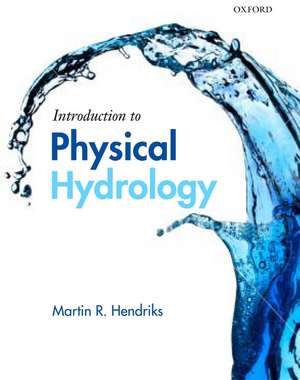
Introduction to Physical Hydrology
Autor Martin Hendriksen Limba Engleză Paperback – 21 ian 2010
Preț: 417.37 lei
Preț vechi: 526.96 lei
-21%
Puncte Express: 626
Carte tipărită la comandă
Livrare economică 20-25 noiembrie
Livrare express 15-21 octombrie pentru 109.99 lei
Livrare prin curier în România Termenul estimat este afișat lângă disponibilitate.
Transport gratuit pentru acest produs Plată online sau ramburs, în funcție de opțiunile comenzii.
Retur gratuit în 14 zile Comandă securizată și suport în română.
Specificații
ISBN-13: 9780199296842
ISBN-10: 0199296847
Pagini: 352
Ilustrații: 180 colour line drawings
Dimensiuni: 190 x 245 x 15 mm
Greutate: 0.68 kg
Ediția:New.
Editura: OUP OXFORD
Colecția OUP Oxford
Locul publicării:Oxford, United Kingdom
ISBN-10: 0199296847
Pagini: 352
Ilustrații: 180 colour line drawings
Dimensiuni: 190 x 245 x 15 mm
Greutate: 0.68 kg
Ediția:New.
Editura: OUP OXFORD
Colecția OUP Oxford
Locul publicării:Oxford, United Kingdom
V-ar putea interesa
-
 Water: A Very Short IntroductionJohn Finney-20%Preț: 56.62 lei70.82 lei
 -
 Environmental Chemistry: A global perspectiveGary W. vanLoon-20%Preț: 494.36 lei620.12 lei
 -
 -18%Preț: 35.66 lei43.27 lei
 -
 -14%Preț: 208.08 lei241.30 lei
 -
 Physical Geography: The BasicsJoseph HoldenPreț: 164.05 lei
 -
 Fundamentals of HydrologyTim DaviePreț: 425.62 lei
 -
 The Fourth Phase of Water: Beyond Solid, Liquid, and VaporGerald PollackPreț: 246.76 lei
 -
 -27%Preț: 354.47 lei485.08 lei
 -
 HydrogeologyKevin M Hiscock-23%Preț: 599.58 lei778.67 lei
 -
 -9%Preț: 511.95 lei562.58 lei
 -
 Elements of Physical HydrologyGeorge M. Hornberger-15%Preț: 481.38 lei566.33 lei
 -
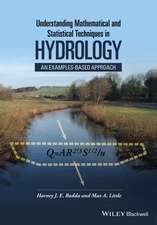 Understanding Mathematical and Statistical Techniques in HydrologyHarvey J E RoddaPreț: 489.62 lei
 -
 WaterAnna Skowronska-28%Preț: 73.89 lei102.74 lei
 -
 One WellRochelle StraussPreț: 119.49 lei
 -
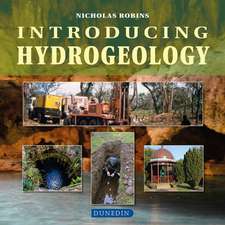 Preț: 265.97 lei
 -
 Flow, Water, Flow!Dom ConlonPreț: 63.35 lei
 -
 Human NatureKate MarvelPreț: 136.91 lei
 -
 Surface, Sub-Surface Hydrology and ManagementSubodh Chandra Pal-18%Preț: 1102.59 lei1344.62 lei
 -
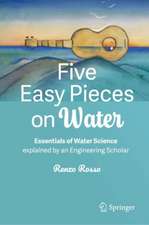 Five Easy Pieces on WaterRenzo RossoPreț: 271.58 lei
Recenzii
I think it is the best textbook for undergraduates that I have seen so far. I am very fond of your examples, your exercise material and the treatment of mathematics.
Excellent mathematical tools, and boxes that bring extra knowledge and interesting applications. A pleasure to read.
A detailed and thorough review of the physical principles of hydrology... case studies and examples as 'boxes', and student exercises (along with all important answers) makes this student textbook a useful addition to the literature available in this subject area.
The enterprise of Hendriks in writing this book represents an ambitious and difficult task, with the self-stated objective being to provide 'a combined approach to hydrology from environmental and social perspectives, in addition to the more traditional physical geography and civil engineering perspectives'. This approach works well and is likely to be well received by those wishing to rapidly immerse themselves in this field with little or no prior knowledge. It is an ideal introductory text for undergraduates in hydrology.
Excellent mathematical tools, and boxes that bring extra knowledge and interesting applications. A pleasure to read.
A detailed and thorough review of the physical principles of hydrology... case studies and examples as 'boxes', and student exercises (along with all important answers) makes this student textbook a useful addition to the literature available in this subject area.
The enterprise of Hendriks in writing this book represents an ambitious and difficult task, with the self-stated objective being to provide 'a combined approach to hydrology from environmental and social perspectives, in addition to the more traditional physical geography and civil engineering perspectives'. This approach works well and is likely to be well received by those wishing to rapidly immerse themselves in this field with little or no prior knowledge. It is an ideal introductory text for undergraduates in hydrology.
Notă biografică
Martin Hendriks is Associate Professor of Physical Hydrology at Utrecht University, where he teaches hydrology and physical geography at all levels, and co-ordinates their MSc programme in Physical Geography and Hydrology.