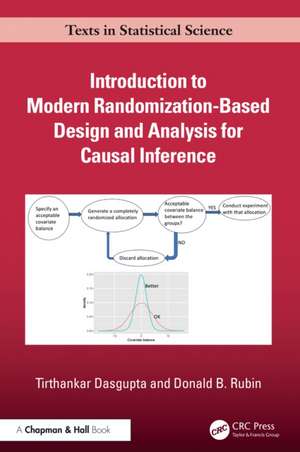
Introduction to Modern Randomization-Based Design and Analysis for Causal Inference: Chapman & Hall/CRC Texts in Statistical Science
Autor Tirthankar Dasgupta, Donald B. Rubinen Limba Engleză Hardback – 21 sep 2026
- Strengthens the link between design and analysis, enabling students to see immediately how the structure of an experiment shapes the exact tools used to analyze it.
- Teaches foundational concepts without assuming linear-model assumptions.
- Equips readers with the tools needed to analyze non-standard and complex experiments, whose randomization mechanisms fall outside the scope of traditional textbooks.
- Support students with limited programming experience by providing algorithms and code throughout the book, enabling them to implement randomization-based methods easily and efficiently.
Din seria Chapman & Hall/CRC Texts in Statistical Science
- 14%
 Preț: 675.87 lei
 - 20%
 Preț: 713.42 lei
 - 9%
 Preț: 826.96 lei
 - 8%
 Preț: 602.18 lei
 - 14%
 Preț: 1504.46 lei
 - 14%
 Preț: 753.82 lei
 - 9%
 Preț: 826.08 lei
 - 9%
 Preț: 824.13 lei
 - 8%
 Preț: 446.40 lei
 - 18%
 Preț: 1072.86 lei
 - 15%
 Preț: 560.19 lei
 - 18%
 Preț: 734.98 lei
 -
 Preț: 444.29 lei
 - 18%
 Preț: 752.30 lei
 - 15%
 Preț: 530.47 lei
 - 18%
 Preț: 941.48 lei
 - 18%
 Preț: 709.93 lei
 - 9%
 Preț: 816.65 lei
 - 9%
 Preț: 640.24 lei
 - 18%
 Preț: 1280.63 lei
 - 15%
 Preț: 533.53 lei
 - 18%
 Preț: 777.27 lei
 -
 Preț: 447.53 lei
 - 18%
 Preț: 796.60 lei
 - 18%
 Preț: 1091.13 lei
 - 18%
 Preț: 695.93 lei
 - 15%
 Preț: 530.47 lei
 - 18%
 Preț: 939.05 lei
 - 18%
 Preț: 726.61 lei
 - 15%
 Preț: 528.08 lei
 - 5%
 Preț: 877.00 lei
 - 15%
 Preț: 465.33 lei
 - 18%
 Preț: 717.88 lei
 - 15%
 Preț: 489.45 lei
 - 18%
 Preț: 812.99 lei
 - 18%
 Preț: 945.32 lei
 - 9%
 Preț: 674.08 lei
 - 15%
 Preț: 652.65 lei
 - 18%
 Preț: 1367.70 lei
 - 18%
 Preț: 757.82 lei
 - 20%
 Preț: 418.40 lei
 - 18%
 Preț: 1467.42 lei
 - 15%
 Preț: 652.56 lei
 - 18%
 Preț: 1077.45 lei
 - 8%
 Preț: 558.93 lei
 - 9%
 Preț: 742.48 lei
 - 18%
 Preț: 799.03 lei
 - 18%
 Preț: 964.16 lei
Preț: 685.58 lei
Preț vechi: 806.56 lei
-15% Nou
Puncte Express: 1028
Carte tipărită la comandă
Livrare economică 27 noiembrie-11 decembrie
Livrare prin curier în România Termenul estimat este afișat lângă disponibilitate.
Transport gratuit pentru acest produs Plată online sau ramburs, în funcție de opțiunile comenzii.
Retur gratuit în 14 zile Comandă securizată și suport în română.
Specificații
ISBN-13: 9780367500986
ISBN-10: 0367500981
Pagini: 360
Ilustrații: 104
Dimensiuni: 156 x 234 mm
Greutate: 0.83 kg
Ediția:1
Editura: CRC Press
Colecția Chapman and Hall/CRC
Seria Chapman & Hall/CRC Texts in Statistical Science
ISBN-10: 0367500981
Pagini: 360
Ilustrații: 104
Dimensiuni: 156 x 234 mm
Greutate: 0.83 kg
Ediția:1
Editura: CRC Press
Colecția Chapman and Hall/CRC
Seria Chapman & Hall/CRC Texts in Statistical Science
Public țintă
Postgraduate and Undergraduate AdvancedNotă biografică
Tirthankar Dasgupta is a Professor of Statistics at Rutgers University, New Jersey. Prior to joining Rutgers University, he served as a faculty member at Harvard University. His primary research interests include experimental design and causal inference. He is a fellow of the American Statistical Association. He has published about 50 peer-reviewed research articles and has served on the editorial boards of several leading journals of statistics including the Journal of the American Statistical Association, Journal of the Royal Statistical Society (Series B) and Statistical Science.
Donald B. Rubin is an Emeritus Professor of Statistics at Harvard University, and is currently affiliated with Temple University. He is most well known for the Rubin causal model, a set of methods designed for causal inference with observational data, and for his methods for dealing with missing data. Professor Rubin is a fellow/member/honorary member of the Woodrow Wilson Society, Guggenheim Memorial Foundation, Alexander von Humboldt Foundation, American Statistical Association, Institute of Mathematical Statistics, International Statistical Institute, American Association for the Advancement of Science, American Academy of Arts and Sciences, European Association of Methodology, the British Academy, and the US National Academy of Sciences. He has authored or co-authored about 450 publications (including 10 books), has four joint patents, and is one of the most highly cited authors in the world, with nearly 450,000 citations.
Donald B. Rubin is an Emeritus Professor of Statistics at Harvard University, and is currently affiliated with Temple University. He is most well known for the Rubin causal model, a set of methods designed for causal inference with observational data, and for his methods for dealing with missing data. Professor Rubin is a fellow/member/honorary member of the Woodrow Wilson Society, Guggenheim Memorial Foundation, Alexander von Humboldt Foundation, American Statistical Association, Institute of Mathematical Statistics, International Statistical Institute, American Association for the Advancement of Science, American Academy of Arts and Sciences, European Association of Methodology, the British Academy, and the US National Academy of Sciences. He has authored or co-authored about 450 publications (including 10 books), has four joint patents, and is one of the most highly cited authors in the world, with nearly 450,000 citations.
Cuprins
1. Understanding experimental design: fundamental concepts 2. CRD with one factor, two levels 3. Better comparisons using blocking 4. Beyond blocking: acceptable versus unacceptable allocations 5. Randomized experiments with J(> 2) treatment arms 6. The 22 factorial experiment 7. 2K factorial designs 8. Design and analysis of factorial experiments with constraints 9. Model-based analysis of designed experiments and superpopulation inference 10. Including covariates in the design, model-based analysis and subsequent inference
Descriere
This book provides a modern, accessible, and computationally supported introduction to experimental design grounded firmly in randomization and the formulation of ideas and methods in terms of potential outcomes. The book also incorporates new developments at the interface of causal inference and experimental design.