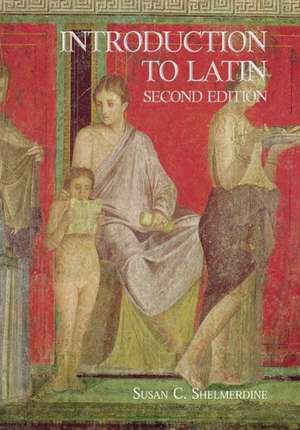
Introduction to Latin
Autor Susan C. Shelmerdineen Limba Engleză Paperback – mar 2013
Introduction to Latin, Second Edition is an introductory Latin textbook designed with a streamlined flow that allows it to be completed in one year. Its concise and uncluttered approach gives students what they need to master the material. Grammar is integrated within the context of reading fluency. Innovative exercises provide translation practice as well as build “instinctive skills” that prepare students for reading authentic Latin works.
Features:
Features:
- Concise, streamlined presentation focuses on what students need to know, allowing the material to be covered in a year, even for courses which meet only three days a week
- Innovative exercises that go beyond the usual translation practice, engaging students with the mechanisms of the language and developing “more instinctive” skills
- Succinct grammatical explanations that don’t overwhelm the students with superfluous detail while also providing help for students with little or no understanding of English grammar
- Latin readings from ancient sources in the form of both sentences and short passages allow for students to connect with authentic Latin
- Practical instructions often overlooked by other textbooks, including reading a dictionary entry, reading strategies, sentence patterns, gapping, and expectations
- Revised order of presentation that spreads material out more evenly between the first and second halves of the book
- Derivatives exercises added at the end of each chapter providing practice connecting English words with their Latin roots
- Bridge to next level: final three chapters provide review and include longer narrative readings with minimal editing to bridge students to the next level of Latin
- Revised selection of readings for more appropriate level of difficulty
Preț: 349.63 lei
Puncte Express: 524
Carte indisponibilă temporar
Doresc să fiu notificat când acest titlu va fi disponibil:
Se trimite...
Specificații
ISBN-13: 9781585103904
ISBN-10: 158510390X
Pagini: 392
Ilustrații: 15 halftones
Dimensiuni: 178 x 254 x 20 mm
Greutate: 0.55 kg
Ediția:Second Edition
Editura: Hackett Publishing Company,Inc
Colecția Focus
Locul publicării:United States
ISBN-10: 158510390X
Pagini: 392
Ilustrații: 15 halftones
Dimensiuni: 178 x 254 x 20 mm
Greutate: 0.55 kg
Ediția:Second Edition
Editura: Hackett Publishing Company,Inc
Colecția Focus
Locul publicării:United States
Recenzii
“Shelmerdine has greatly improved an already excellent book. . . . I have always liked the way she explains concepts, such as sentence patterns, subordinate clauses, correlating conjunctions, etc., that other books take for granted; or to put it another way, the book discusses the structure of the Latin sentence as a whole before breaking it down into its individual parts allowing the students (and the teachers!) to really understand how the Romans put words together.”
— Thomas Kohn, Wayne State University
— Thomas Kohn, Wayne State University
“Shelmerdine’s Introduction to Latin is in my judgement the best introductory Latin textbook available at present; I have kept choosing it year by year since it was first published. The book explains key grammatical concepts clearly and gives students plenty of practice with exercises (some of which are drawn directly from Latin authors) and longer reading passages, which provide a gentle transition from very basic narratives at the outset to lightly-edited Latin prose and poetry in the latter portions of the text. Shelmerdine has deliberately avoided burdening the textbook with non-essential information on Roman history and culture, but the study of the language itself and above all the reading passages provide an instructor with ample opportunity to comment on these matters in class.”
— Christopher Grundke, Dalhousie University
— Christopher Grundke, Dalhousie University
Of the First Edition:
“This is just the book I’ve been hoping for: it is intelligently planned and organized, and maintains a good pace without being overwhelming. The exercises are very good and make reasonable sense. Presentation of grammar and syntax is very sound from a linguistic point of view, as well as being very comprehensible to the non-specialist. The exercises are ample, well-designed, and sensible, providing some opportunity for discussion of cultural context. Of particular note are the reading chapters located after every five regular chapters, which are very useful for review and provide valuable supplementary material (but can also be omitted if time limitations so demand.)”
— Barbara Weiden Boyd, Bowdoin College
“This is just the book I’ve been hoping for: it is intelligently planned and organized, and maintains a good pace without being overwhelming. The exercises are very good and make reasonable sense. Presentation of grammar and syntax is very sound from a linguistic point of view, as well as being very comprehensible to the non-specialist. The exercises are ample, well-designed, and sensible, providing some opportunity for discussion of cultural context. Of particular note are the reading chapters located after every five regular chapters, which are very useful for review and provide valuable supplementary material (but can also be omitted if time limitations so demand.)”
— Barbara Weiden Boyd, Bowdoin College
Of the First Edition:
“A concise, no-nonsense approach that isn't 'over-scripted.' Shelmerdine allows the instructor scope for real teaching and meaningful interaction with students.”
— Peter O'Brien, Dalhousie University
“A concise, no-nonsense approach that isn't 'over-scripted.' Shelmerdine allows the instructor scope for real teaching and meaningful interaction with students.”
— Peter O'Brien, Dalhousie University
Of the First Edition:
“Shelmerdine does make one important break with tradition: her exercises are not exclusively exercises of translation. Many of them consist of identifying cases or other forms underlined in sentences, or in finding the agreements; frequently students are given sentences with an ending left out and invited to supply it. Or again, they will be asked to change perfect verb-forms to the pluperfect, and so on. Such tasks are a staple in the teaching of modern languages, where they have proved their worth. They promote an active engagement with mechanisms of the language, and because each individual problem can be worked in an instant they develop a more instinctive sort of skill than does the slow, laborious job of writing a sentence from scratch. . . .
On balance, this book is quite a good one. I have seen no other beginner’s manual, of any approach whatever, so very friendly to the student. While urging classicists to follow the lead of the modern languages, I understand that few will be ready to abandon wholly the grammar-translation method by which they were themselves taught and for which their techniques are designed. For those who do not take that step, Introduction to Latin is an excellent choice. In fact, I consider it their best choice wherever students lack basic grammatical knowledge, that is to say in all but the most elite institutions.”;
— Benjamin Victor, Université de Montréal [Bryn Mawr Classical Review 2007.09.07]
“Shelmerdine does make one important break with tradition: her exercises are not exclusively exercises of translation. Many of them consist of identifying cases or other forms underlined in sentences, or in finding the agreements; frequently students are given sentences with an ending left out and invited to supply it. Or again, they will be asked to change perfect verb-forms to the pluperfect, and so on. Such tasks are a staple in the teaching of modern languages, where they have proved their worth. They promote an active engagement with mechanisms of the language, and because each individual problem can be worked in an instant they develop a more instinctive sort of skill than does the slow, laborious job of writing a sentence from scratch. . . .
On balance, this book is quite a good one. I have seen no other beginner’s manual, of any approach whatever, so very friendly to the student. While urging classicists to follow the lead of the modern languages, I understand that few will be ready to abandon wholly the grammar-translation method by which they were themselves taught and for which their techniques are designed. For those who do not take that step, Introduction to Latin is an excellent choice. In fact, I consider it their best choice wherever students lack basic grammatical knowledge, that is to say in all but the most elite institutions.”;
— Benjamin Victor, Université de Montréal [Bryn Mawr Classical Review 2007.09.07]
Introduction to Latin, Second Edition is an introductory Latin textbook designed with a streamlined flow that allows it to be completed in one year. Its concise and uncluttered approach gives students what they need to master the material. Grammar is integrated within the context of reading fluency. Innovative exercises provide translation practice as well as build “instinctive skills” that prepare students for reading authentic Latin works.
New to the Second Edition
Thomas Kohn, Wayne State University
Susan C. Shelmerdine is Professor in the Department of Classical Studies at the University of North Carolina, Greensboro. She is also the author of Homeric Hymns, available from Focus Publishing.
New to the Second Edition
- Order of presentation introduces concepts evenly to students throughout entire course
- End-of-chapter derivatives exercises provide practice connecting English words with their Latin roots
- Final three chapters provide bridge to intermediate Latin through longer, minimally edited readings
- Revised selection of readings build on the skills students accumlate with each chapter
- Online exercises, audio recordings, and more accompany each chapter at http://courses.pullins.com
Thomas Kohn, Wayne State University
Susan C. Shelmerdine is Professor in the Department of Classical Studies at the University of North Carolina, Greensboro. She is also the author of Homeric Hymns, available from Focus Publishing.