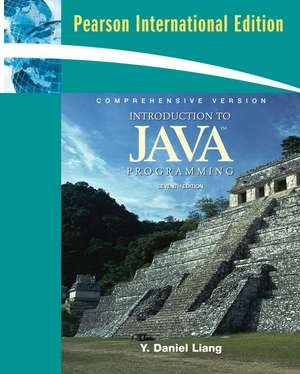
Introduction to Java Programming, Comprehensive Version: International Version
Autor Y. Daniel Liangen Limba Engleză Paperback – 29 feb 2008
Supplements:
Author Website:
- Student Resources include: Source Code, Solutions to even numbered Programming Problems, Answers to review questions, Software related links and errata
- Instructor Resources include: Interactive and Animated Slides, full programming exercises. UML diagram solutions, quiz generator, LiveLab, and sample exams. (contact your local sales rep for password)
Student Resources:
- VideoNotes are Pearson's new visual tool designed for teaching students key programming concepts and techniques. These short step-by-step videos demonstrate how to solve problems from design through coding. VideoNotes allow for self-paced instruction with easy navigation including the ability to select, play, rewind, fast-forward, and stop within each VideoNote exercises. Margin icons in your textbook let you know when a VideoNotes video is available for a particular concept or homework problem.
- GOAL Pearson's premier online homework and assessment system for Computer Science.
- Turbo JBuilder is free and can be downloaded at Eclipse: www.borland.com/products/downloads/download_jbuilder.html.
- Power Point Lecture Slides
- Solutions
- GOAL : Pearson's premier online homework and assessment system for Computer Science.
- Test Files
Preț: 465.49 lei
Puncte Express: 698
Cartea se retipărește
Doresc să fiu notificat când acest titlu va fi disponibil:
Se trimite...
Specificații
ISBN-13: 9780136059660
ISBN-10: 013605966X
Pagini: 1328
Dimensiuni: 203 x 254 mm
Greutate: 2.25 kg
Ediția:7Nouă
Editura: Pearson Education
Colecția Pearson Education
Locul publicării:Upper Saddle River, United States
ISBN-10: 013605966X
Pagini: 1328
Dimensiuni: 203 x 254 mm
Greutate: 2.25 kg
Ediția:7Nouă
Editura: Pearson Education
Colecția Pearson Education
Locul publicării:Upper Saddle River, United States
Cuprins
NOTE: this is a comprehensive version. For a brief text, please visit "Introduction to Java Programming, Brief Edition"
Chapter:1 Introduction to Computers, Programs, and Java
Chapter:2 Elementary Programming
Chapter:3 Selections
Chapter:4 Loops
Chapter:5 Methods
Chapter:6 Arrays
Chapter:7 Objects and Classes
Chapter:8 Strings and Text I/O
Chapter:9 Thinking in Objects
Chapter:10 Inheritance and Polymorphism
Chapter:11 Abstract Classes and Interfaces
Chapter:12 Object-Oriented Design and Patterns
Chapter:13 GUI Basics
Chapter:14 Graphics
Chapter:15 Event-Driven Programming
Chapter:16 Creating User Interfaces
Chapter:17 Applets and Multimedia
Chapter:18 Exception Handling
Chapter:19 Binary I/O
Chapter:20 Recursion
Chapter:21 Generics
Chapter:22 Java Collections Framework
Chapter:23 Algorithm Efficiency
Chapter:24 Lists, Stacks, and Queues
Chapter:25 Trees, Heaps, and Priority Queues
Chapter:26 Sorting
Chapter:27 Graph Applications
Chapter:28 Weighted Graph Applications
Chapter:29 Multithreading
Chapter:30 Networking
Chapter:31 Internationalization
Chapter:32 JavaBeans and Bean Events
Chapter:33 Containers, Layout Managers, and Borders
Chapter:34 Menus, Toolbars, and Dialogs
Chapter:35 MVC and Swing Models
Chapter:36 JTable and JTree
Chapter:37 Java Database Programming
Chapter:38 Advanced Java Database Programming
Chapter:39 Servlets
Chapter:40 JavaServer Pages
Chapter:41 JSF and Visual Web Development
Chapter:42 Web Services
Chapter:43 Remote Method Invocation
***Note that Chapters 38-43 are bonus chapters in the companying CD-ROM
Appendixes
Appendix A Java Keywords
Appendix B The ASCII Character Set
Appendix C Operator Precedence Chart
Appendix D Java Modifiers
Appendix E Special Floating-Point Values
Appendix F Correlation between the 7E and 6E
Chapter:1 Introduction to Computers, Programs, and Java
Chapter:2 Elementary Programming
Chapter:3 Selections
Chapter:4 Loops
Chapter:5 Methods
Chapter:6 Arrays
Chapter:7 Objects and Classes
Chapter:8 Strings and Text I/O
Chapter:9 Thinking in Objects
Chapter:10 Inheritance and Polymorphism
Chapter:11 Abstract Classes and Interfaces
Chapter:12 Object-Oriented Design and Patterns
Chapter:13 GUI Basics
Chapter:14 Graphics
Chapter:15 Event-Driven Programming
Chapter:16 Creating User Interfaces
Chapter:17 Applets and Multimedia
Chapter:18 Exception Handling
Chapter:19 Binary I/O
Chapter:20 Recursion
Chapter:21 Generics
Chapter:22 Java Collections Framework
Chapter:23 Algorithm Efficiency
Chapter:24 Lists, Stacks, and Queues
Chapter:25 Trees, Heaps, and Priority Queues
Chapter:26 Sorting
Chapter:27 Graph Applications
Chapter:28 Weighted Graph Applications
Chapter:29 Multithreading
Chapter:30 Networking
Chapter:31 Internationalization
Chapter:32 JavaBeans and Bean Events
Chapter:33 Containers, Layout Managers, and Borders
Chapter:34 Menus, Toolbars, and Dialogs
Chapter:35 MVC and Swing Models
Chapter:36 JTable and JTree
Chapter:37 Java Database Programming
Chapter:38 Advanced Java Database Programming
Chapter:39 Servlets
Chapter:40 JavaServer Pages
Chapter:41 JSF and Visual Web Development
Chapter:42 Web Services
Chapter:43 Remote Method Invocation
***Note that Chapters 38-43 are bonus chapters in the companying CD-ROM
Appendixes
Appendix A Java Keywords
Appendix B The ASCII Character Set
Appendix C Operator Precedence Chart
Appendix D Java Modifiers
Appendix E Special Floating-Point Values
Appendix F Correlation between the 7E and 6E
Notă biografică
Dr. Liang earned his Ph.D. in Computer Science from the University of Okalahoma in 1991, and an MS and BS in Computer Science from Fudan University in Shanghai, China, in 1986 and 1983. Prior to joining Armstrong, he was an associate professor in computer science at Purdue University in Fort Wayne, where he twice received the Excellence in Research award.
Dr. Liang was trained in theoretical computer science. He was active in graph algorithms from 1990 to 1995 and published more than ten papers in several established journals such as SIAM Journal on Computing, Discrete Applied Mathematics, Acta Informatics, and Information Processing Letters. Since 1996, he has devoted to writing texts and published more than thirty books with Prentice Hall. His popular computer science texts are widely adopted in the world.
Dr. Liang was elected a Java Champion in 2005 by Sun Microsystems. He has given lectures on Java internationally.
Dr. Liang was trained in theoretical computer science. He was active in graph algorithms from 1990 to 1995 and published more than ten papers in several established journals such as SIAM Journal on Computing, Discrete Applied Mathematics, Acta Informatics, and Information Processing Letters. Since 1996, he has devoted to writing texts and published more than thirty books with Prentice Hall. His popular computer science texts are widely adopted in the world.
Dr. Liang was elected a Java Champion in 2005 by Sun Microsystems. He has given lectures on Java internationally.
Caracteristici
• Innovative fundamentals-first approach — Starts students with essential problem-solving and programming concepts (control statements, methods, and arrays); moves on to object-oriented programming, graphical user interface (GUI), and applets; and finally introduces exception handling, binary I/O, and recursion.
• Exceptionally broad range of carefully chosen examples — Reinforces key concepts with objectives lists, introduction and chapter overviews, easy-to-follow examples, chapter summaries, review questions, programming exercises, and an interactive self-test.
• GOAL online courseware — Utilizes the industry’s most advanced online homework application to give students solutions to even-numbered programming exercises, source code for the examples in the book, online self assessment (w/over 1000 multiple-choice questions) and online homework.
• The most extensive instructor support package available — Includes interactive and animated slides, TestGen (w/over 2000 multiple-choice questions), solutions to all programming exercises, sample exams and supplemental exercises.
• Instructor resource center and companion website at http://www.cs.armstrong.edu/liang/intro7e/
These resources contain:
— Microsoft PowerPoint slides with interactive buttons to view full-color, syntax-highlighted source code and to run programs without leaving the slides
— Sample exams
— Solutions to all the exercises (Students can access the solutions of even-numbered exercises in the book’s companion CD-ROM)
— Web-based quiz generator
— Online quiz.
• Complete coverage on Java collections framework, threads, JavaBeans, advanced GUI components, JDBC, Servlets, JSP, networking, and RMI.
• Practical examples on gaming (simulating lottery, interactive quiz, Sudoku), business/financial (computing loan payments, taxes, and printing payroll statements), science (body mass index, wind chill temperature) — Replaces pure mathematical examples such as computing deviations and matrix multiplications.
• Case studies – Offer additional examples for learning the fundamentals of programming, such as writing loops.
• Carefully chosen, easy-to-follow, representative examples – Include a description, source code, sample run, and an example review.
• UML (Unified Modeling Language) graphical notations throughout — Describes classes and their relationships; teaches students design and development of Java programs using the industry standard modeling technique.
• Notes and tips throughout — Offer valuable advice and insight on important aspects of program development.
• Sample exams — Includes multiple-choice questions, correct programming errors, trace programs, and write programs.
• Supplemental exercises with solutions — Give instructors more options when assigning homework or writing exams.
• Exceptionally broad range of carefully chosen examples — Reinforces key concepts with objectives lists, introduction and chapter overviews, easy-to-follow examples, chapter summaries, review questions, programming exercises, and an interactive self-test.
• GOAL online courseware — Utilizes the industry’s most advanced online homework application to give students solutions to even-numbered programming exercises, source code for the examples in the book, online self assessment (w/over 1000 multiple-choice questions) and online homework.
• The most extensive instructor support package available — Includes interactive and animated slides, TestGen (w/over 2000 multiple-choice questions), solutions to all programming exercises, sample exams and supplemental exercises.
• Instructor resource center and companion website at http://www.cs.armstrong.edu/liang/intro7e/
These resources contain:
— Microsoft PowerPoint slides with interactive buttons to view full-color, syntax-highlighted source code and to run programs without leaving the slides
— Sample exams
— Solutions to all the exercises (Students can access the solutions of even-numbered exercises in the book’s companion CD-ROM)
— Web-based quiz generator
— Online quiz.
• Complete coverage on Java collections framework, threads, JavaBeans, advanced GUI components, JDBC, Servlets, JSP, networking, and RMI.
• Practical examples on gaming (simulating lottery, interactive quiz, Sudoku), business/financial (computing loan payments, taxes, and printing payroll statements), science (body mass index, wind chill temperature) — Replaces pure mathematical examples such as computing deviations and matrix multiplications.
• Case studies – Offer additional examples for learning the fundamentals of programming, such as writing loops.
• Carefully chosen, easy-to-follow, representative examples – Include a description, source code, sample run, and an example review.
• UML (Unified Modeling Language) graphical notations throughout — Describes classes and their relationships; teaches students design and development of Java programs using the industry standard modeling technique.
• Notes and tips throughout — Offer valuable advice and insight on important aspects of program development.
• Sample exams — Includes multiple-choice questions, correct programming errors, trace programs, and write programs.
• Supplemental exercises with solutions — Give instructors more options when assigning homework or writing exams.
Caracteristici noi
- Revised chapter openings – Now emphasize applications to help students to understand the type of problem being introduced in that chapter.
- Former Chapter 7 now split into Chapter 7 and Chapter 9 – The new chapter 7 introduces objects and classes and chapter 9 focuses on class design.
- New optional sections on GUI’s at the end of Ch. 2 — 6 using JOptionPane. More complete coverage of the Swing library can be found in Ch. 13.
- UML notation is used in every example beginning in Ch. 8 along with additional notes to describe the relationships.
- New chapters on data structures:
– Chapter 21, “Generics,” presents an in-depth coverage on generics. Generics is now covered before Java Collections Framework so it can be incorporated with the data structures.
– Chapter 23, “Algorithm Efficiency,” is brand new to use many concrete examples to introduce algorithm analysis and design.
– New chapters 27-28 introduce graph applications. - New chapter on JSF for visual Web development.
- New chapter on Web services.
- Several non-essential topics moved to the text’s Companion Website, to help students focus on learning problem solving and programming techniques:
– These topics include the & and | operators, the discussion on how expressions are evaluated internally in Java, regular expressions, initialization blocks, how to package Java projects into archive files, and more.
– Advanced language details are now online.
– Last six chapters on web 38, 39, 40, 43 were in book and are now on CD. 41, 42 are new and are on CD. - Problem-driven, new examples and exercises:
- 20% of programming examples are new
- 30% of programming exercises are new