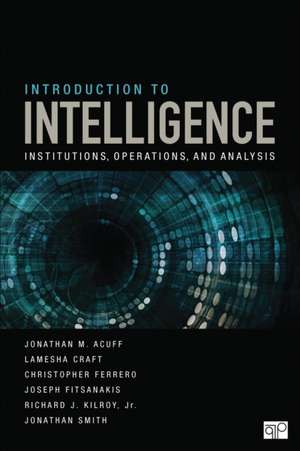
Introduction to Intelligence
Autor Christopher J. Ferrero, Jonathan M. Acuff, Jonathan Smith, Joseph Fitsanakis, Lamesha Craft, Richard J. Kilroyen Limba Engleză Paperback – 13 mai 2021
Notăm cu interes apariția volumului Introduction to Intelligence, o resursă concepută pentru a traduce complexitatea teoretică a serviciilor de informații în competențe analitice aplicabile. Textul se distinge prin rigoarea cu care abordează nu doar instituțiile și operațiunile, ci și fundamentul metodologic necesar viitorilor analiști. Descoperim aici o structură pedagogică solidă: autorii încep prin a defini rolul și limitările serviciilor de informații, trecând apoi printr-o cronologie vastă, de peste 3.000 de ani, care ancorează practicile moderne în evoluția istorică a securității statale.
Reținem că, spre deosebire de alte manuale care se concentrează exclusiv pe studiul organizațional, acest titlu, publicat de Sage Publications, Inc, pune un accent deosebit pe procesele interne și pe „ciclul informațiilor”, oferind în același timp perspective critice asupra acestor modele tradiționale. Organizarea pe capitole reflectă o progresie logică: de la cadrul securității naționale și birocrația specifică, la metodele concrete de colectare și comunicare. Cartea este o alternativă excelentă la Handbook of Intelligence Studies pentru cursurile de științe politice sau securitate națională, cu avantajul unei abordări comparative și internaționale, care nu se limitează doar la studiile de caz clasice, ci integrează realitățile secolului XXI.
Fiecare capitol beneficiază de expertiza unui autor diferit, precum Christopher J. Ferrero sau Richard J. Kilroy, asigurând o profunzime tehnică pe care un singur autor ar fi atins-o cu dificultate. Această multiperspectivitate transformă volumul într-un instrument esențial pentru înțelegerea modului în care informația brută este transformată în suport decizional strategic.
Preț: 825.13 lei
Preț vechi: 1071.59 lei
-23%
Carte disponibilă
Livrare economică 29 mai-04 iunie
Livrare express 19-23 mai pentru 90.49 lei
Specificații
ISBN-10: 1544374674
Pagini: 440
Dimensiuni: 158 x 229 x 17 mm
Greutate: 0.53 kg
Ediția:1
Editura: Sage Publications, Inc
Locul publicării:Washington DC, United States
De ce să citești această carte
Această carte se adresează studenților și profesioniștilor aflați la început de drum în domeniul securității și științelor politice. Cititorul câștigă o înțelegere clară a mecanismelor prin care funcționează serviciile de informații la nivel global, beneficiind de o structură didactică ce include concepte cheie și lecturi recomandate. Este un ghid practic care demitizează procesul de intelligence, oferind instrumente analitice concrete în locul generalităților teoretice.
Despre autor
Volumul reunește o echipă de experți recunoscuți, printre care Christopher J. Ferrero, Jonathan M. Acuff și Joseph Fitsanakis, cadre didactice și specialiști cu experiență vastă în analiza de securitate și relații internaționale. Autorii, precum Richard J. Kilroy și Lamesha Craft, combină experiența academică de la instituții de prestigiu cu expertiza practică în domeniul militar și al securității naționale. Această colaborare multidisciplinară permite abordarea subiectului din perspective variate, de la istoria spionajului până la provocările cibernetice contemporane, oferind cititorului o viziune echilibrată între teorie și practică profesională.
Descriere scurtă
Introduction to Intelligence: Institutions, Operations, and Analysis offers a strategic, international, and comparative approach to covering intelligence organizations and domestic security issues.
Cuprins
Preface
Acknowledgments
About the Authors
Chapter 1. Introduction
What Is Intelligence?
The Purpose of Intelligence
Conclusion: The Promise and the Limitations of Intelligence
Key Concepts
Additional Reading
Chapter 2. Intelligence History
Intelligence From Antiquity to the Westphalian State System
Intelligence in Late Medieval and Early Modern Europe
Intelligence in America From the Revolution to Pearl Harbor
World War II and the Birth of the Modern
The Cold War
Intelligence in the 21st Century: 9/11 and Its Aftermath
Conclusion: Assessing Over 3,000 Years of Intelligence History
Key Concepts
Additional Reading
Chapter 3. Intelligence and Security Institutions: Organizations and Processes
An Illustration of Intelligence Support
The National Security Framework in the US System
The Growth of the National Security Bureaucracy
Intelligence Organizations in the US System of Government
The Intelligence Cycle and Its Critics
Conclusion: Critiques and Alternative Approaches
Key Concepts
Additional Reading
Chapter 4. Comparative Intelligence Systems
Cases in Intelligence Studies
The United Kingdom
French Republic
Federal Republic of Germany
Israel
Russian Federation
People’s Republic of China
Conclusion: Similarities and Differences of Foreign
Key Concepts
Additional Reading
Chapter 5. Intelligence Operations
How Do We Collect Intelligence?
Complexity and Challenges of Contemporary Intelligence Operations
Intelligence Collection Planning
The Five Principal Intelligence Collection Disciplines and Beyond
Military Intelligence
Conclusion: Intelligence Operations Summary
Key Concepts
Additional Reading
Chapter 6. Counterintelligence
The World of Espionage and Intrigue
Counterintelligence Roles and Missions
Defensive Counterintelligence
Offensive Counterintelligence
Contemporary Challenges for Counterintelligence
Conclusion: Counterintelligence Summary
Key Concepts
Additional Reading
Chapter 7. Covert Action
Types of Covert Action
Oversight of Covert Action in the United States
The US Military and Covert Action
Conclusion: Considerations in Covert Action
Key Concepts
Additional Reading
Chapter 8. Cyberspace Operations and the Information Environment
Convergence of Technology
Peeling Back the Layers of Cyberspace
The US Cyber Strategy
Analyzing Cyber Threats
Conclusion: The Complexity of Threats in the Cyberspace Domain
Key Concepts
Additional Reading
Chapter 9. Intelligence Regulation and Governance
McCarthyism and the Second Red Scare
Domestic Intelligence and COINTELPRO
The Watergate Scandal
The Church and Pike Committees
Intelligence Oversight After Watergate
Intelligence Oversight in Practice
The Separation of Powers in Intelligence Oversight
Conclusion: An Imperfect but Indispensable System
Key Concepts
Additional Reading
Chapter 10. Inter-Agency Communications
The Inherent Tensions in Intelligence Communications
Communications Challenges in Intra-Agency Settings
Communications Challenges in Inter-Agency Settings
Products for Intelligence Consumers
Getting the Attention of Intelligence Consumers
Retaining the Attention of Intelligence Consumers
Conclusion: Making Intelligence Useful
Key Concepts
Additional Reading
Chapter 11. Intelligence Analysis
Epistemology and Intelligence Analysis
Forecasting and the Challenges of Prediction
Psychological Biases and Intelligence Analysis
Conclusion: From the Philosophy of Science to Practice
Key Concepts
Additional Reading
Chapter 12. Analytic Methods
The Contemporary Context of Intelligence Analysis
Methods Used to Analyze Intelligence Targets
Presenting Findings: The Structure and Voice of Written
Conclusion: Patterns of Recruitment and Training of Intelligence Analysts in the US Intelligence Community
Key Concepts
Additional Reading
Chapter 13. The Ethics of Intelligence
Of Ethics and Moral Systems
Case Studies
Conclusion: The Ethical Demands of National Service
Key Concepts
Additional Reading
Chapter 14. Threats to the United States and Its Interests
Strategic Competitors
Pandemics
Climate Change as a Driver of International Instability
Cyber Threats in the 21st Century
Inter-state War
Ethnic Conflict, Revolution, and State Destabilization
Weapons of Mass Destruction
Terrorism
Criminal Networks
Conclusion: Of Threats and Priorities
Key Concepts
Additional Reading
Index
Notă biografică
Jonathan M. Acuff is an associate professor of intelligence and national security studies at Coastal Carolina University. A former officer in the US Army Reserve, Professor Acuff has also worked as a military analyst for the National Bureau of Asian Research (NBR). While at NBR, he conducted research funded by the Department of Homeland Security evaluating the vulnerability of private sector facilities in the Pacific Northwest to terrorist attacks, as well as several projects supported by US Pacific Command (PACOM). He has published articles in Intelligence and National Security, International Political Sociology, and Totalitarian Movements and Political Religions. He is also the author of numerous book chapters and is the editor (with Brent J. Steele) of Theory and Application of the ¿Generation¿ in International Relations and Politics (Palgrave, 2012). Acuff has served four terms on the Executive Committee of the Ethnicity, Nationalism, and Migration (ENMISA) section of the International Studies Association. Professor Acuff previously taught at the University of Washington, Saint Anselm College, and Seattle University and was a Ford Foundation Fellow at the University of Iowa. He teaches courses on intelligence analysis, strategy, international security, terrorism, and writing in intelligence.